System of record vs. system of action: Gartner’s ERP challenge

An enterprise resource planning (ERP) system can have an accurate customer order while at the same time leaving your team to do almost everything needed to fulfill it. In other words, someone checks availability, creates the next document, updates the status, and tells the customer what happens next. The record is complete, but fulfilling the order still takes (a lot of) manual work.
The system of record vs. system of action debate revolves around that gap. Gartner’s 2026 Hype Cycle for ERP analysis describes a shift toward software that uses real-time information to make decisions and execute work. Manufacturers should be able to use those records to reduce the work of running the business.
Bonx, the AI-native manufacturing ERP, is ahead of the curve when it comes from moving customers from manual operational tasks to being able to handle 2x-4x more with exactly the same team. Here are five convictions we have around AI-native manufacturing ERP and what modern manufactures should expect from their software.
Legacy ERP often made the sales administrator responsible for turning an incoming purchase order into a usable record. Someone had to identify the customer, match the products, check quantities and prices, and copy the details into the right fields. The system could hold an accurate order once a person had done the work to create it.
We believe manufacturers should expect their ERP to take on that preparation. In Bonx, the administrator can upload the document and review the extracted details beside the original. After confirmation, a file containing several orders can be split into separate records, saving someone from copying each line into a form.
Bonx checks totals before automatic validation, and uncertain matches need review. The software does the extraction so the team can concentrate on the details that need checking.
In a legacy ERP, recording an order did not necessarily move it toward fulfillment. Even where fixed rules automated individual steps, someone often had to decide what came next, create the next document, and update the customer.
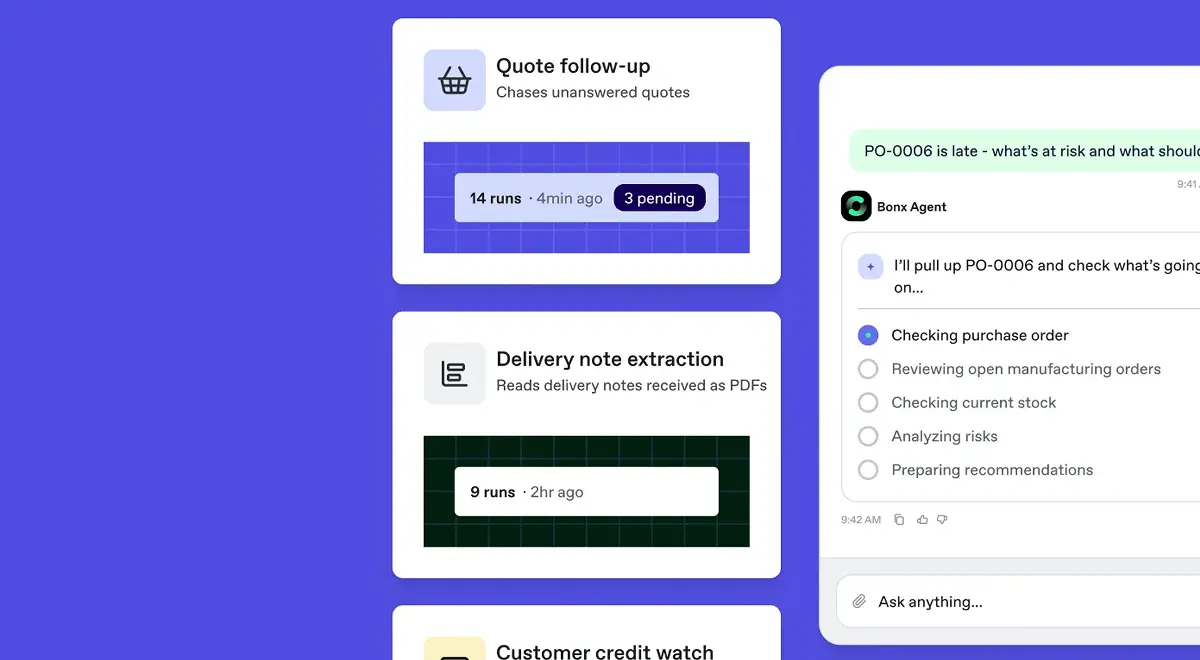
Manufacturers should expect software to do more of that work. In Bonx, a configured workflow can create a shipment or draft invoice when a record reaches a defined step. A manager can also write an agent's instructions in natural language and attach it to a process step or business event. The agent then uses the record's context to prepare or execute the assigned work.
The team decides how much supervision that work needs. Sensitive changes can require human validation, and a proposed customer email remains editable before sending. Routine work can proceed under the configured rules, while people review decisions that need their attention. Our guide to agentic ERP explores how that changes the team's role.
Legacy ERP often required manufacturers to fit their operations into predefined workflows or commission custom development. When neither option worked, the missing process lived outside the system. One manufacturer evaluating Bonx had built its own shop-floor application, yet still needed manual file uploads to update stock in its ERP.
We believe a manufacturer's operating rules should be part of the software its team uses every day. In Bonx, teams can configure required fields, stock movements, tasks, and permissions at each process step. A site with a different receiving process can have its own workflow. Related records, custom tables, and interfaces can hold information that does not fit a standard form.
A customer instruction or site-specific requirement kept in a separate spreadsheet still depends on someone remembering to apply it. Bringing that information into the process gives the people and agents doing the work access to the context they need.
Legacy ERP suites often brought manufacturing, accounting, and customer relationship management (CRM) into one product. People moving between those functions interpreted what an operational change meant and decided which records to update. As software takes on more of those decisions, its permissions need clear limits. Permission to prepare a shipment should not automatically grant permission to change the accounting ledger.
Our conviction is that manufacturers should be able to define which work each system owns and where human approval is required. Bonx concentrates on manufacturing operations, including native sales invoicing. The accounting tool keeps the books, while the CRM manages the commercial relationship.
When an invoice is approved, Bonx freezes its accounting snapshot and passes the coded invoice to the accounting tool for posting. Bonx owns the operational invoice; the accounting system owns the ledger entry. See how Bonx hands customer invoices to accounting for the full flow.
With legacy ERP, a handoff between systems often became another job for the team: export a file, import it elsewhere, and check that the records matched. A failed transfer meant finding what was missing and working out what needed to be sent again.
We believe an ERP that takes on more operational work should also help the team follow it across system boundaries. In Bonx, managers can control which fields an integration imports and exports. Export history shows attempts and failure reasons on the record, and approved invoice exports run through a retrying queue.
If an invoice exists in Bonx but has not reached accounting, the team can inspect the failed attempts without reconstructing the handoff from scratch. Persistent failures still need an owner. The system should make those failures visible and support recovery, so a broken connection creates less work for the people coordinating the two systems.
If you’re evaluating ERP software, give your ERPs vendor one representative order with a complication your team actually handles: a partial shipment, an unusual customer instruction, or an item that needs approval before release. Follow it through the next operational actions and the accounting handoff.
Watch who interprets the situation, who changes the records, and who notices when the normal process cannot continue. An agent summary is useful if it explains completed work or brings a decision to the right person. It adds another inbox if someone must read it and then do everything manually.
Bonx’s direction is to give agents ownership of operational workflows, with people handling exceptions and setting the limits. To do that, the product has to make the manufacturer’s context available, execute through its processes, and keep responsibility clear when work crosses into another system. Adding actions to a chat interface alone leaves that work unresolved.
Choose a flow that consumes time every week and ask to see it in Bonx, including an exception and a failed handoff. Check which steps the system performs and where your team needs to intervene.


Contact us
So were we. That's why we built Bonx, the AI-native manufacturing ERP.