Common Bonx integration scenarios & top manufacturing tech stacks in 2026

"I want everything under one roof" is one of the most reasonable things a manufacturing leader can say during an enterprise resource planning (ERP) project. The instinct is 100% right; no one wants a fragmented suite of tools that don’t work together. Unfortunately, it is also where a lot of ERP projects go wrong.
That’s because historically, the solution has been to buy one giant suite and force every team, tool, and process into it. Sales, finance, e-commerce, warehouse management, shipping, suppliers, production, quality, and reporting all had to move under the same system. On paper, that sounds clean. In practice, it often creates a bigger project, weaker (or even inadequate) tools for many — if not most — stakeholders, slower adoption, and more manual work than before, especially on the operational side.
At Bonx, we believe the all-in-one ERP promise is the wrong answer to the right request. When people say they want everything under one roof, they are not actually asking for less software in a literal sense. They are asking for an end to frustrations in their day-to-day like duplicated data entry, manual data entry, missing stock truth, disconnected orders, late finance handoffs, and so much more.
We built Bonx to be the best manufacturing ERP on the market and to specifically address, and put an end to, these frustrations. Our vision is a world where talented manufacturers spend their time on the operational work that matters and that only humans can do, while AI-enabled systems with the right guardrails handle the routine. We believe your software should proactively take work off your team’s plate, not make it harder to get things done.
Central to this vision is the Bonx integration engine, a system we’ve designed and built to connect Bonx to virtually anything your operations depends on, from CRM, e-commerce, accounting, third-party logistics providers (3PLs), and warehouse management systems (WMS) to machines, hardware, electronic data interchange (EDI), and custom systems.
Because while we don’t believe in an all-in-one ERP, we do believe that manufacturers need operational control, which means being able to run orders, stock, production, quality, logistics, and finance handoffs from one place.
Connecting to “virtually anything your operations depends on,” while true, feels broad. To make this more concrete, here are a few integration patterns we see continually with Bonx customers:
This article walks through these common stacks and shows how Bonx works in each one to bring a seamless “everything under one roof” experience, but via integrations. It also covers hardware and electronic data interchange (EDI) integrations to show the range of the Bonx integration engine, because we do not believe integration should stop at moving records from one software tool to another. Done properly, integration can change how your operations run and remove day-to-day frustrations and inefficiencies that are costing your team time and your business money.
In B2B manufacturing, the problem is not that sales uses a CRM. The problem is what happens when a confirmed deal has to become real operational work.
Sales wants to keep working in the CRM because that is where the customer relationship lives: pipeline, quotes, contacts, conversations, expected close dates, and follow-up. That CRM might be HubSpot, Salesforce, Pipedrive, or something more specific to the business. Maybe it’s just plain old email. Either way, operations does not want another spreadsheet where confirmed deals have to be copied into production planning, and finance does not want to reconstruct invoices from email threads, delivery notes, and manually corrected order lines.
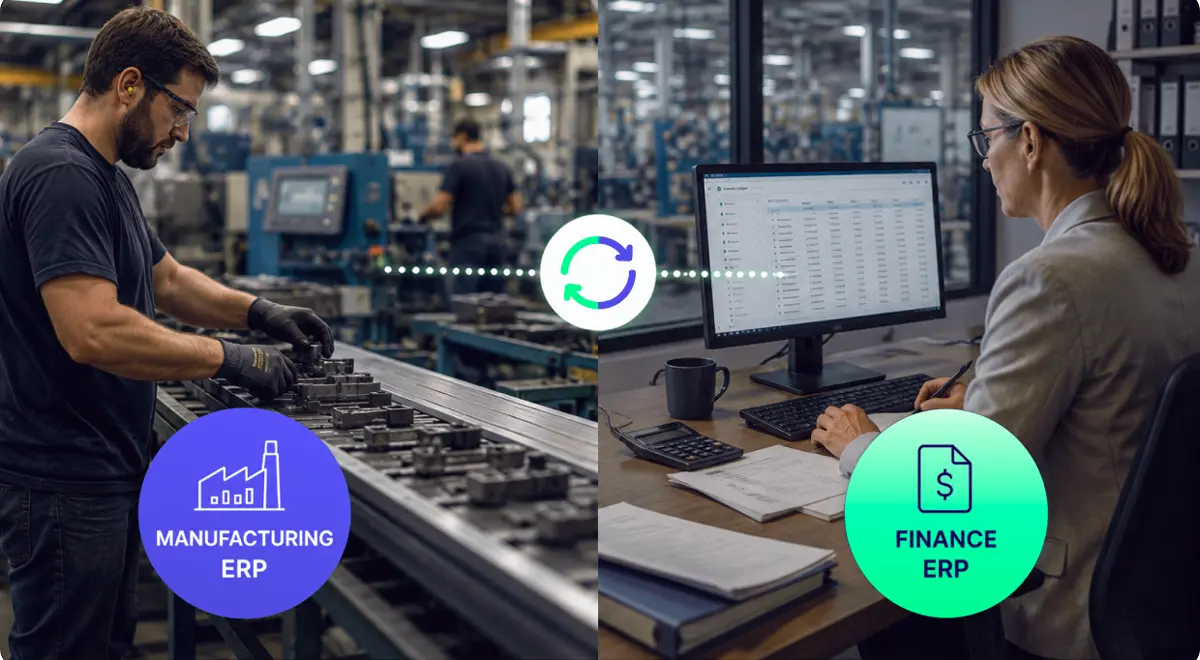
In Bonx customer stacks, the CRM owns the commercial relationship, Bonx owns operational execution, and the accounting system owns invoicing, accounting, and financial close.
In practice, a confirmed deal or signed quote in the CRM becomes an operational order in Bonx. Bonx can then generate the work that follows: production requirements, stock reservations, procurement needs, manufacturing orders, quality steps, delivery preparation, and traceability. Once the operational event is ready for finance, the right information flows to the accounting tool.
That handoff seems straightforward, but B2B manufacturing orders are rarely simple. A deal may involve custom specifications, variants, delivery windows, partial shipments, material constraints, subcontracted steps, and documents that need to follow the order through production. If sales keeps the order in the CRM and operations rebuilds it by hand, errors are inevitable. If finance has to wait until the end to understand what actually shipped, invoicing becomes a cleanup job.
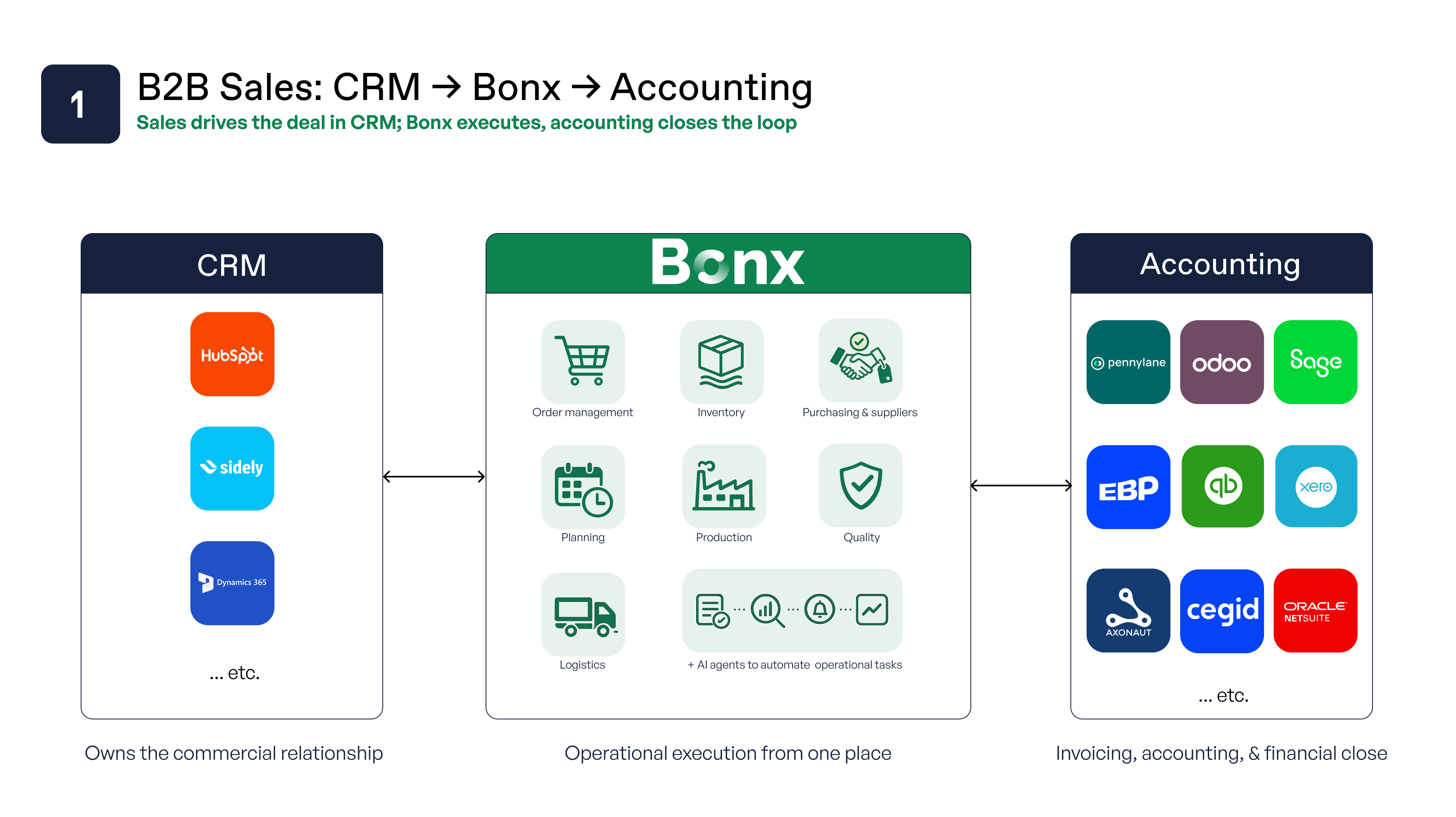
Bonx is not a financial ERP and does not replace accounting, payroll, or financial close; instead, it sends reliable operational data to the finance tool so finance can do its job with fewer corrections.
You can see the pattern in custom jewelry house Amantys, where Bonx connects HubSpot, the workshop, and Pennylane. Sales teams keep the customer layer in HubSpot, Bonx creates complete work orders for highly customized pieces, and Pennylane receives the information finance needs. The result today is zero data re-entry between HubSpot, the workshop, and Pennylane, with production, sales, and accounting synchronized around the same order reality.
This is the useful version of "under one roof." Not one tool pretending to be CRM, workshop system, and accounting system at once. The CRM keeps the commercial relationship, Bonx turns the confirmed deal into operational work, and accounting gets the right data back without the team rebuilding the order by hand.
B2C manufacturing creates a different integration problem. It starts on an e-commerce platform, marketplace, or direct-to-consumer storefront like Shopify, WooCommerce, Prestashop, or a custom commerce layer. There may be no invoice management inside the operational ERP because the commercial and payment layer already handles that part. The critical question is what happens after the order is placed.
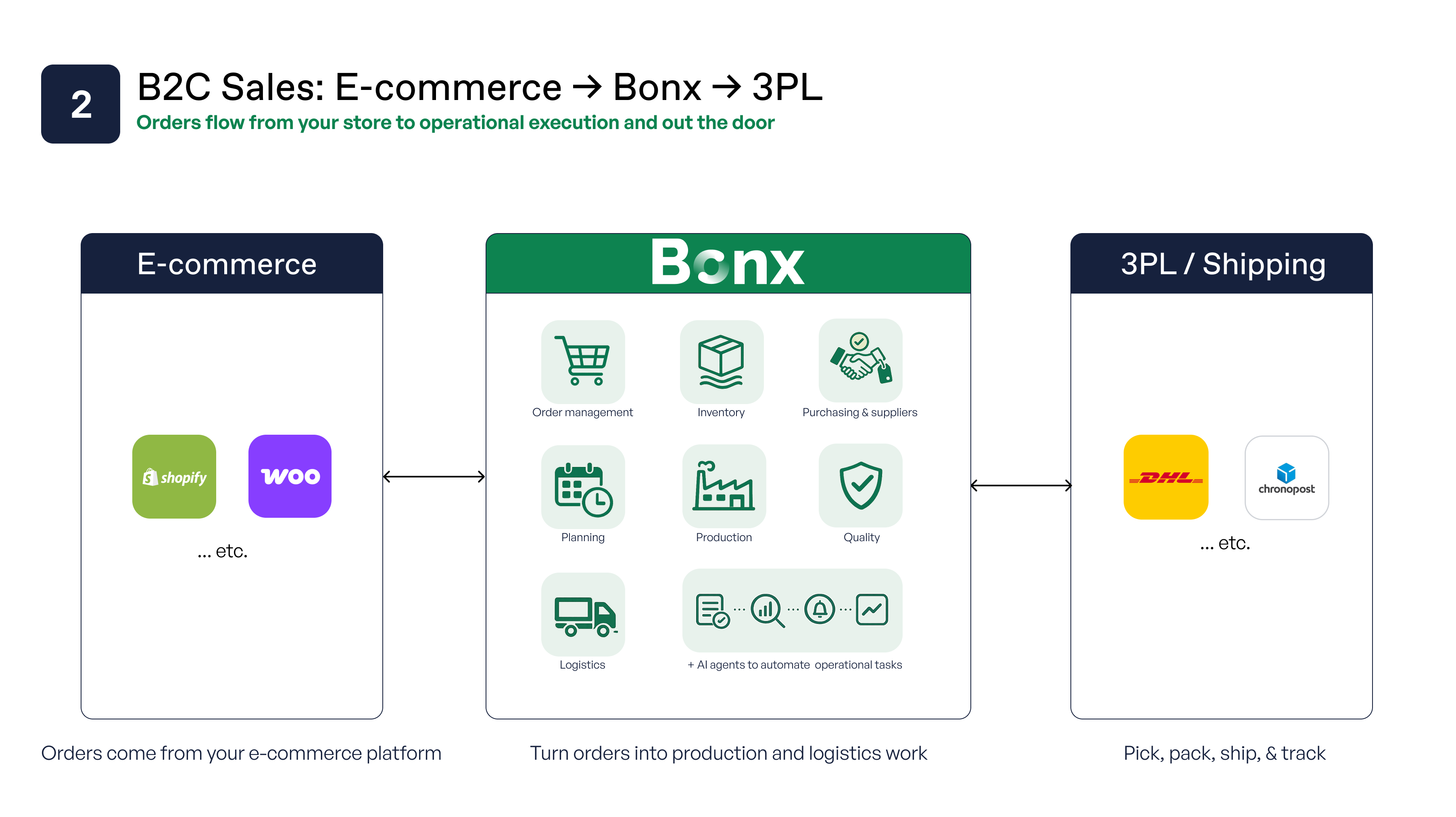
For a manufacturer selling direct to consumer (DTC), the e-commerce platform owns the online order, Bonx owns operational availability, production, traceability, and shipment readiness, and the 3PL or shipping system executes fulfillment.
That means Bonx receives e-commerce orders and turns demand into operational work. Depending on the product, it may reserve stock, trigger production, apply first-expired-first-out logic, check quality status, connect the right batch to the order, prepare picking instructions, or send shipment data to the 3PL. The 3PL can then pick, pack, ship, and return shipping status without the team copying order data between systems.
This is especially important when the product promise depends on operational control. For example, Féroce's promise is that its grass-fed ground beef is fully traceable from farm to plate through a QR code on every package. Without operational control, that promise falls apart.
That's why Féroce deployed Bonx in 42 days before a national TV appearance multiplied orders tenfold. In that case, Shopify remained the commercial core. Bonx structured the operational flow around batch traceability, cold storage, material balance, subcontractor coordination, and shipment preparation. When thousands of orders arrived in a single day, Féroce kept traceability intact and shipped without degrading the customer promise.
That is the point of the integration engine. The ERP does not need to become the e-commerce platform. It needs to understand enough of the order to run the manufacturing and logistics flow correctly, then pass the right information to the 3PL at the right time.
The B2B and B2C examples are relatively simple handoffs: one commercial system, Bonx, then finance or logistics. Multi-location stock is more complex because the same inventory picture may depend on several warehouses, subcontractors, or 3PLs, each working in its own system.
In Bonx customer stacks, those locations can be owned by the manufacturer, operated by a 3PL, run by a subcontractor, or mixed across all three. The ownership model matters less than the result: Bonx integrates with each location or system, then maintains the global operational inventory truth used for procurement, production, quality, traceability, and sales commitments.
That does not mean every warehouse has to work the same way. Some locations may receive instructions from Bonx. Others may send stock availability, reservations, shipment confirmations, or constraints back into Bonx. In both cases, the integration engine keeps the local execution system and the central operational ERP aligned.
The flow might look like this:
If you work with three 3PLs, you do not want three warehouse systems each becoming the planning truth. You want Bonx to see the full network, then synchronize each location through its own local execution system.
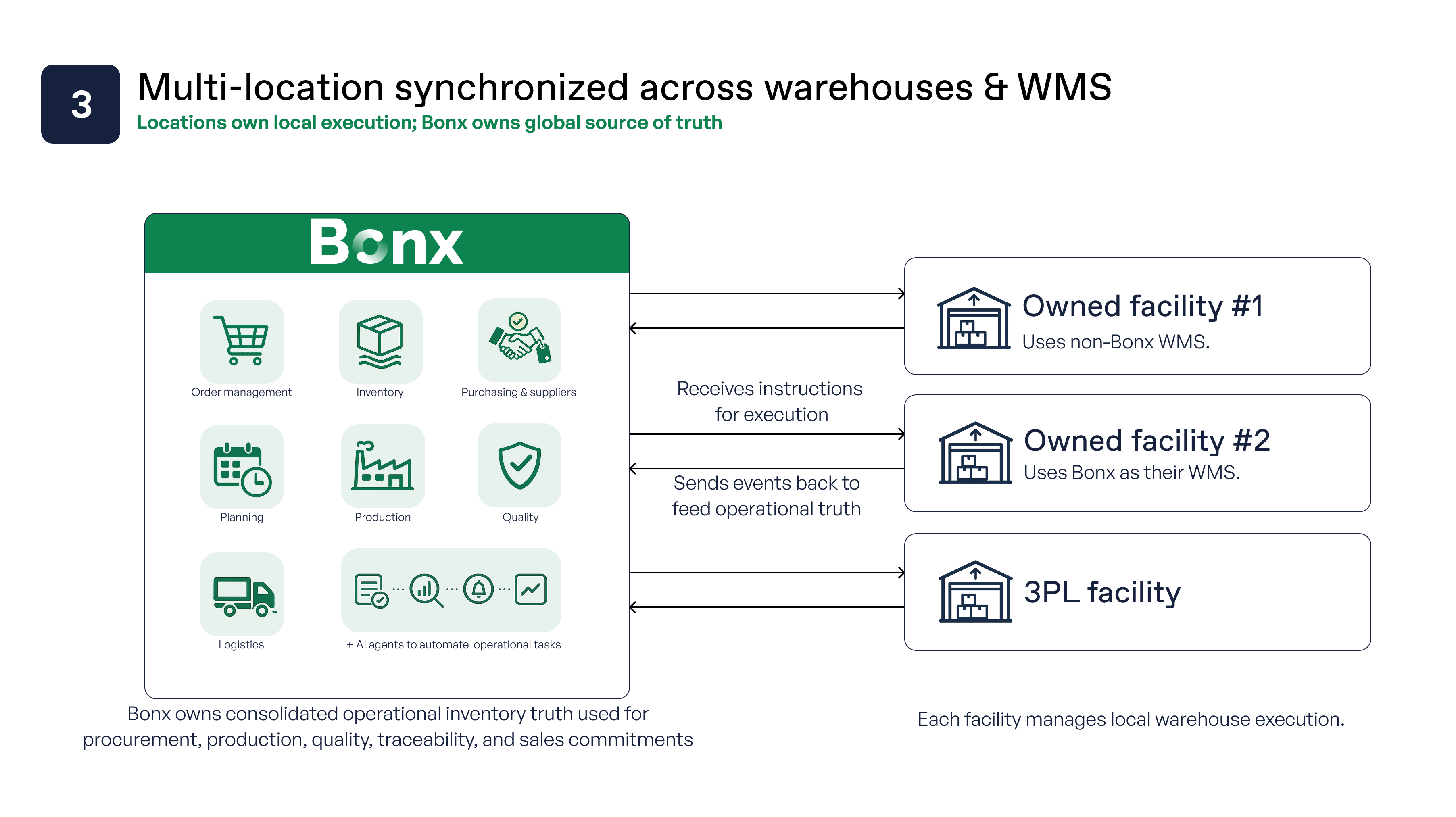
This is the pattern behind the phrase "multi-location stock sync." You manage operations in Bonx, including procurement, production planning, quality, traceability, and sales commitments, while each location keeps using the system that works locally. Bonx does not need to force one stock ownership model across the entire network. It needs to connect the systems well enough to maintain the global view.
For operations leaders, this is where the value becomes concrete. If stock is split across Paris, Lyon, and a subcontractor site near Milan, planning cannot work from partial truth. Procurement needs to know whether the next purchase is actually needed. Sales needs to know what can be promised. Production needs to know whether components are available. Quality needs to know which batch is blocked and where.
Without a central operational ERP, the network becomes a reconciliation exercise. Each warehouse may be locally correct, but planning, procurement, and sales are still working from a fragmented view. Bonx can sit at the center and keep the operational picture connected, even when different locations use different systems and different ownership models.
The important point is that Bonx's integration engine is not locked into one theoretical architecture; the right ownership model depends on the business. Sometimes Bonx should be the stock owner. Sometimes the WMS should be the stock owner. The integration should reflect how the operation actually works, not how an ERP diagram wants the world to look.
That flexibility is what makes the engine powerful. It can support synchronization with Bonx at the center, reverse synchronization from a WMS into Bonx, and mixed models where some stock locations are fully owned in Bonx while others are synchronized from external systems.
With Bonx, the integration question does not stop with software. Some of the most important operational data starts on the floor: the weight measured on a scale, the job running on a printer, the status of a CNC machine, the output of a production line, or the measurement captured by industrial equipment. We believe that data should not stay outside the ERP, waiting for someone to read it, copy it, correct it, or enter it later.
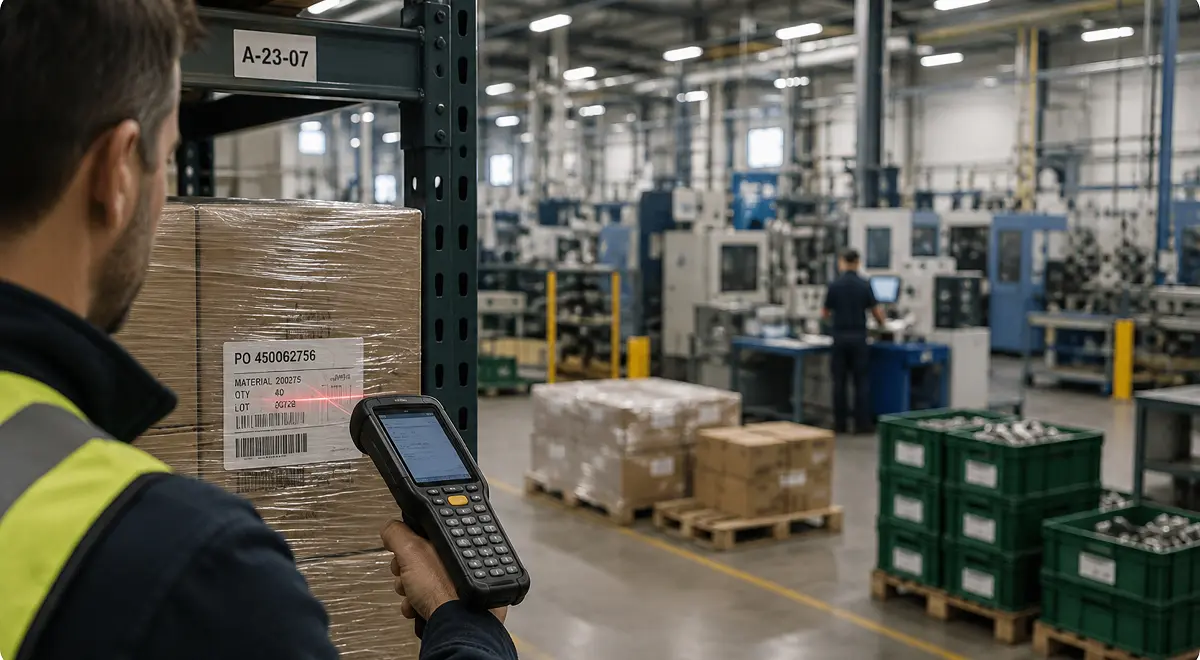
Bonx can connect to hardware through a synchronization agent installed on the machine or local environment. When the equipment exposes usable data, the agent gives Bonx a controlled way to read from it or exchange information with it, so machine activity can become part of the same operational system as orders, stock, production, quality, and traceability. Concretely, hardware integration means that you can push jobs from Bonx and receive job updates from the machine.
That can mean connecting Bonx to weighing scales for jewelry, truck weighing, or ingredient control. It can mean connecting to printing machines, CNC machines, scanners, or other industrial equipment. The exact setup depends on the machine, the data available, and the workflow the manufacturer needs, but the principle is the same: hardware should not create a separate island of operational truth.
Something Added deployed Bonx in two months with a native integration to HP 3D printers. Bonx groups orders, generates manufacturing orders, assigns jobs to machines, and supports 24/7 production with more than 10,000 parts produced each month. For another example in practice, Recyc Matelas chose Bonx partically because it was able to connect very easily to the existing weighing system, thereby limiting double data entry and errors.
Traditional ERP vendors often talk about integrations as if the job is mostly technical: connect the API, map the fields, test the transfer, and move on. That is rarely enough because the hard part is not just moving data, it is deciding what the data means operationally and having a system that can act on those inputs.
Is this e-commerce order confirmed demand, or does it wait for payment status? Is this stock available, reserved, expired, blocked, quarantined, or in transit? Does this CRM deal create production work immediately, or only after an approval step? Does a 3PL shipment close the operational order, trigger a finance event, update traceability, or all three?
If those rules are not clear, integration creates confusion, fast. Bad data moves more quickly, and teams stop trusting the system.
Bonx built its integration engine for that level of operational detail. It can model the flow around operational ownership, business rules, and exceptions, rather than treating each integration as a one-off pipe between two tools. The engine is flexible enough to support the patterns manufacturers actually need: CRM to ERP to accounting, e-commerce to ERP to 3PL, ERP-owned stock synchronized to several WMS tools, and WMS-owned stock feeding operational decisions back into Bonx.
Ultimately, at Bonx we believe the goal for manufacturers should not be fewer tools for the sake of fewer tools. It should be less manual work overall, and especially less manual coordination at the handoff points between systems, teams, warehouses, suppliers, machines, and finance.

Contact us
So were we. That's why we built Bonx, the AI-native manufacturing ERP.