Make your manufacturing ERP smarter over time with AI workflow automation
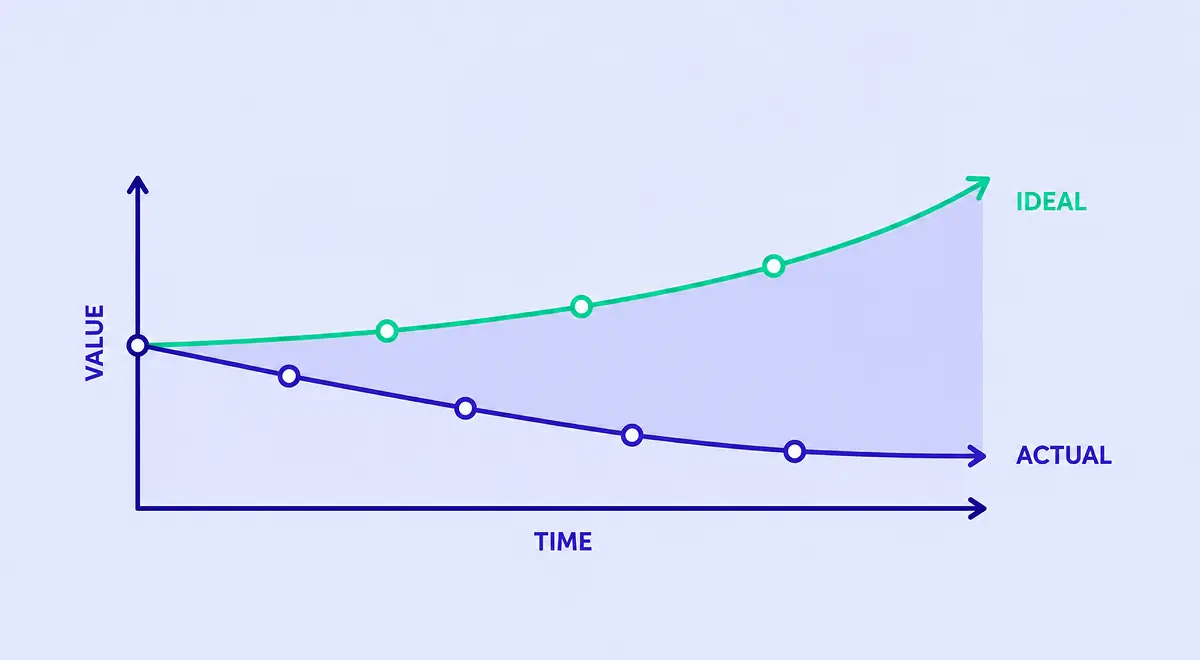
Your enterprise resource planning (ERP) system should get more valuable and more useful the longer you run on it.
That sounds obvious until you look at how most ERP systems age in real manufacturing companies. As the business changes, products multiply, customers ask for more specific delivery rules, suppliers get less predictable, and quality constraints become more specific, the ERP becomes heavier, slower to change, and less trusted over time.
The core irony is that manufacturing ERPs are supposed to create organizational discipline and visibility. The fact that most do not is not a law of nature, but a design choice of legacy ERP. Today, with more advanced AI and workflow automation, it does not have to be so.
This article looks at why legacy manufacturing ERPs are static by design, why an AI-native ERP can improve as it absorbs more operational knowledge, and what that shift looks like when manufacturing AI agents start carrying routine procurement, planning, production, and traceability work under human supervision.
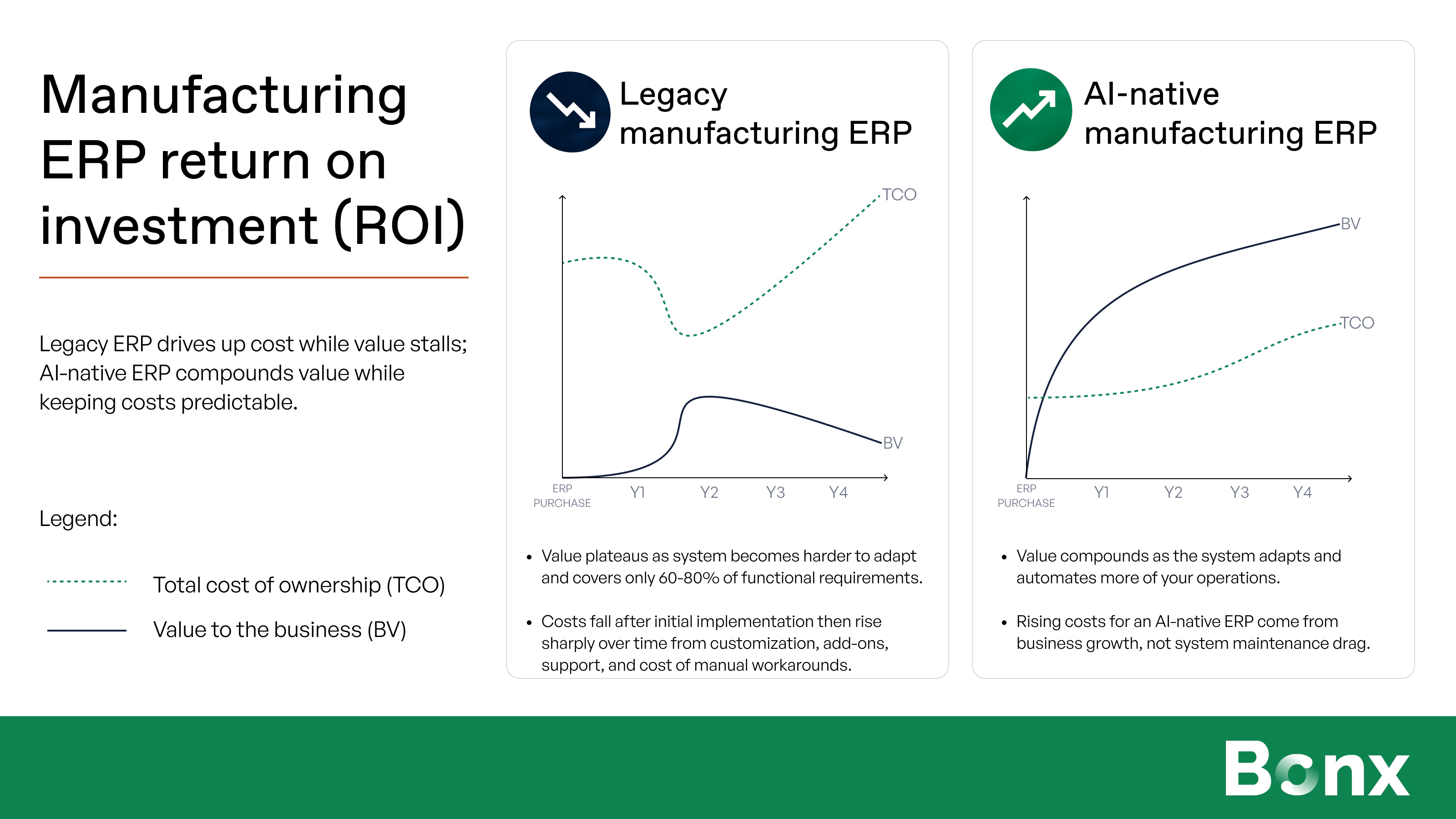
A legacy ERP often creates its highest sense of value at go-live. The company finally has one official system. Orders, stock, purchasing, production, quality, and logistics have names, fields, statuses, and reports. After months of workshops and configuration, the business gets a cleaner operating backbone than the collection of spreadsheets and local habits it had before.
The problem is that legacy ERPs treat normal operational movement as a maintenance problem. The system was configured around one version of the company, and the more the company changes, the more people have to keep reconciling work against that frozen model. At first, the gap is small, but it grows over time until the ERP no longer reflects the operational truth.
That is the wrong value curve. Software should not become less useful because the company learned, grew, and improved.
Legacy ERPs were built for a world where software needed everything translated into rigid structure. For some parts of the business, that structure is important; no serious manufacturer wants probabilistic stock movements, approximate batch traceability, or fuzzy purchase order quantities. The system needs reliable records for inventory, orders, production, quality, and logistics.
But manufacturing operations are not made only of clean records. They also depend on rules that change, exceptions that repeat, and judgment that experienced people apply without writing it down every time.
A buyer knows which supplier to avoid during peak season. A planner knows that two orders can technically run on the same machine but should not be grouped when a certain material is involved. A production manager knows which workshop can take overflow only if the packaging team is not already overloaded. A quality lead knows when a batch status should block shipment completely and when a commercial exception needs review.
In a legacy ERP, those rules usually have two places to live:
That is why the system does not get smarter; it cannot easily learn from the operational logic the team uses every day and can only enforce the logic that was modeled into it upfront. For a slower, simpler business, that may be acceptable. For a growing manufacturer, it is a tax on every improvement the team tries to make.
AI workflow automation should be part of how the ERP was built, not a layer on top of the same old legacy system.
With AI on top of a legacy ERP, you get things like a chatbot that answers questions about stock, a summary that explains late orders, or a workflow rule that sends an alert when a field changes. All of these applications of AI are useful and probably save a few clicks, but they do not fundamentally change the value curve of your ERP.
Your ERP should absorb more work over time because it has the right data, rules, and context, including the exceptions and intricacies of the work, to do so. Having a system with usable operational knowledge that can then actually act is where the relationship between people and the software can start to change.
For more on the category difference, read Bonx's guide to how AI ERP differs from legacy ERP. For the narrower question of systems that can act inside the workflow, read Bonx's practical guide to agentic ERP.
An ERP gets smarter when the product architecture in and of itself lets the team turn operational knowledge into something the system can use safely.
That requires three things:
Autonomy without control is not useful in manufacturing, but at the same time, total, rigid control without giving the ERP any autonomy leaves the team with all the tedious, manual work. The better model is progressive autonomy, where the system earns more responsibility by proving itself on bounded work.
In practice, a smarter manufacturing ERP carries more routine work as it gains better records, clearer rules, stronger integrations, and more trust from the team. Bonx is an AI-native manufacturing ERP; here are just a few examples of AI agents in Bonx to illustrate what this looks like in practice.
Procurement is full of decisions that repeat often enough for software to prepare, but not blindly enough for software to own.
Which components will run short if the current demand plan holds? Which supplier should be used for a standard material? Which purchase order can be prepared because the price, lead time, and supplier choice are routine? Which shortage needs a buyer because the supplier is unreliable, the price changed, or the customer order is strategic?
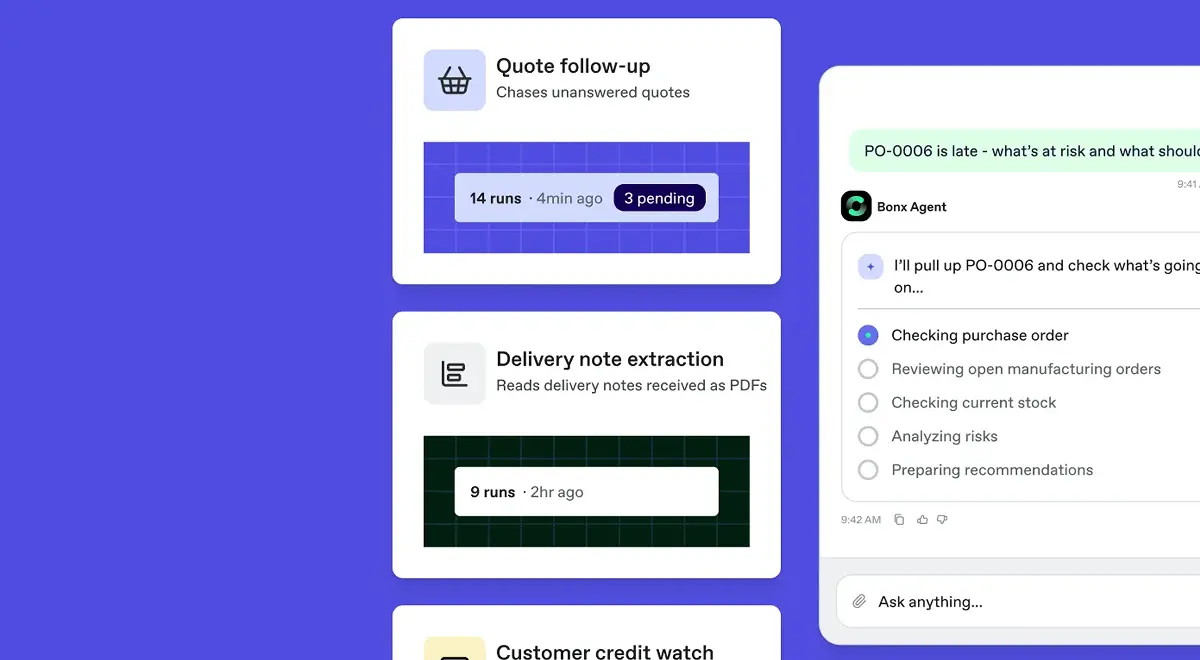
A static ERP can show stock and open purchase orders. A procurement agent should prepare the next purchase orders, group needs by supplier, apply approved lead-time and sourcing rules, and route the risky cases to a human. That is the kind of work Bonx's procurement control module is meant to bring into the operating system instead of leaving it scattered across spreadsheets and supplier messages.
Food manufacturer L'Atelier du Ferment connected operations to Sidely and Pennylane while supporting full batch traceability across more than 100,000 bottles. With Bonx, the team can generate manufacturing orders and procurement suggestions based on sales, shelf life, and cold storage capacity. That is the kind of procurement work a manufacturing ERP should start carrying once the system knows the constraints well enough.
The buyer's job does not disappear. It gets cleaner. The system handles more of the checking and preparation, while the buyer spends more time on supplier risk, price changes, and exceptions that need judgment.
Production planning usually fails slowly before it fails loudly: a lead time drifts, quality holds stock, or a supplier delay affects a batch that affects tomorrow's schedule. The planner sees the problem because they know the business, but the ERP often waits for someone to update it.
A scheduling agent should keep watching the signals that make the plan stale. It can prepare manufacturing orders, group work by industrial constraints, flag impossible capacity assumptions, update priorities within approved limits, and ask a planner when a tradeoff affects customer promise, margin, quality, or capacity.
For a deeper look at this planning handoff, read how AI production planning changes scheduling without replacing planners. For the product layer behind it, see Bonx's production orchestration module.
Additive manufacturer Something Added deployed Bonx in two months with a native integration to HP 3D printers. Before Bonx, production depended on manual checks, order grouping, machine selection, and print job launch decisions. With Bonx, orders can be grouped automatically, manufacturing orders generated, and jobs assigned to machines based on industrial constraints. The factory now runs 24/7 production and produces more than 10,000 parts each month with a reduced team.
AI scheduling should not mean an AI assistant that simply helps prepare a calendar more efficiently. It can, and should, go further, with the system taking over repeatable scheduling work inside clear industrial limits, while people keep control of the tradeoffs.
Traceability is one of the places where static ERP logic hurts most.
The clean version is simple: receive batch, consume batch, produce batch, ship batch. The real version includes substitutions, partial consumption, rework, quality holds, shelf life, subcontracting, split shipments, and documents that have to match what actually happened.
A smarter manufacturing ERP should not make quality teams reconstruct the chain by hand after the fact. It should connect stock movements, batch status, production events, quality rules, and shipments while the work is happening.
Féroce deployed Bonx in 42 days before a national TV appearance multiplied orders tenfold. The operating system was in place before the surge, so the business could keep traceability and logistics under control when volume moved faster than a manual setup could have handled.
The important buying criterion is not whether a vendor can say "AI" in the demo. It is whether the ERP can become more central to how the business runs after go-live, instead of forcing people to rebuild the real operating system around it. That is the practical value of AI workflow automation in a manufacturing ERP: it should help the business run with more clarity and less manual load after go-live, not slowly drift away from reality until someone starts another project.
Your manufacturing ERP should get smarter over time. If it does not, your team will have to.
AI workflow automation in ERP means the system uses artificial intelligence to perform or prepare operational work inside approved business processes. In manufacturing, that can include preparing purchase orders, generating manufacturing orders, grouping production work, surfacing exceptions, updating statuses, or routing approvals.
Classic ERP automation usually follows fixed if-this-then-that rules. AI workflow automation can use broader operational context, including demand, stock, supplier lead times, quality status, capacity, and business rules, then prepare or perform the next action under human supervision.
AI workflow automation is one of the clearest ways agentic ERP shows up in daily operations. When an ERP can take action inside approved workflows, procurement, planning, production, quality, and logistics stop being only record-keeping processes and become work the system can help carry.
Legacy ERPs struggle because much of their logic is either coded into the system or left outside it in processes defined during implementation. When the business changes, the system often needs a consultant, a ticket, or a workaround instead of learning from the way the team actually operates.
Manufacturing AI agents can include procurement agents that prepare purchase orders, scheduling agents that update plans when constraints change, quality agents that flag blocked stock, and logistics agents that prepare shipment actions or documents.
No. A smarter ERP should move operations teams from repetitive execution to oversight. People still handle customer tradeoffs, supplier judgment, quality risk, capacity decisions, and business priorities. The system carries more of the routine work around those decisions.


Contact us
So were we. That's why we built Bonx, the AI-native manufacturing ERP.