LCS x Bonx: When Reactivity Is the Product, the Workshop Can't Be a Black Box
How a fast-growing textile customization atelier brought real-time visibility to five production workshops - and made speed a promise it could actually keep.








–95%
–90%
+30%

In Textile Customization, the Client Is Always Late
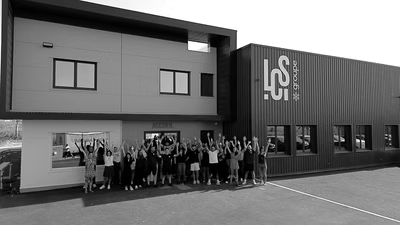
LCS Groupe (La Crémerie Sérigraphie) is a textile customization manufacture based in Perpignan. Founded in 2014, the company produces custom apparel and merchandise for corporate clients, festivals, communication agencies, and resellers across France.
In this market, one thing is constant: the client is always late. That's not a complaint. It's the job description.
Textile customization is an event-driven business. Festivals order crew merchandise weeks before opening. Corporate clients discover they need 200 uniforms a month before their new hires arrive. Agencies need samples turned around before the client changes their mind. The order that arrives with comfortable lead time is the exception. The one that arrives late, urgent, and non-negotiable is the rule - because the event it's tied to has a date that doesn't move.
LCS built its entire operation around this reality. A 2,000 m² integrated facility with five workshops, integrated precisely to absorb last-minute complexity without losing time between handoffs.
Reactivity isn't a value on their website. It's the operational architecture of the company - the reason clients come back, and the reason the business has grown consistently since 2014.
One order. Five workshops. No shared view.
An LCS order is not a straight line. It is a routing problem.
Depending on what a client has ordered, a single job may pass through the press workshop for heat transfers, the screen printing atelier for base graphics, the embroidery station for logo work, the digital workshop for finishing, and the sewing team for final assembly. Each step depends on the previous one. Each handoff is a potential bottleneck. Each delay compounds - silently, until it surfaces as a missed deadline.
For years, LCS managed this complexity through paper work orders and the institutional knowledge of Mélanie and the team. One manufacturing order printed and handed off per workshop, per job. Everyone knew where things were because they had spent years learning to know.
It worked. And it had a ceiling.
Nicolas Gomarir, the CEO, had set a clear target: reach €5 million in revenue with 66 employees within three years - roughly doubling order volume and headcount while maintaining the reactivity that had built the business in the first place. At twice the volume, the knowledge that lives in people's heads doesn't transfer automatically to the people who replace them. Paper doesn't tell the embroidery team that the press workshop is running two hours late. And the gap between what a sales rep promises a client and what's actually happening on the floor grows wider with every order added to the queue.
The phone call nobody should have to make
The pressure points were already visible before they became costly.
When a client called to ask where their order was, someone had to physically walk the floor to find out. When a last-minute modification came in - a size change, a color correction, an added line - it was unclear whether production had already started, which determined whether the change was still possible and what it would cost to make it. When the sewing atelier was waiting on output from the press workshop, there was nothing telling the upstream team that their delay had consequences downstream.
Each of these moments was a small tax on time and attention. Across 40 people handling predominantly small-series orders under tight deadlines, they accumulated into something heavier: a structural drag on the very promise LCS was selling. And for the clients who experienced the friction - a slow answer on order status, a modification request that required three calls to process - it created exactly the kind of doubt that erodes loyalty in a market where alternatives are not hard to find.
When the floor starts talking
Bonx was deployed to make visible what paper and institutional knowledge could no longer track at scale.
The most immediate change was the work order itself. Paper OFs were replaced by digitized manufacturing orders, each linked to a QR code scanned at every stage of production. When an operator at the press station completes their step, the order advances in the system. The embroidery team sees it's coming. The logistics coordinator sees where it sits in the queue. The customer success team can answer a client status inquiry without leaving their desk - or making a phone call.
Work order generation, previously done manually for each job, became automatic: one order per workshop per confirmed quote, routed to the right team without human intervention. For jobs touching four or five workshops, this alone removed a significant source of errors and delay.
Purchasing flows were connected to production scheduling, so that fabric orders and component procurement stopped operating in parallel with the production plan and started informing it. And clients received, for the first time, direct access to their order status - a notification at each production milestone, and a form to submit modification requests without disrupting the floor.
A Deadline Business, Built to Last
The headline metrics are real: 95% fewer production errors, 90% less paper, a full day recovered on average lead time.
But the result that matters most to Nicolas isn't visible in any single metric. It's that LCS can now pursue its growth target without betting that the right people will always be in the right place with the right information in their heads. The production floor is legible - to management, to the commercial team, to logistics, and to clients. What happens in the press workshop at 10am is visible to the sewing team at 10:01.
In a business where the client is always late and the deadline never moves, that visibility isn't an operational improvement. It's the product.
To sustain its reputation for reactivity while doubling in size, LCS deployed Bonx to replace paper work orders with real-time production visibility across five workshops — making speed a promise the business could keep at any volume.
LCS Groupe built its business on one promise: absorbing last-minute orders and delivering on time, no matter how complex the routing across its five specialized workshops. As the company set out to double its revenue, the paper work orders and institutional knowledge that held the operation together were becoming a structural ceiling — invisible on ordinary days, costly when a deadline slipped. Bonx digitized the entire production flow, from automatic work order generation to real-time floor tracking, giving every team — and every client — a live view of where each order stands.
Read the story of another client