Nervures x Bonx: Preserving the Precision of a Workshop When Production Goes Industrial
How France's leading paraglider manufacturer structured its operations to scale without losing the craftsmanship that defines its products.







–95%
1

When a paraglider leaves the workshop, there is no margin for error
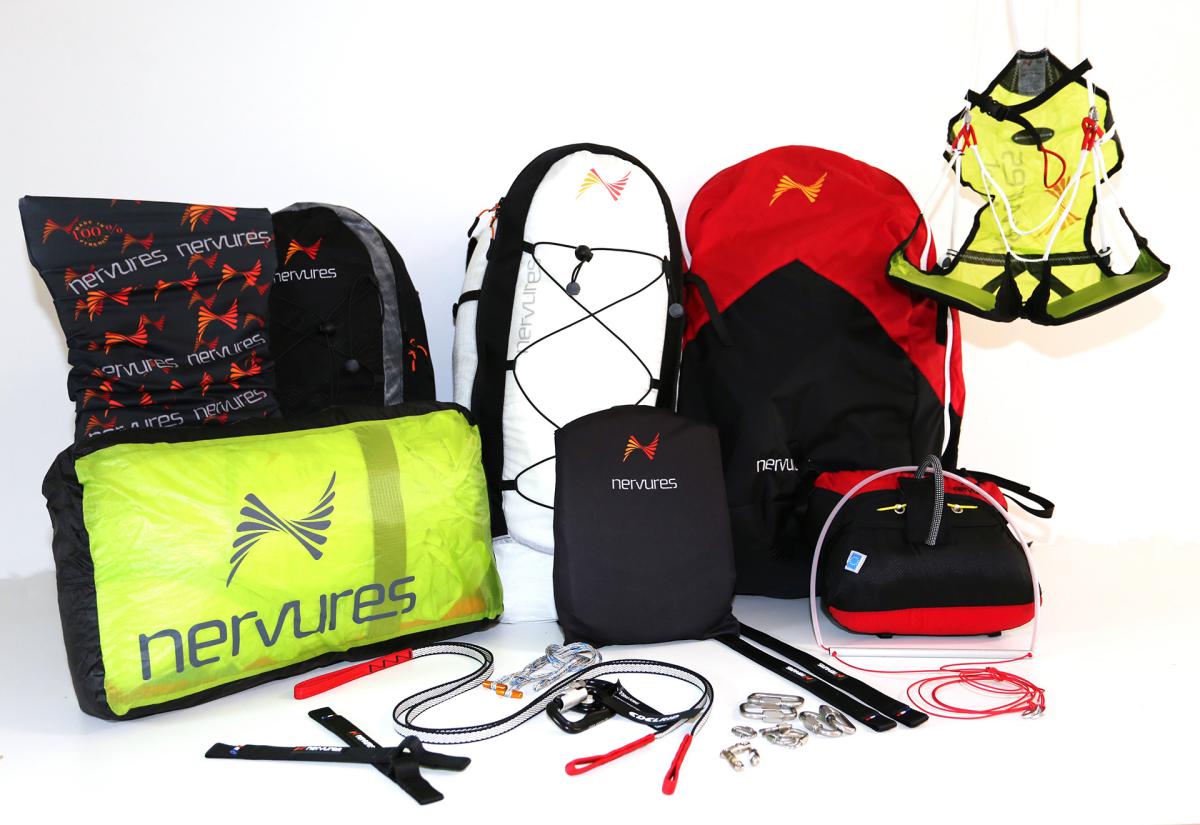
A paraglider is not a consumer product. It is a certified piece of aviation equipment. Every wing that leaves Nervures carries with it a chain of production decisions - materials, component assemblies, quality checks, traceability records - that cannot be approximated or reconstructed after the fact. The tolerance for error is, in a word, zero.
This is the operational reality that defines Nervures. For more than three decades, the company has built its reputation on precision: precise design, precise manufacturing, precise quality control. At craft scale, that precision is maintained through proximity - everyone knows what was built, when, and with what.
The challenge Nervures now faces is not a quality problem. It is a scaling problem. And those two things, left unaddressed, quickly become the same thing.
A system that runs on time. Borrowed time
For years, Nervures has managed production through Google Sheets and its finances through Sage. Within each domain, the tools do their job. Production managers track manufacturing orders and scheduling. Finance has its own view of the numbers. The setup is known, mastered, and reliable.
The system holds. But holding it together has a price
When Jean-Marie and the team want to analyze production costs, or understand how a scheduling decision affects margins downstream, the data has to be manually extracted, reconciled across two disconnected systems, and re-entered. Today, that's an hour here, an hour there. But every new order, every new SKU, every new operator adds to that load. The time the system demands grows with the business without producing anything in return.
Doubling revenue in three years doesn't come with twice the hours to spend on manual reconciliation. At some point, the time required to keep everything aligned is time the business simply can't afford to give.
Three pressure points were already visible before becoming problems: production scheduling and capacity planning, logistics flow predictability, and the ability to generate operational analytics - cost of goods, stock levels, quality metrics - without hours of consolidation that should never have been necessary in the first place.
Nervures didn't wait for the system to fail. They acted while it was still working.
The Wrong Tools for a Precise Problem
Nervures evaluated its options carefully. A full ERP migration would have been the standard answer and also the most disruptive one. Replacing their legacy ERP, rebuilding production logic from scratch, retraining every operator on a system designed for a company three times its size: the cost, the delay, and the risk were all disproportionate.
What the team needed was not a replacement for what worked. It was a layer that could connect the pieces already in place, eliminate the manual reconciliation in between, and give production and management teams a shared operational picture - without requiring them to change how they worked.
That is the problem Bonx was built to solve.
Three perimeters, one unified picture
Bonx was deployed in three structured sprints, each targeting a distinct operational perimeter.
The first two weeks focused on data integration: connecting Nervures' existing systems — Google Sheets for production data, Sage for financial flows — and building the shared object layer (articles, customers, orders) that would underpin everything else.
The next four weeks addressed production management: manufacturing order generation, production progress tracking, scheduling by operator, and materials requirements planning. For the first time, production planners had a system that could generate work orders automatically and track advancement in real time — without a spreadsheet in sight.
The final phase covered quality management and operational performance: quality control checklists, production dashboards, and KPIs covering efficiency, adherence to schedule, and cost metrics. Management gained access to live margin visibility that previously required days of manual consolidation.
Throughout the deployment, Bonx adapted to Nervures' processes — not the other way around. Existing workflows were preserved; the tool was layered on top of what already worked, filling the gaps that created friction.
The number that matters most
The north star metric from Nervures' deployment is a 95% reduction in manual data re-entry, the single most tangible measure of how much operational energy was being absorbed by coordination work rather than production work.
But the more significant result is structural: Nervures now has a single source of truth across production, logistics, and finance. A change in the production plan is immediately visible in inventory projections. A quality event on the floor is captured in the same system that generates cost-of-goods reporting. Planning decisions and financial outcomes are no longer separated by a manual reconciliation process.
For a company whose product demands precision at every step, this is not a convenience. It is the operational foundation that makes scaling possible without compromising the standard.
What Comes Next
Nervures' ambition is to double in revenue within three years. That means more products, more production orders, more operators to coordinate, and more data to manage - potentially across multiple sites.
Each of those milestones introduces operational complexity that, without the right infrastructure, has a way of accumulating quietly until it surfaces as a quality or delivery problem. The work done with Bonx was not about fixing today's processes. It was about ensuring that the precision Nervures is known for remains intact as the company grows into a different scale entirely.
A paraglider built today and a paraglider built when Nervures is twice its current size should be indistinguishable. That is the standard. It is also the reason the operational infrastructure matters.
Faced with the challenge of doubling revenue while maintaining the zero-tolerance precision its products demand, Nervures deployed Bonx to eliminate manual data reconciliation and build a unified operational layer across production, logistics, and finance.
Nervures has spent thirty years building a reputation on precision — every paraglider it produces is a certified piece of aviation equipment where the margin for error is zero. As the company set out to double its revenue within three years, the manual reconciliation between its production spreadsheets and financial systems was quietly consuming the time and attention that growth requires. Bonx was deployed to connect the existing tools, automate what didn't need human intervention, and give production and management teams a single, real-time picture of operations — without disrupting what already worked.
Read the story of another client