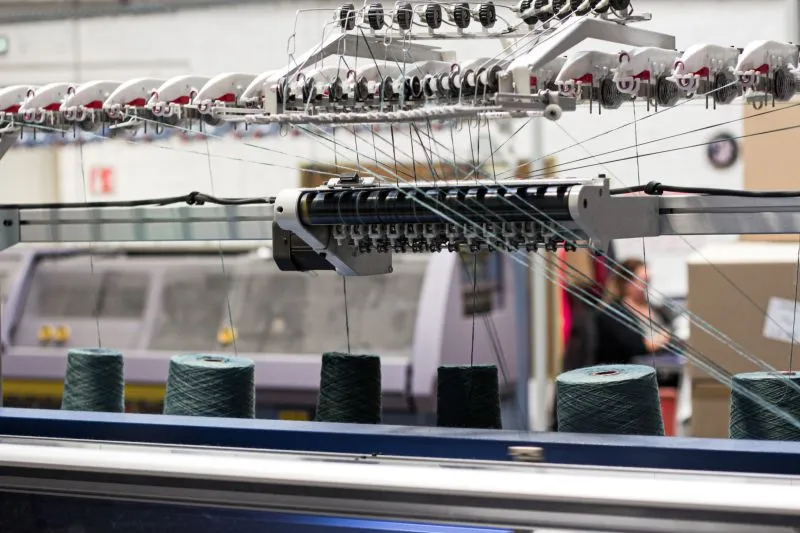
Something Added built an automated dark factory with Bonx, producing 10,000+ parts monthly with a lean team
Something Added built a 3D printing factory in Barcelona designed from day one to run continuously, stay lean, and eventually replicate. With Bonx as the operational backbone, orders group automatically, jobs assign to machines based on industrial rules, and the factory runs 24/7, producing 10,000+ parts monthly without adding headcount.







2 months
24/7 production
10,000+ parts/month

The real challenge of additive manufacturing isn't design but rather scaling into production. It is exactly out of this challenge that Something Added, who build 3D-printed midsoles for performance footwear, was founded. They started as a 1,000 m² factory in Barcelona designed from the start to run continuously, stay lean, and be replicated internationally.
Staying true to their mission meant turning every repetitive production decision (including which orders to batch, which job goes to which machine, how to trace every part) into a rule the system could execute on its own.
The challenge in Something Added’s vision
From the start the vision was bold, but very quickly, Something Added ran into the operational reality. Each printing cycle involved the receipt and analysis of 3D files, manual checks, operator decisions to launch print jobs, and repetitive physical actions on the machines.
These actions are acceptable in R&D, but as soon as the objective becomes continuous production, they turn into a structural bottleneck.
On top of this challenge, additive manufacturing also introduces a specific constraint in that parts from dozens of different orders can be produced together in the same run. That’s because one print corresponds to a block of powder containing a batch of midsoles, which means multiple orders must be aggregated to optimize material usage and machine time. In the end, each produced part must be linked to the right customer, at the right price, with full traceability.
Why Something Added chose Bonx
Faced with these specific constraints, Something Added chose to structure its production system before increasing volumes. Something Added’s priority was to find a solution that would automate repetitive decisions, group orders, assign jobs to machines based on clear industrial rules, and manage workload in real time, while retaining the flexibility to evolve its processes.
That last part is critical. Because products and workflows at Something Added evolve quickly, the selected solution had to adapt without relying on heavy integrations or external consulting. So the team drew a clear line early on, ruling out any solution that required too many manual actions, fixed workflows, or that had weak integration with 3D printers.
Something Added evaluated specialized 3D printing software and off-the-shelf, all-in-one ERPs. The former understood the machines but couldn't flex around an operation that was still being built. The latter handled standard production flows, but Something Added's model wasn't standard. What they needed was a system that could encode their specific industrial rules, namely how orders get grouped, how jobs get assigned, and how the whole thing evolves, and adapt as the operation scaled.
Bonx was the only option that could do both. Once Bonx was selected, the work began on-site. The teams traveled to Barcelona to observe the real operations of the Something Added factory, shadow the operators, and understand precisely how processes were running.
At the same time, they worked directly with the technical teams at HP to implement a native connection between Bonx and the 3D printers, a critical integration for Something Added’s industrial model.
Two months later, Bonx was live and running in production.
Bonx at Something Added in practice
Before Bonx, production relied on a chain of manual steps that included receiving 3D files, performing checks, grouping orders, selecting machines, and launching print jobs.
These were not just clicks. They also required constant physical movement across the factory, back-and-forth between workstations, machines, and files, and a strong dependence on operators to move production forward.
With Bonx, operations changed. Orders were grouped automatically, manufacturing orders were generated, and jobs were assigned to machines based on predefined rules. The teams stopped spending their time organizing production and focused on supervising execution.
Since deployment, Bonx has been used daily. Workflows have evolved, new operators (including temporary staff) have been onboarded, and the organization has adapted without rebuilding the system.
The solution has already scaled alongside Something Added’s rapid growth, including periods running at 100% capacity, with 24/7 production and tens of thousands of parts produced each month.
“We operate a fully automated dark factory, and Bonx is the backbone behind it. It structures our operations without slowing us down. The system supports our growth while keeping everything synchronized.”
— Romain Adamowicz, CEO at Something Added
What’s next for Bonx and Something Added
With Bonx implemented and production structured, Something Added can focus on what comes next. The first priority is clear: deepen automation.
The goal is to further reduce human intervention wherever it still exists, especially in physical flows, in order to make the unit more robust, predictable, and easier to operate.
The second priority is replication. The Barcelona unit was designed from the start as a standard. That is, a compact factory, run by a lean team, managed through a centralized system. This logic makes it possible to deploy the model internationally, closer to key markets, without rebuilding the organization each time a new site opens.
Bonx will continue to grow with Something Added, and vice versa, as they expand operations, providing the foundation that enables the duplication of a proven industrial model without reintroducing complexity as the company scales.
Read the story of another client