How can a manufacturing ERP be implemented quickly?
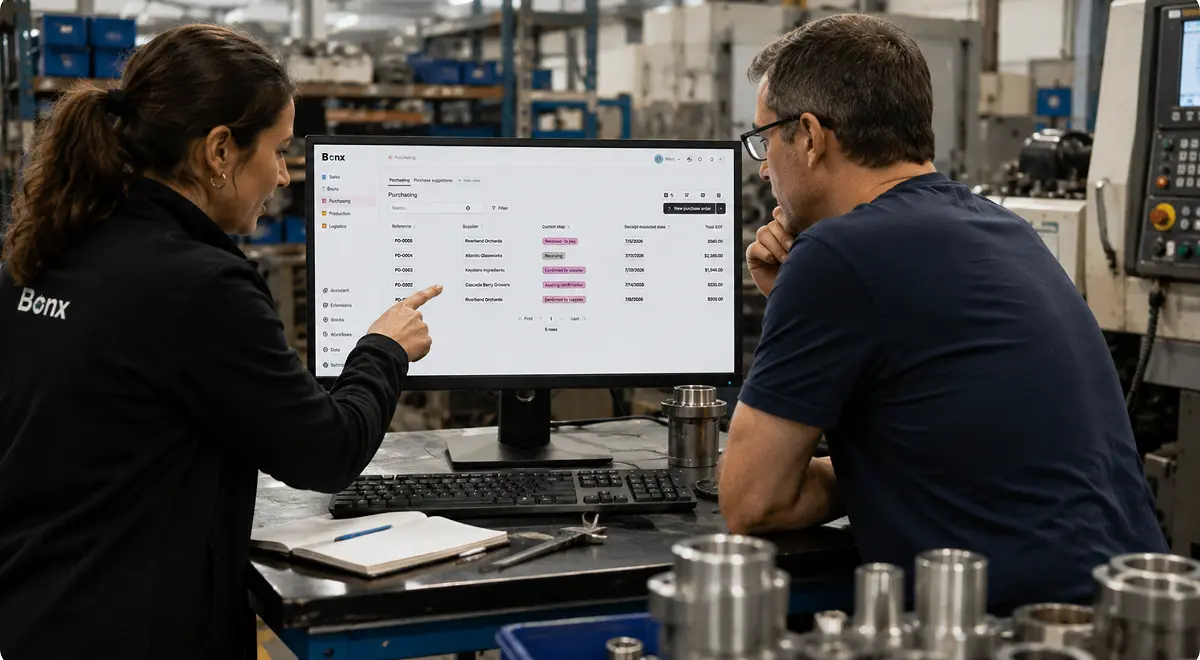
At Bonx, we believe manufacturing ERP implementation should happen in weeks or months, not years. We also believe that your ERP should be creating value for your business right away, ideally before the full rollout is done.
But it’s not just a belief; it’s also a proof point as well as a point of pride. Our customer Feroce went live with Bonx in 42 days without interrupting operations, then handled a national TV-driven order surge while keeping every package traced and shipped to the same standard. Something Added deployed Bonx in two months with a native integration to HP 3D printers, helping the factory group orders automatically, generate manufacturing orders, and run 24/7 production with more than 10,000 parts produced each month.
For anyone used to legacy ERP, these beliefs and claims can sound so strange that they’re difficult to believe. Exactly how is Bonx able to meet such aggressive implementation timelines? This article breaks it down.
The legacy ERP implementation timeline is partly a technology problem, as legacy ERPs were built around rigid data schemas and code-heavy adaptation. Representing a process often means translating the business into the ERP's existing structure, then adding configuration, custom development, testing, and rework around that structure. The lead time between "this is how our process works" and "the process exists in the software" is long, which is at the core of why many legacy ERP implementations fail.
Bonx's operational model is built to be configured and adapted faster. For example, by leveraging AI agents in the deployment phase itself to map data and rules into processes. The goal is a system that can represent the flow of work faster, connect to the tools around it, and take routine work off the team earlier in the deployment.
The technology itself changes implementation speed in two key ways:
The technology itself (e.g., the data model, operational model, etc.) of AI-native ERP vs legacy ERP is one factor in a faster implementation. But technology aside, a go-live with Bonx doesn’t simply mirror a legacy ERP implementation but with a tighter calendar. Here are three additional ways we’re able to get our customers up and running quickly with a different approach to implementation.
In a legacy ERP project, the team often tries to model the full business upfront, then waits for value until the end, which can be years down the line. In Bonx’s model, the team chooses the first flow of work, gets it live, learns from actual use, then extends from there.
That said, we certainly do have customers that prefer (or require, usually due to the end of life of another system) an implementation where the whole company switches over to the new system in one dramatic moment. More often, though, the first go-live involves a real, specific, and important operational flow, not the entire company or system. It might be customer orders through shipment, spare parts orders, production declarations for one activity, stock and purchasing for a controlled scope, etc.
The important word is "real." A first go-live with Bonx is not a demo environment, a mock process, or a theoretical workflow. It means real users, real orders, real stock movements, real documents, and real operational value.
That often means that the first go-live runs beside existing tools. In fact, several Bonx deployment plans use a parallel phase where the team runs real work through Bonx while the existing tool remains to validate the flow, lowering the psychological risk of ERP deployment.
While our approach to implementation means that the system does not necessarily need to cover the whole company for every use case on day one, we are bullish on defining (and hitting) success metrics. What the go-live does need to prove is that for the initial defined scope, it really works. Not just technically speaking, but from a human perspective.
For one recent deployment plan, the go-live criterion was simple: one user needed to create a complete customer order, from quote to shipment documents, in less than 10 minutes without help. That is a much better standard than a checklist of configured fields, because it tests whether the system can support a real operational action.
For first go-live scope, we think about answering practical questions like:
The idea is that this approach to implementation should feel more concrete because while the first scope might be smaller, the bar for success and business impact is higher.
Many manufacturers have been taught to see the ERP go-live moment as a cliff. Before it, everything is preparation, and after it, everything is support. For Bonx, go-live is the first proof that the system can support the business, and from there, the implementation keeps expanding, with the full participation of our team.
In order for this system to work, our team is disciplined about what comes after that first step. For example, in one recent deployment plan, Bonx and the customer froze all second-scope topics until the first go-live was complete. Integrations, dashboards, special codes, extra reports, and additional workflows were not ignored; rather, they were placed in a parking lot, ordered by priority, and scheduled for after the first live flow.
That is not a compromise; it’s how the project avoids becoming a months-long legacy ERP implementation. And that’s not to say that edge cases don’t matter, but the question is whether they need to block the go-live of the first use case providing operational value. If a dashboard, integration, or exception is useful but not required for the first real flow to work, it should not hold the go-live hostage.
This is the part of our approach to implementation that can feel uncomfortable at first. Teams are used to treating ERP scope as protection: if we write it all down now, we will not miss anything. But oversized scope can create the opposite result where the project becomes too heavy to move, and the business waits months before anyone can use the system.
A fast ERP implementation doesn’t mean it’s passive for our customers or that customers carry no responsibilities in making it happen. Though it asks for fewer ceremonial workshops than a legacy ERP deployment, going live with Bonx still requires decisions, data, and ownership.
Of course, not every manufacturer has the same scope or exactly the same timeline, but as a starting point, we generally ask that our clients provide full details of their operational truth: products, customers, suppliers, prices, stock, bills of materials, routings, quality rules, documents, and the exceptions that happen often enough to matter. The team also needs to identify the users who can validate the flow, because a system cannot go live safely if nobody owns the answer to "does this match how we work?"
From there, what changes is the shape of the work. Instead of spending months translating the business into a rigid ERP structure, the team works on the first live flow. Which data is needed for that flow? Which statuses matter? Which documents must be generated? Which decisions need human approval? Which steps can be automated later, once trust is built?
We don’t ask our customers to make their best people available for workshops for weeks and weeks over the course of a year before they see value. At the same time, fast implementation is not a promise to skip the hard parts. Going live with Bonx still takes focus, but the difference is that we firmly believe it should give value back to your business quickly, and we do everything we can to deliver on that promise.


Contact us
So were we. That's why we built Bonx, the AI-native manufacturing ERP.