The Odoo alternative built for manufacturing operations
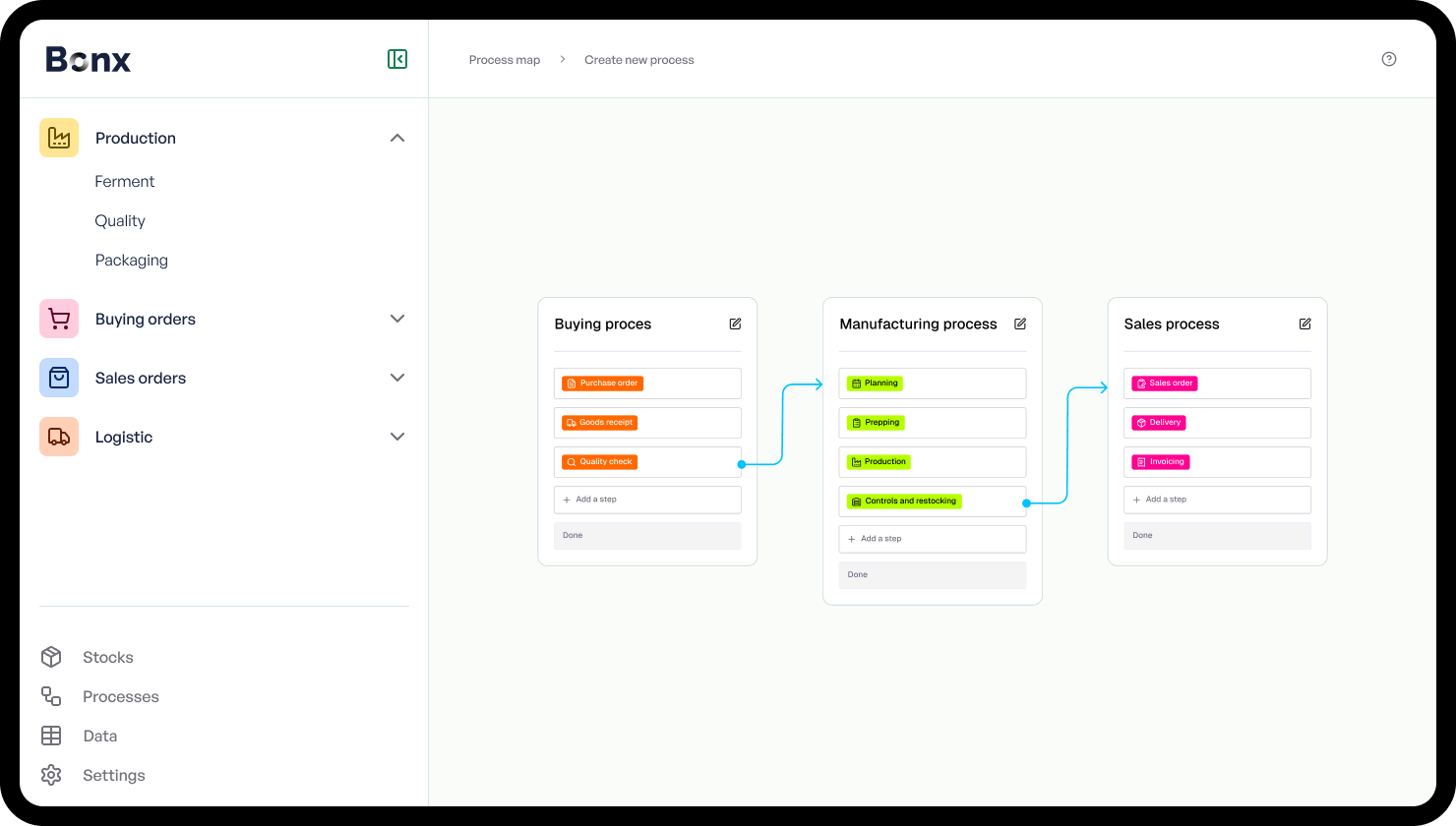







Bonx and Odoo are built for different jobs. If your priority is having a broad business suite with many apps under one vendor, including accounting, HR, inventory, etc., Odoo might be the right choice.
However, if your priority is improving operations (order management, production flow, stock truth, purchasing, planning, quality, traceability, logistics, etc.) with a tool that can integrate across the rest of your stack, deploy quickly, and introduce AI for routine operational work, choose Bonx.


Why manufacturing teams choose Bonx over Odoo
Bonx handles extreme variability
Odoo works best when the process is very standard; when customization is required, it’s possible, but painful. Bonx works just as well with standard process as with custom work, small series, changing demand, unstable supply, and shifting delays.


Bonx excels at driving operational coordination
Manufacturing operations get messy in the coordination layer: exceptions, tradeoffs, handoffs, etc. Bonx brings that operational coordination into one system, where Odoo often still sits alongside Excel and other ancillary workarounds that then need to be reconciled back into the ERP later.
Bonx is built for real-time decision making
Most manufacturing ERPs record past transactions but do not, even with AI features added on top, help people act in real time. At Bonx, we built a manufacturing ERP with AI at its core to help operations decide what happens next with live context across orders, stock, planning, production, quality, and logistics.

Bonx delivers quantifiable value, fast
Bonx is not valuable because it deploys quickly (though it does, in just one to three months); it is valuable because teams see operational work disappear quickly. Less paper, less re-entry, fewer manual checks, higher productivity, stronger traceability, and more orders handled without more coordination overhead.
See Bonx in action
Bring your real order, stock, production, quality, traceability, and finance handoff challenges or questions. We'll show how Bonx can bring 2x-4x team efficiency to your operations with a personalized demo.
FAQ on Bonx vs. Odoo
Bonx is the AI-native manufacturing ERP that fits how you work, and works while you sleep.
Rarely. Odoo can be a good fit for manufacturers that want a broad business suite with manufacturing included. The question is whether the manufacturing app depth and implementation model fit your factory's real operational flow.
Bonx is an AI-native manufacturing ERP focused on the operational core of manufacturing. Odoo is a broad all-in-one business suite. Bonx is the stronger fit when the factory needs operational depth, fast deployment, strong integrations with existing tools, and a system of action that can help move routine work into the ERP.
Sometimes, but not always. If Odoo is being considered as the operational ERP for manufacturing, Bonx can be an alternative. If Odoo already owns accounting, CRM, or other administrative workflows, Bonx serves as the manufacturing operations layer that connects with Odoo.
No. Bonx is not a financial ERP. Bonx owns manufacturing operations and connects operational data to accounting and finance tools when needed. That separation is deliberate: finance needs clean records, while operations needs a system that helps the factory act during the day. For the deeper argument, read why we believe manufacturing ERP and finance ERP should often be separated.
Test the real order flow. Ask each system to show how demand becomes production work, how stock and procurement respond, how operators update progress, how quality blocks affect logistics, how traceability is captured, how finance receives operational data, and what changes after go-live without a consulting project. For the fuller evaluation framework, read Odoo for manufacturing: what to check before choosing.
