AI ERP vs. legacy or traditional ERP: What's actually different, and does it matter?

Every ERP vendor is selling AI right now: legacy suites, mid-market players, niche industry tools. They've all got homepage banners, demo scripts, and conference keynotes about it. Almost none of that tells you whether the software actually does anything different.
The thing that matters is: what happens on a Friday afternoon when a supplier delivery you booked three months ago is going to arrive one month late and lock production if nothing is done about it? Most "AI ERP" demos, watched closely, don't change that moment.
So when a manufacturer asks what's actually different about an AI-native ERP versus a legacy one, the answer has to skip past the marketing layer and into the architecture. Two systems can both claim AI capabilities and share almost nothing structurally underneath.
That gap is what determines whether the implementation takes weeks or years, whether your team is doing the daily work or supervising it, and whether operations costs rise or fall as you scale. If you're choosing a system this year, the gap is worth understanding properly.
At most legacy ERP vendors today, the AI story is some combination of three things, often stacked on top of each other:
These features all have some real use. They're also surface changes that don't touch the system underneath.
The ERP is the rigid, schema-driven system it has always been: every business rule, every workflow, every customer-specific exception modeled in fields that were defined years ago and are painful to change. The AI layer is like a smarter receptionist, but the processes and file systems haven’t changed.
No AI layer, however sophisticated, can compensate for an underlying data model designed before large language models (LLMs) existed and built on the assumption that every customer-specific rule has to be modeled by hand as a custom development project.
If your team's day looks like "check screen, follow instruction, click, repeat," adding a chatbot mostly changes the input method. The actual operational work, the deciding and prioritizing and reconciling and chasing, sits on the same shoulders it always has.
AI-native ERPs are different at the foundation, not in the feature comparison. The real distinction sits in the architecture, which determines what the system can ever become for you. The architectural questions worth asking come down to three things.
A legacy ERP keeps track of everything that already happened: the orders placed, the parts received, the products shipped. The next state — the next sales order to send out, the next purchase order to issue, the next production run to launch — is the human's job to figure out and key in.
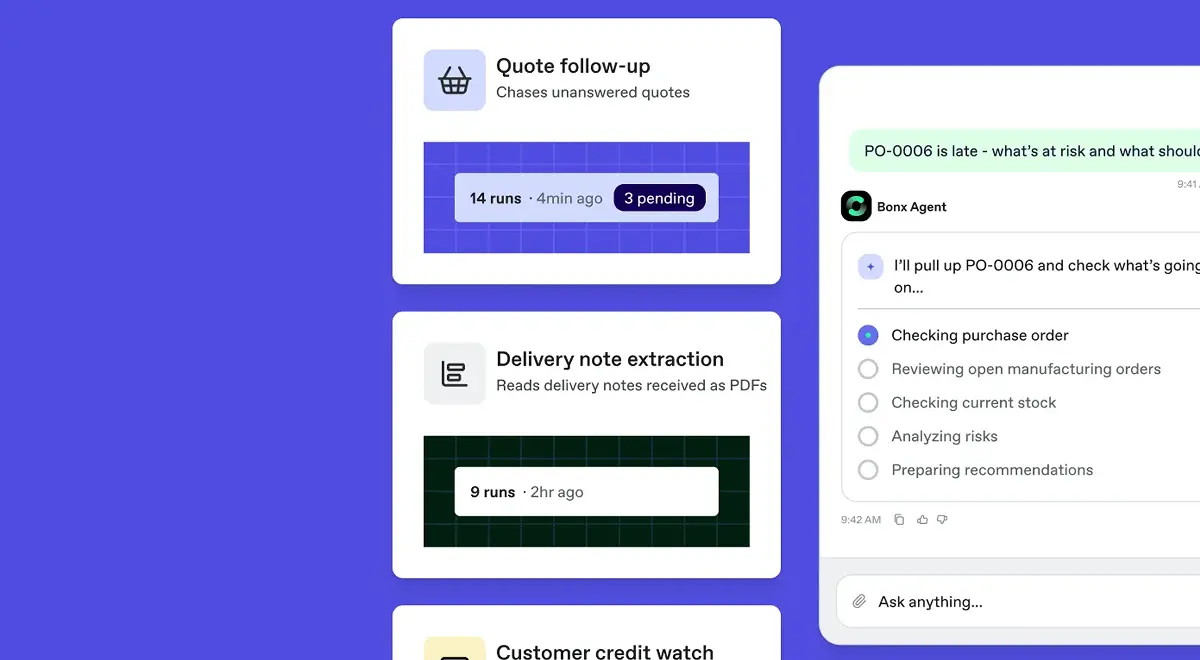
An AI-native ERP keeps the same history, but also prepares the next state and executes it after the human reviews it where it matters:
The team's job shifts from generating the next state to reviewing what the system proposes and stepping in on the exceptions.
You can see this in practice at L'Atelier du Ferment, where Bonx generates manufacturing orders against sales forecasts, shelf life, and cold storage capacity. Because L’Atelier du Ferment produces food products with tight shelf life and cold storage constraints, the planning math could be punishing. But with Bonx, the team is able to approve what comes out and step in when something looks off.
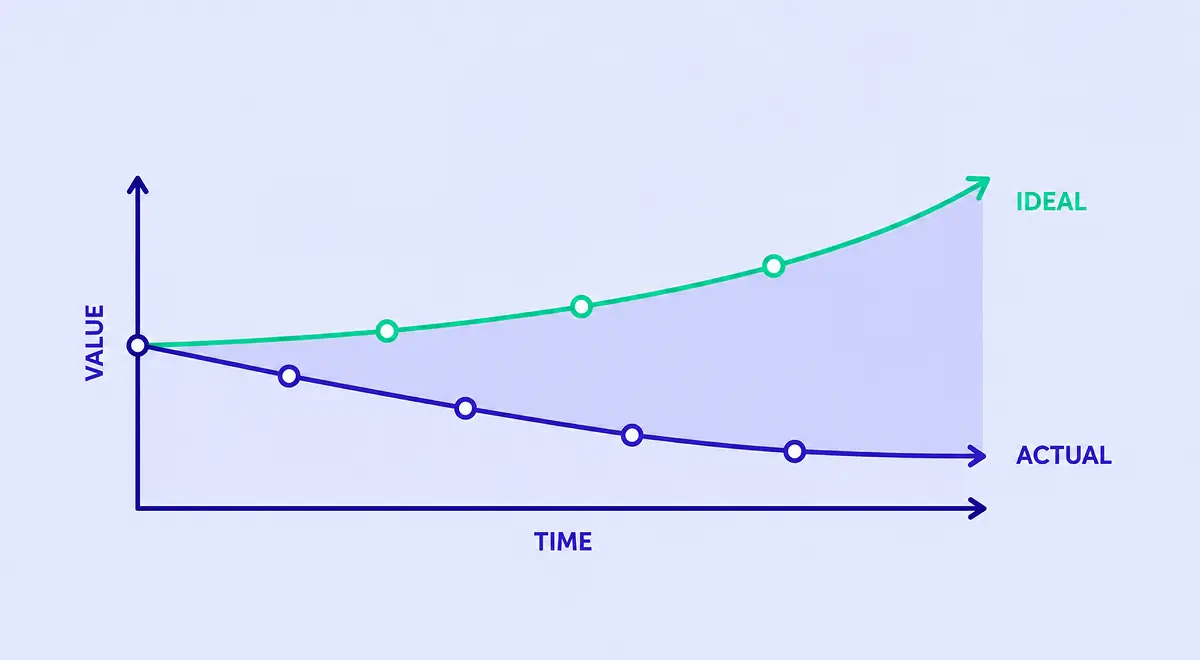
Legacy ERPs demand steadily more work from your team over time. Master data drifts and needs cleaning, processes evolve and need re-documenting, new SKUs need fresh routings configured by hand. The system gets heavier the longer you use it, and the maintenance bill creeps up quietly.
AI-native ERPs go the other way. They learn the patterns of your business, absorb more of the daily routine, and leave your team with the judgment calls:
The gap widens with time. By year three, it's the difference between needing twenty-five people in operations and needing twelve to run the same volume.
Legacy ERPs store everything in predefined data schemas. That works fine for things like stock movements, bills of materials, and traceability, where the schema is broadly universal and pays off in computational rigor.
However, it breaks for the 10–30% of operational data that's customer-specific or fast-changing: pricing rules with regional exceptions, routing logic that depends on which production cell is online, sourcing rules that vary by supplier and material grade. That data either doesn't fit the schema (so it migrates into spreadsheets) or it gets bolted into the schema and locks the system into a shape that's painful to change later.
Bonx specifically solves this problem with a hybrid architecture:
That hybrid is the architectural reason deployments measured in years can collapse to weeks.
For example, fast-growing food brand Feroce went live with Bonx in just 42 days with no operational interruption, a timeline that's structurally impossible for a 100% schema-driven system.
It's also why the system can keep adapting after go-live without consultant projects: most of what a manufacturer wants to change over time lives in the text-based layer, where the internal team can edit a rule the same way they'd edit a document.
The gap between AI-native and legacy architectures matters most for COOs trying to scale operations at growing manufacturers. The mechanics show up in four operational dimensions:
Time to value. The legacy ERP playbook is 12 to 24 months to go live, sometimes longer, with a meaningful share of projects failing outright. AI-native deployments run 4 to 12 weeks. If your business is growing 30% a year, an 18-month implementation means you'll outgrow the original requirements before the system is live.
Operational coverage. Most legacyERPs cover roughly 60% of what a manufacturer actually does. The other 40% lives in spreadsheets, side tools, and the heads of long-tenured staff. AI-native systems absorb more of that long tail because the hybrid schema can hold the customer-specific logic that traditional ERPs forced into Excel. Coverage usually moves above 90%, which means fewer Excel files holding the operation together and fewer places for things to slip through.
Team capacity. When the software handles the routine, the same team runs more business. Two to four times the volume on the same headcount is the structural consequence of moving operational decisions out of human hands and into the software. Operators move into oversight: reviewing batches, approving exceptions, tuning rules. A legacy ERP can't reproduce that effect because it was built around humans being the engine, not the supervisor.
Long-term impact. A legacy ERP will accumulate drift compared to the reality of the company over time. An AI-native ERP that self-heals and self-improves from past executions can stay in sync with the reality of the business.
If none of those three things matter to your business, the AI ERP vs legacy ERP question is a marketing distinction. For everyone else, especially anyone trying to scale operations without scaling headcount in a market that keeps expecting more customization and faster delivery, the distinction is operational and material.
A few questions cut through the marketing in any demo.
Who configures the system during and after go-live? If the answer is "we'll send our team in for a configuration project," you're looking at a legacy ERP. AI-native systems hand the wheel to your internal team.
What does the system actually do on its own? Answers like "it alerts you" and "it suggests" come from systems of record. Systems of action use verbs like "it generates," "it schedules," "it drafts." The work has happened before the human approves it.
How long is the implementation? A proposal quoting 12 to 18 months is selling a 2010-era ERP with a 2026 marketing layer. AI-native systems deploy in weeks because the architecture allows them to. Effort and seniority on the implementation team are downstream of that.
Where do your customer-specific rules live? "In configuration fields the consultants set up" is the rigid-schema answer. "As text the system reads and acts on, and that the team can edit themselves" is the hybrid-schema answer. The first option is what makes traditional ERPs painful to change. The second is what lets AI-native systems evolve as you do.
What's the real operational coverage? Ask the vendor what percentage of your daily operations will actually live inside their system versus in spreadsheets and side tools. Vendors that answer the question honestly are the ones worth evaluating further.
In five years, "AI ERP vs traditional ERP" will sound the way "cloud ERP vs on-prem ERP" sounds now. The category won't really split along that line for much longer.
The split that matters will be between manufacturers running on systems where software does the operational work and manufacturers whose ERP has quietly become scaffolding while the real operations live in spreadsheets and a few well-organized Slack channels. The first group widens its lead every quarter. The second group spends an increasing share of its time reconciling data between systems that should be talking.
For most COOs, the move to AI-native operations is happening eventually. The variable is timing. A planned move now, on a timeline of your own making, with a system built for the architecture, generally goes better than a forced move three years from now, after a couple of important customers have walked over lead times the legacy stack couldn't support.
If you're early in an ERP evaluation and want a clearer view of what the new model looks like in practice, we'd be glad to show you.
The difference between AI ERP and legacy ERP is architectural, not feature-level. A traditional ERP is a system of record: it captures what already happened and waits for humans to enter the next action. An AI-native ERP is a system of action: it prepares and executes the next operational step (manufacturing orders, purchase orders, production schedules) and asks the team to confirm or override. The architectural difference shows up in deployment time, operational coverage, and team capacity.
For most vendors today, more or less. A chatbot interface, a predictive reorder-point module, and a document parser are typical "AI ERP" features that don't change the underlying system. AI-native ERP is structurally different from traditional ERP: hybrid structured and unstructured data, self-service configuration without consultants, and agents that execute work rather than describe it.
Cloud ERP and AI ERP describe different dimensions. Cloud ERP refers to deployment model (hosted vs. on-premise). AI ERP refers to architecture (whether the software acts, or just records). A legacy ERP can run in the cloud and still be a pure system of record. AI-native ERP describes systems built around AI agents and hybrid data architecture, regardless of where they're hosted.
AI-native deployments typically run two to three months. Traditional ERP implementations run 12 to 24 months, sometimes longer, with a meaningful share of projects failing outright. For example, Bonx customer Feroce went live in 42 days with no operational interruption. The architectural reason for the gap: AI-native systems use hybrid data schemas, which require less upfront consultant configuration and more team-led adaptation after go-live.
Bolting AI onto a traditional ERP can deliver short-term wins on narrow use cases, but the rigidity of the underlying schema limits what the AI can ever do. To get the full operational impact of AI ERP — automated execution, hybrid data architecture, self-service configuration — most manufacturers will eventually need to replace the legacy system. The "agentic layer over SAP" approach has a ceiling.
Mid-market manufacturers (typically 20–200 people) trying to scale operations without scaling headcount see the largest benefit. The impact is highest for companies with high product variability, frequent process changes, or operational complexity that traditional ERPs force into spreadsheets. We see this most often in food manufacturing, custom industrial products, jewelry, and additive manufacturing.

Contact us
So were we. That's why we built Bonx, the AI-native manufacturing ERP.