How to choose between generic ERP and jewelry-specific software
When the time comes to move off of spreadsheets, paper processes, or an old system, jewelry manufacturers often must choose between a few main software categories:
Assuming you’re looking for software that specifically addresses manufacturing and operational challenges, which path is the best fit for you is highly dependent on how your business works. In other words, how orders are created, how metals move by weight, how stones are reserved, how workshop time is planned, how suppliers and subcontractors are involved, etc.
This article breaks down a few examples of jewelry ERP decisions as well as the strengths and drawbacks of each type of system.
Generic or legacy ERP is usually strongest where business processes are standardized: financial control, purchasing, high-level inventory, sales orders, reporting, and administrative workflows. But when it comes to operational detail between order confirmation and delivery, generic or legacy ERP can struggle to fit the specificities of the jewelry industry.
For example, one custom jewelry workshop Bonx spoke with had already tried to explore a generic ERP route. The company needed to move beyond Excel because it was growing quickly and planning to triple headcount over the next few years. It was all made-to-order work, with its own brand on one side and subcontracting for larger jewelry houses on the other.
Among other requirements, the workshop needed:
These specific and detailed requirements are a far cry from "can the ERP manage production orders?" The workshop did not need a broad administrative ERP first. It needed an operational system that could represent jewelry production at the level of weight, time, workstation, subcontracting, and traceability.
The same workshop had looked at Odoo and found that it could not get precise enough for the way the business worked (get an in-depth comparison on how Bonx and Odoo stack up).
Ultimately, generic ERP can be a good fit if the jewelry operation is relatively simple, or if the main project and pain points revolve around finance, purchasing, or centralized reporting. But when the real pressure is workshop execution, metal accountability, custom order detail, and production visibility, generic systems can’t get specific enough.
Jewelry-specific software solves a real problem, which is that generic ERPs often do not understand jewelry well enough. But "jewelry-specific" does not automatically mean "specific to your jewelry business."
The jewelry category is too varied for one vertical template to fit everyone. Bridal, fine jewelry, watches, repairs, made-to-order, small series, stone trading, multi-boutique retail, supplier-led production, and workshop-led brands all run differently. A system can use the right vocabulary and still be too rigid for the workflows, sales channels, integrations, approval steps, or workshop habits of your business.
Bonx has seen this in real jewelry evaluations. For example, one growing custom workshop had considered a jewelry-specific tool used in the sector, but rejected it because it felt expensive, difficult to adapt independently, and too dependent on vendor support for changes. The team did not want to call a provider every time it needed to adjust a workflow, add a field, or evolve the way production was tracked.
That autonomy was crucial because the company was still growing into its operating model. It needed a system precise enough for jewelry, but flexible enough to change with the business.
Amantys, a custom jewelry house in Paris, reached a similar conclusion from a different angle. The team evaluated both all-in-one generic ERPs and sector-specific jewelry solutions before choosing Bonx.
The jewelry-specific options were not flexible enough for the way Amantys worked: interfaces were too rigid, processes were too standardized, integrations were limited, and customization was weak. On the other hand, the generic ERP options required heavy configuration for almost everything, yet still did not properly cover jewelry-specific requirements, such as the police register.
That is the trap: generic ERP can be too broad, while vertical software can be too narrow.
A generic ERP may answer yes to inventory and production, then struggle with the jewelry-specific detail. A jewelry-specific tool may answer yes to jewelry, then struggle when the business does not follow its standard template.
AI-native manufacturing ERP is not a generic finance ERP trying to stretch into jewelry. It is also not a rigid jewelry template that assumes every workshop works the same way. It can handle the specificities of jewelry operations by adapting to each company's real workflow, both by virtue of being specialized in manufacturing operations as well as bringing AI-native technology.
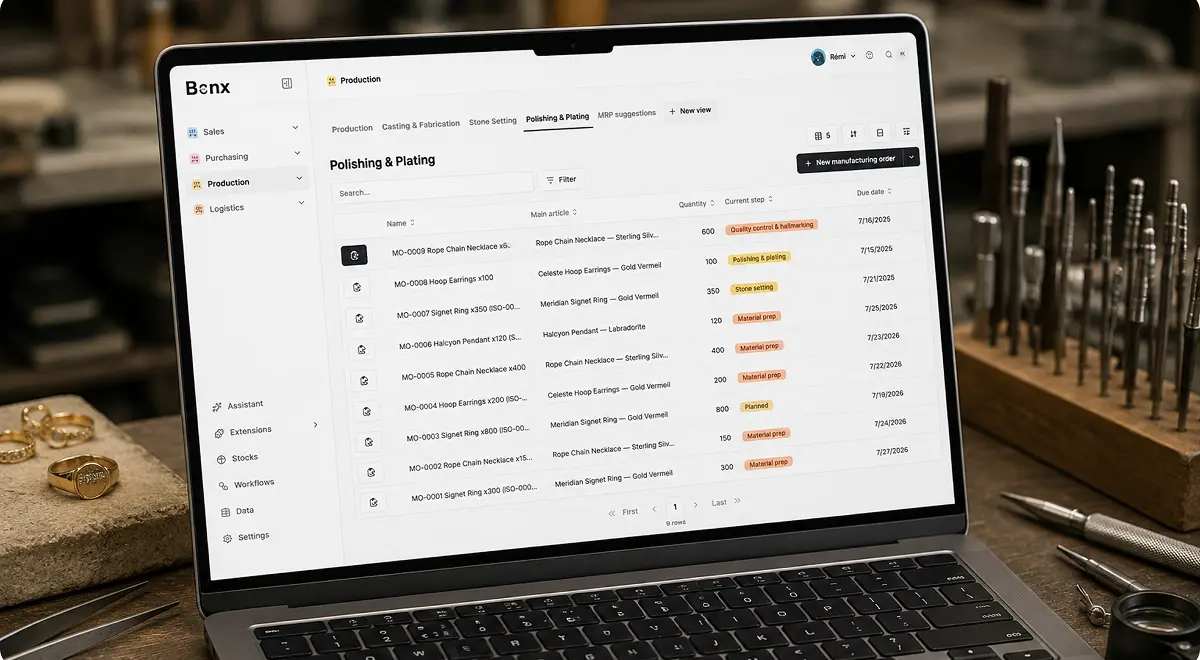
Bonx is the AI-native manufacturing ERP for jewelry manufactuers that connects order management, inventory, purchasing, planning, production, quality, traceability, and logistics in one operational flow. It also connects to the tools already in the stack, including e-commerce, customer relationship management (CRM), and accounting tools.
The goal of Bonx is not to replace every tool but to create a reliable operational backbone that connects to the tools already doing their job. For example, sales may already work in HubSpot, Shopify, a boutique point-of-sale tool, WordPress, email, or a shared inbox. Finance may work in Pennylane, Fatture in Cloud, an accountant's system, or another invoicing tool. Design files may live in Dropbox.
We believe that the best system is not the one with the broadest module list or the most jewelry vocabulary. It is the one that can keep your actual production work visible, traceable, and adaptable as the business grows.
Here are the patterns Bonx has seen across jewelry companies evaluating ERP.
Amantys is a Parisian custom jewelry house founded by two former Place Vendôme designers. The company creates engagement and wedding jewelry, with a high-touch customer experience and a production model where every order is different.
Before Bonx, production tracking depended on Google Sheets, Dropbox, shared calendars, and a repurposed invoicing tool. That worked while the business was smaller, but it became fragile as Amantys opened a second boutique in Bordeaux and had to coordinate two commercial teams with one workshop.
The requirements were specific:
Bonx became the operational layer between HubSpot, the workshop, and Pennylane. Each custom order now creates a complete manufacturing record with metal, diamond, technical characteristics, workshop instructions, and deadlines. Sales, production, and accounting stay synchronized with zero manual data re-entry between HubSpot, Bonx, and Pennylane.
Amantys did not need a generic ERP to take over the whole company. It also did not need a rigid jewelry template. It needed a production-centered system that understood jewelry and connected cleanly to the existing stack.
In another jewelry project, the company was replacing an older jewelry/POS setup built around ODEIS. The goal was not simply to add another ERP. It was to remove an inefficient legacy stack, move point of sale toward Shopify POS, and make production and stock workflows less dependent on one person knowing how everything worked.
The breaking point was operational, as inefficiencies became obvious when the logistics lead was away. That is a familiar ERP trigger: the old system looks acceptable until the person holding the process together is unavailable.
The learning in this use case was that legacy vertical tools often do cover part of the jewelry workflow. The problem is that they may not connect cleanly to the newer stack the business wants to use, such as Shopify, modern reporting, or a more flexible production model.
For those companies, the ERP decision is not "jewelry-specific or not?" It is "can the system connect the old-world jewelry requirements with the modern stack we are actually building?"
Not every jewelry company needs heavy serial tracking or complex stone allocation. One design-led jewelry brand Bonx spoke with had a much lighter production model: roughly 470 stock-keeping units (SKUs), four collections per year, around 15 SKUs per collection, no lot tracking, no serial numbers, and a flat bill of materials. On paper, that sounds simpler than high-jewelry custom production.
Yet the operational challenge was still very real. All orders flowed through Shopify across e-commerce, retail point of sale, and wholesale. Stock was split between a central studio, a store, items reserved for wholesale orders, and semi-finished goods held by suppliers. Supplier receipts did not always match purchase orders. Partial deliveries and backorders made native Shopify workflows too clumsy. Invoicing in Fatture in Cloud was still manual, line by line, with currencies, delivery documents, and partner commissions to reconcile.
That is a perfect example of why jewelry-specific labels are not enough. This business did not need the same feature checklist as a custom bridal house or Place Vendôme subcontractor. It needed flexible stock ownership, Shopify integration, supplier visibility, purchase workflows, and dashboards that matched its actual model.
The right ERP fit was not determined by the word "jewelry." It was determined by the workflow.
Bonx has also seen jewelry manufacturers moving from older local management systems into a more operational ERP model.
In one Italian atelier, the prior system was inexpensive and familiar, but the operational questions had become more ambitious: they wanted real-time weighing, metal loss monitoring, time tracking by barcode, workshop execution, invoicing handoffs, and business intelligence. The team needed more than a static management system. It needed proof that the software could turn workshop activity into usable operational data.
That case also shows the hard truth of ERP adoption. A flexible system is not valuable just because it exists. The process has to be followed, operators have to capture the right data, managers have to use it. The value comes when the ERP becomes the way work moves, not a reporting layer updated after the fact.
The best choice depends less on the category and more on the operating model.
Choose a generic ERP if the main need is broad administrative structure, finance-led reporting, purchasing control, and relatively standard inventory or production workflows. Generic ERP may also make sense if the business wants to replace a large part of the back office at once and is prepared for the implementation scope that comes with it.
Choose jewelry-specific software if the tool's assumptions match the way the business already works. That can be a good fit for companies with stable workflows, limited integrations, and requirements that sit neatly inside the vertical tool's standard model.
Choose a flexible manufacturing ERP if the business needs jewelry-specific operational depth but does not want to be trapped in one vertical template. That is usually the case when the company has custom orders, precious material tracking, workshop planning, supplier or subcontractor complexity, multiple sales channels, existing CRM or accounting tools, and processes that will keep evolving after go-live.
What jewelry production needs from their software is not a bigger system for the sake of it, and not a vertical label for comfort. It needs a system precise enough for jewelry, flexible enough for the business, and connected enough that sales, production, and finance stop rebuilding the same truth in separate tools.

Contact us
So were we. That's why we built Bonx, the AI-native manufacturing ERP.