Buy vs. build your manufacturing ERP
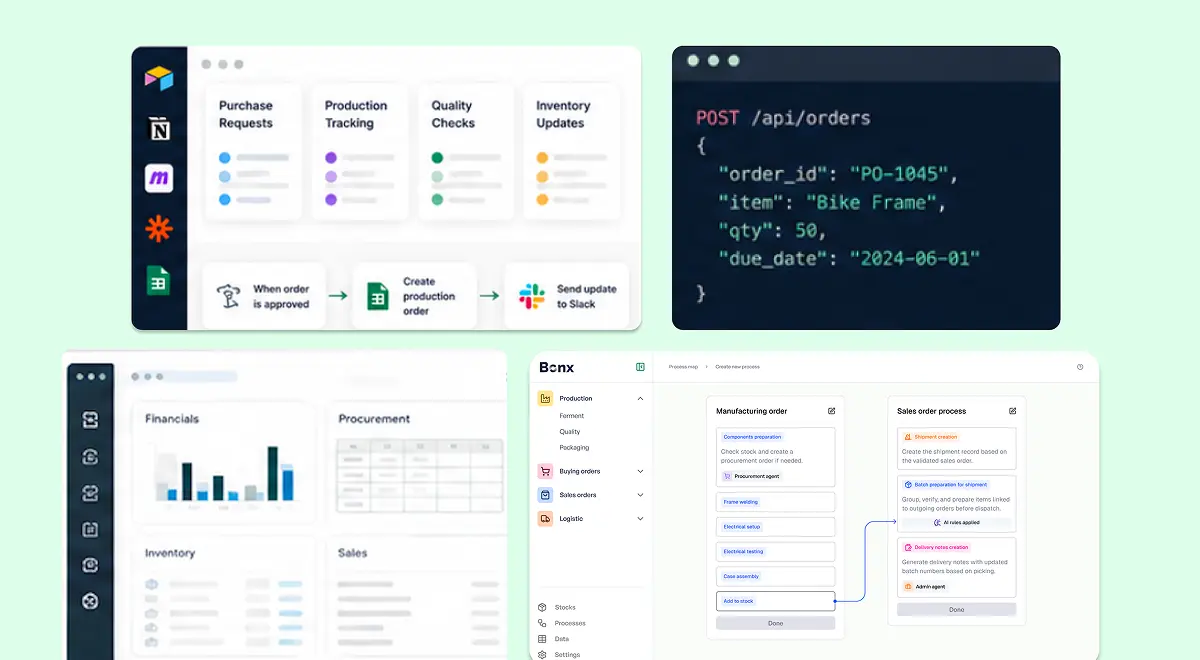
Manufacturers have never had more options for how to run their operations. Spreadsheets have become more powerful, AI coding tools make custom software feel accessible to teams that would never have considered building an ERP two years ago, and there are more options for buying an ERP off the shelf than ever before.
That changes the enterprise resource planning (ERP) conversation. This article compares three paths for industrial small and midsize enterprises: build, buy, and hybrid. For each one, it looks at what the option can mean in practice, when it makes sense, when it starts to create risk, and how to decide which system should own operational truth.
Build does not only mean vibe coding a full ERP from scratch. For most manufacturers, "build" includes every internal system the team creates or assembles to make operations work better.
That can be a spreadsheet, a no-code workflow, an internal app, a set of automations, a custom integration, or a full AI-assisted software project. It is worth unpacking each option separately because they do not carry the same risk.

Spreadsheets are often the first system that actually fits the operation. They are fast to change, easy to understand, and close to the people doing the work. When volume is manageable and a few experienced people can still keep the whole picture in their heads, a spreadsheet can be the right tool.
That is why spreadsheet-based operations can last longer than ERP vendors like to admit. They give teams room to adapt before the company is ready to formalize every flow.
The threshold comes later, when the spreadsheet stops supporting one decision and starts carrying operational truth. More people, products, customers, stock locations, quality rules, and handoffs enter the business; the workbook gets massive, fragile, and hard to change without breaking something. That is a signal for change: the spreadsheet is no longer helping the operation move faster, but rather becoming part of the work the operation has to carry.
No-code and low-code tools for building workflows and automated processes, including Airtable, Notion, Make or Zapier, AppSheet, Glide, Retool, etc., can be a strong next step. They bring more order and automation than spreadsheets alone, without the full overhead of an ERP project.
For focused use cases, low-code and no-code tools can be exactly right. Examples include a standardized quality checklist or process, supplier onboarding flows, maintenance logs, a prototype for a new planning method, or a centralized dashboard to monitor key performance indicators (KPIs).
No-code tools are excellent when the problem is bounded. They become risky when the company asks them to become the operating backbone for purchasing, inventory, planning, production, quality, traceability, and logistics.
At that point, the questions get heavier. Which system owns stock? Which system owns quality status? Which system decides whether an order can ship? What happens when two tools disagree? Who maintains the workflow when products, sites, routing logic, or customer requirements change?
AI coding tools, including Claude Code and OpenAI Codex, among many others, shrink the distance between ideas and working software, making build-from-scratch feel newly possible.
Compared with a vendor demo built around generic examples, a vibe-coded prototype can feel immediately relevant to your business and make coding your own ERP feel like the obvious next step.
That is real progress, but an impressive v1 is not the same as a system reliable enough to run the business. Getting to something that works end to end takes considerably more time: testing edge cases, hardening integrations, managing permissions, documenting logic, monitoring failures, and keeping the system useful as operations change.
The visible parts of an ERP are not the hardest parts to own. Products, purchase orders, manufacturing orders, inventory movements, and dashboards are only the beginning. The hard work in building an ERP from scratch is making sure the system behaves correctly when the factory is moving, including handling:
Build makes sense when the business is still small enough for a lightweight system to work, or when the problem is specific, bounded, and tied to something that makes the company different, such as how it prices, plans capacity, or serves a particular customer segment.
That might mean a quoting helper that reflects how your sales team prices custom work, a production dashboard for a specific workshop, a small automation that removes repeated data cleanup, or a prototype for a new planning method. In each case, the tool improves a focused part of the operation without becoming the system every team depends on.
The best internal builds usually share a few traits:
Build starts to strain when the tool moves from helping one team make a better decision to owning truth across the business.
Before committing to build, pressure-test the situations that make manufacturing difficult in the first place: late materials, blocked batches, supplier changes, customer-specific labeling, volume-based routings, subcontractor capacity, and traceability requirements. Build can be viable if the system handles those cases without workarounds or having to call the person who built the system to handle it.
There is also an external reality many growing manufacturers underestimate: customers, auditors, and certification bodies may eventually ask to see the system behind the operation. A large customer may require lot traceability before renewing a contract. ISO 13485, FDA, AS9100, or a major buyer's vendor qualification process can turn "we know how it works internally" into "show us the records, controls, and traceability." Any internal system, whether it's in spreadsheets or vibe coded from scratch, still has to stand up to that conversation.
When it comes to building your own operational system, the bottom line is this: does the company want to be responsible for the roadmap, testing, monitoring, permissions, support, and long-term reliability of the system the factory relies on every day?
There are more options than ever for buying an ERP, and they cover different needs. A manufacturer can choose a legacy all-in-one suite, a sector-specific tool, or an AI-native manufacturing ERP that covers just the operational core and brings the possibility of action and automation.
The question is whether the system understands enough of manufacturing to carry daily operations without turning every normal change into a project.

The legacy all-in-one ERP promise is familiar: one vendor, one system, one source of truth for the whole company.
That can be useful when the business needs a broad administrative backbone, especially around finance, controls, reporting, and standardized processes. The problem is that manufacturing operations often need more movement than the all-in-one model handles well.
Production changes, supplier constraints move, customer requirements vary, and quality can block stock; operators need a system that works during the shift, not a reporting tool they update after the work is done.
If an all-in-one ERP is strong in finance but weak in planning, production, quality, traceability, or shop floor capture, the factory pays for that weakness every day. The system may be bought, but the team still ends up building around it. This is why manufacturers should be careful about turning a factory software project into a finance-led all-in-one ERP decision; the split between operational ERP and finance ERP is covered in more detail in Manufacturing ERP vs. finance ERP: why separate them.
Sector-specific ERP can be a good fit when the company needs depth around a particular industry constraint, such as food traceability, textile customization, cosmetics compliance, or medical device quality management.
The tradeoff is that sector depth can come with narrower flexibility. A vertical tool may handle one industry pattern well but struggle when the company adds new channels, new production models, subcontracting, or workflows that do not match the software's assumptions.
An AI-native manufacturing ERP is not just a manufacturing ERP with an AI interface on top. The difference is that the system is built to act on operational data, not only store it.
That means the ERP should connect orders, inventory, purchasing, planning, production, quality, traceability, and logistics in one operational flow, then help move work forward under human oversight. It can prepare procurement suggestions when demand and stock create a shortage, generate manufacturing orders from sales and capacity, prioritize work when constraints change, or surface exceptions before they become another manual check.
The company configures the system around how the business works, connects it to the tools already in the stack, and adapts it after go-live. The difference is that the company is buying an operational system that already has manufacturing depth and an action layer, instead of starting from a blank page or a generic platform that needs heavy custom development before it can carry the factory.
This path makes sense when stock accuracy, production status, batch traceability, quality blocks, supplier delays, or order handoffs are already creating manual work. At that point, the company probably needs more than another internal layer.
Though “adaptive ERP” isn’t really a category in and of itself (for example, legacy, sector-specific and AI-native ERPs could all, in theory, be adaptive), it’s worth calling out as a clarification point. Because though most ERPs can be adapted to some extent, there are vast differences to what it actually takes to successfully customize the system.
For example, if you need to write code to change an ERP, even if you use AI-assisted coding (e.g., Claude Code or similar), you still need to:
Bottom line: Code is a very tiny fraction of the work required to adapt an ERP. So if your ERP requires code to be adapted, it’s not actually adaptable, it’s just software. At that point, you’re doing IT projects, not managing a manufacturing company. That might be fine for companies that have an IT department, but it’s increasingly rare for SMB/SME manufacturers. And it’s important, if you don’t have an IT department but decide to take on this work, to understand what you’re getting into.
Buying is usually the stronger path when the company needs a shared operational system that can handle core manufacturing workflows, connect with surrounding tools, keep adapting after go-live, and reduce the amount of routine coordination the team has to carry manually. If you are still deciding whether the timing is right, the six signs you need a new ERP or your first ERP are a useful starting point.
Buying software does not automatically fix operations, though. A bought ERP can still be too rigid, too finance-centered, too slow to change, too weak on integrations, or too awkward for operators to use during the shift.
The test is practical: can the system run the real order flow from demand to purchasing, stock, production, quality, logistics, and finance handoff? Can operators use it while work is happening? Can the team change processes after go-live without starting a new consulting project? Can it connect to the tools that already work instead of forcing a full-stack rebuild? If not, buying only changes where the workaround starts.
For many growing manufacturers, the right answer is not pure build or pure buy. It is a hybrid operating model with a clear center.
The company buys the system that should own operational truth, then keeps building or modifying tools around it where the work is specific, experimental, or differentiating.
This is often the healthiest model.
The manufacturing ERP owns orders, inventory, purchasing, planning, production, quality, traceability, logistics, permissions, and operational events. Internal tools support the edges: a custom sales calculator, a customer-specific dashboard, a planning experiment, a data view for management, or a workflow that helps one team move faster.
The test is whether the edge tool can disappear without breaking operational truth. If it can, build freely. If it cannot, it probably belongs closer to the ERP core.
Buy-and-modify can be the right middle path when the platform already covers most of the operational core and the custom layer improves fit around the edges (see the note in the “BONUS: Adaptive ERP” section for additional context).
Broad configurable platforms also belong in this category. Tools like Odoo can give a manufacturer modules, users, documentation, a partner ecosystem, and a lower entry point than a heavy legacy ERP. With the right scope, they can be a practical way to get structure without starting from a blank page.
It becomes risky when the custom layer has to carry the manufacturing depth the platform does not provide: planning rules, stock logic, traceability, quality workflows, subcontracting, shop floor capture, and the integrations that keep the factory connected.
The test is simple: if the platform disappeared behind your custom layer, would you still trust the underlying system to run the factory? If the answer is no, the company is probably closer to build than buy.
AI coding tools are excellent for prototyping operational ideas. A team can test a new planning view, automate a manual check, build a small internal app, or simulate a workflow before committing to a larger system change.
That can make the eventual ERP project better because the team understands what it needs with more precision. The risk is letting prototypes become permanent infrastructure without making that decision deliberately.
The line is simple: prototype when you are learning; formalize when the business starts depending on the result.
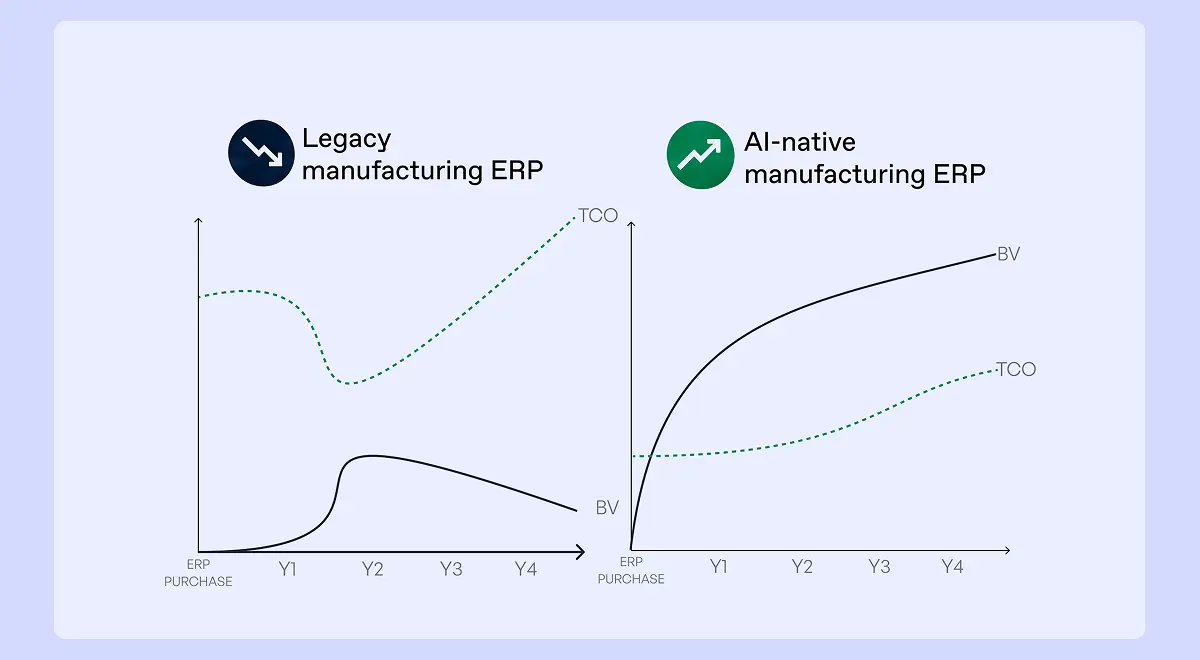
The build case often looks attractive because the vendor quote is easy to see, while internal cost is harder to quantify.
Licenses, implementation fees, partner costs, and subscription pricing show up as line items. Internal work shows up as workshops, testing, bug reports, support questions, undocumented fixes, and the hours your best operations people spend maintaining a system that the business now depends on.
That comparison misses the rarest resource in an industrial SME: the attention of the people who understand how the business works.
To build or heavily modify an ERP, your best operations people become part of the product team. They define flows, test exceptions, validate data, train users, prioritize requests, answer questions, and decide what happens when the system and the factory disagree.
That time comes out of production planning, supplier follow-up, process improvement, hiring, training, quality work, customer promises, and the small decisions that keep the company moving.
For a 20-person manufacturer growing 50% a year, that cost is brutal. For an 80-person manufacturer trying to professionalize operations before the next stage of scale, it is just as risky. The company needs its best people improving the business, not becoming the permanent maintenance team for basic ERP foundations that should already exist.
Bonx is an AI-native manufacturing ERP and a system of action. It works well for manufacturing SMEs that want the speed and adaptability people associate with internal tools, without asking the operations team to become an ERP vendor.
Bonx covers the operational core of manufacturing: order management, inventory, purchasing and supplier management, planning, production, quality, traceability, and logistics. The Bonx integration engine connects with the tools already in the stack, including CRM, e-commerce, accounting, warehouse management, third-party logistics, machines, and custom systems, so the project does not have to become a full-stack rebuild.
At Bonx, we don't think manufacturers should have to choose between rigid software and building everything themselves. Bonx gives teams a manufacturing operating system that can adapt after go-live, while keeping the core flows reliable enough for real production work. Its AI agents can act on routine operational work under human supervision, and its integration engine connects with systems that have APIs so technical teams can extend the operating stack without owning the whole ERP roadmap themselves.
Customer rollouts show what that looks like in practice.
Additive manufacturer Something Added deployed Bonx in two months with a native integration to HP 3D printers, then used it to automate order grouping, manufacturing order generation, and machine assignment rules while supporting 24/7 production and more than 10,000 parts per month.
Food manufacturer L'Atelier du Ferment connected Bonx to Sidely and Pennylane while supporting full batch traceability across more than 100,000 bottles. Bonx helps generate manufacturing orders and procurement suggestions based on sales, shelf life, and cold storage capacity, while keeping sales, production, and finance aligned.
Feroce went live with Bonx in 42 days without interrupting operations, then handled a tenfold order surge in a single day with no break in traceability and 10x cold storage capacity management with no loss of visibility.
That is the standard manufacturers should expect from the buy path: not a rigid ERP that forces the company into someone else's process, and not a blank canvas the team has to maintain forever. A system that carries the operational core, connects to the tools that already work, keeps changing as the business changes, and acts on routine operational work instead of only recording what humans already did.
Build is not wrong, buy is not automatically mature, and hybrid is not a shortcut unless ownership is clear. The better decision is to match each layer of the operating system to the amount of risk, change, and responsibility it carries.
Build the tools that sharpen your advantage. Use spreadsheets, no-code tools, and AI coding tools where the scope is clear, the consequences are contained, and the team can replace the tool without stopping the business.
Modify a platform when its core already fits and the changes are truly around the edges. Buy a manufacturing ERP when the system has to own operational truth across purchasing, inventory, planning, production, quality, traceability, logistics, and the tools around them.
The danger is not that your team cannot build something impressive. It probably can. The danger is that a clever internal system becomes the thing your best operations people have to carry, exactly when the business needs them focused on scale.

Contact us
So were we. That's why we built Bonx, the AI-native manufacturing ERP.