Jewelry manufacturing software for custom production
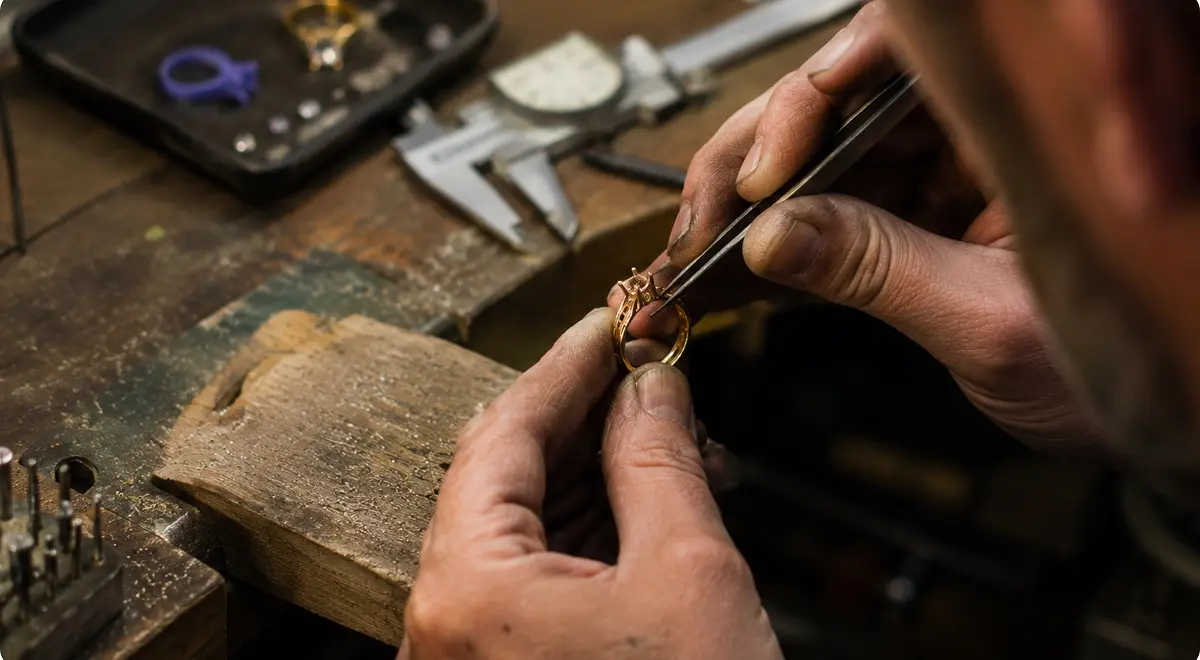
Most generic ERPs say they work for jewelry manufacturing. Yet jewelry production, and in particular custom production, has edge cases most ERPs ignore, like precious metal traceability by weight, stone-to-setting matching, bespoke order management, hallmarking, and more.
A modern jewelry ERP should help your business move faster and scale, not slow you down or make things harder. If you have an ERP but metal usage is corrected after the fact, stone allocation lives in a side file, and the workshop still has to explain order status to sales, the real workflow is sitting outside the system, not in the ERP.
An ERP does not have to make the workshop rigid. It has to make the right details visible at the right moment: before a material is consumed, before a stone is assigned twice, before a promised delivery date slips, and before someone has to rebuild traceability from memory.
Precious metals need a different inventory model from standard components. Weight, purity, batch, supplier, purchase value, transformation stage, and recoverable scrap can all matter.
The same metal can move through several operational states: received, reserved, melted, consumed, lost through normal production variance, returned, or recovered as scrap. If the ERP only sees "material in" and "material out," the team still has to explain what happened between those two points.
For jewelry manufacturers, a strong system should help answer questions like:
The issue reaches beyond compliance. It affects margin, purchasing, quoting, and trust in inventory. When small weight differences carry real value, the system has to make those differences visible.
Stone tracking creates a different kind of pressure. Some stones can be managed by parcel, while others need individual control because size, cut, clarity, color, certification, origin, customer preference, or setting fit matters.
The ERP has to know more than how many stones exist in stock. It has to know what is available, what is reserved, what is assigned to a specific piece, what has been substituted, and what has already moved into production.
This is where many general manufacturing systems feel clumsy. They treat the component as available until it is consumed, but jewelry teams often need the reservation earlier. Once a customer has chosen a stone, or once a stone has been matched to a setting, the business needs that allocation to hold across sales, purchasing, inventory, and workshop planning.
If the system cannot carry that commitment, people create their own controls. They add notes, color-code spreadsheets, message the workshop, or mark physical trays. Those workarounds are understandable, but they become risky as order volume grows or several sites depend on the same workshop.
Bespoke jewelry rarely follows a perfect template from quote to delivery. Specifications change, design approvals take time, a CAD file may need revision, the customer may select a different stone, the workshop may add a technical note that changes timing or routing, the list goes on.
A rigid ERP treats that movement as an exception, where a jewelry-ready ERP treats it as a normal part of the system.
At the end of the day, your ERP needs to carry order-specific detail without forcing the team to rebuild the process every time. That includes metal, stone, design files, technical characteristics, workshop instructions, deadlines, approvals, and customer-facing status.
Custom jewelry house Amantys is a perfect example. Before Bonx, production tracking depended on Google Sheets, Dropbox, shared calendars, and a repurposed invoicing tool. Today with Bonx, each custom order creates a complete work order with metal, diamond, technical characteristics, workshop instructions, and deadlines, so the team can coordinate bespoke production across two boutiques and one workshop.
Jewelry production often depends on steps that do not look like standard assembly. Hallmarking, engraving, polishing, quality control, certification, repairs, subcontracted finishing, and final presentation can all decide whether a piece is ready to deliver.
Those steps are easy to under-model in ERP because they may sit between production, quality, subcontracting, and customer service. The team still manages them, but the system may only see a few broad statuses: in progress, done, shipped.
That is not enough when a customer is waiting, a boutique needs a reliable status, or the business has to prove the movement of precious material.
For Amantys, Bonx supports the structured police register required for jewelry traceability while keeping sales, workshop, and accounting synchronized around the same order. The result is zero data re-entry between HubSpot, the workshop, and Pennylane (their accounting tool), with production and traceability no longer rebuilt across separate tools.
Generic all-in-one or legacy ERPs are broad, so the configuration needed to make them feel usable for jewelry often becomes heavy and resource-intensive. At times, they can cover enough of the process to look acceptable, but the hidden cost is that your team has to manually fill in the missing detail.
Someone maintains the real material movement record. Someone knows which stone is actually assigned. Someone updates the customer relationship management (CRM) tool because the ERP status is too vague for sales. Someone prepares the accounting handoff because production data and finance data do not meet cleanly. Someone reconciles stock when the system number and workshop reality diverge. That work becomes the hidden cost of a weak fit.
Jewelry-specific tools can still create the same problem in a different shape. The category is too varied for one vertical template to fit everyone: bridal, fine jewelry, repair, made-to-order, small series, stone trading, watches, multi-boutique retail, and workshop-led brands all run differently. A tool can understand jewelry terminology and still be too rigid for the workflow, sales channels, CRM, finance tool, approval steps, or workshop habits that make your business yours.
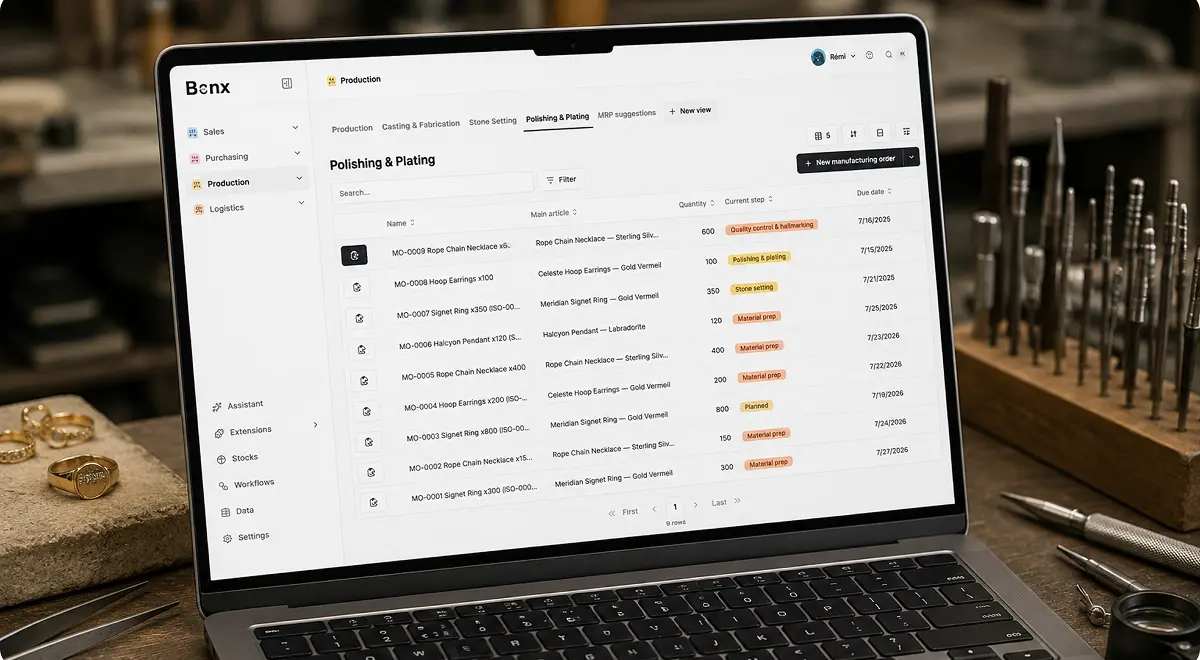
Bonx is an AI-native manufacturing ERP connecting order management, inventory, purchasing, planning, production, quality, traceability, and internal logistics in one operational system, while also connecting to the tools already in the stack, like finance, CRM, and more. That means Bonx does not replace every tool around the business. Rather, it gives the manufacturing operation a shared backbone, then syncs the operational data other tools need.
For example, Bonx customer Amantys uses HubSpot for customer relationships and Pennylane for accounting. Bonx connects both to the workshop, with zero manual re-entry between sales, production, and accounting. Each custom order becomes a complete production record, and the team can keep metal traceability, police register requirements, technical details, workshop instructions, and deadlines connected.
That is the difference between "ERP as a database" and ERP as an operating layer. The system is not just storing the final order, it's helping the team move the work through the business.
In addition to its connectivity, jewelry manufacturers choose Bonx for its adaptability. With Bonx, customers get a solid data model and core modules as well as the flexibility to extend the system infinitely to fit the processes that make your business unique. Where legacy ERP asks your business to change to fit, Bonx does the opposite.
Bonx also gives unparalleled intelligence, putting you in control to introduce AI (with humans in the loop) that helps your operations become more efficient over time.
For a closer look at the sector fit, see Bonx for jewelry and watch manufacturing.
Most vendors will say they support inventory, production, traceability, and custom orders. What a demo should show is that the system can handle the complexities and specificities of your business.
Can it:
At the end of the day, jewelry manufacturers shouldn't settle for less than an ERP that adapts to what makes their business unique and one that helps scale, not weigh down, your work.

Contact us
So were we. That's why we built Bonx, the AI-native manufacturing ERP.