Procurement software for manufacturers: the 2026 guide
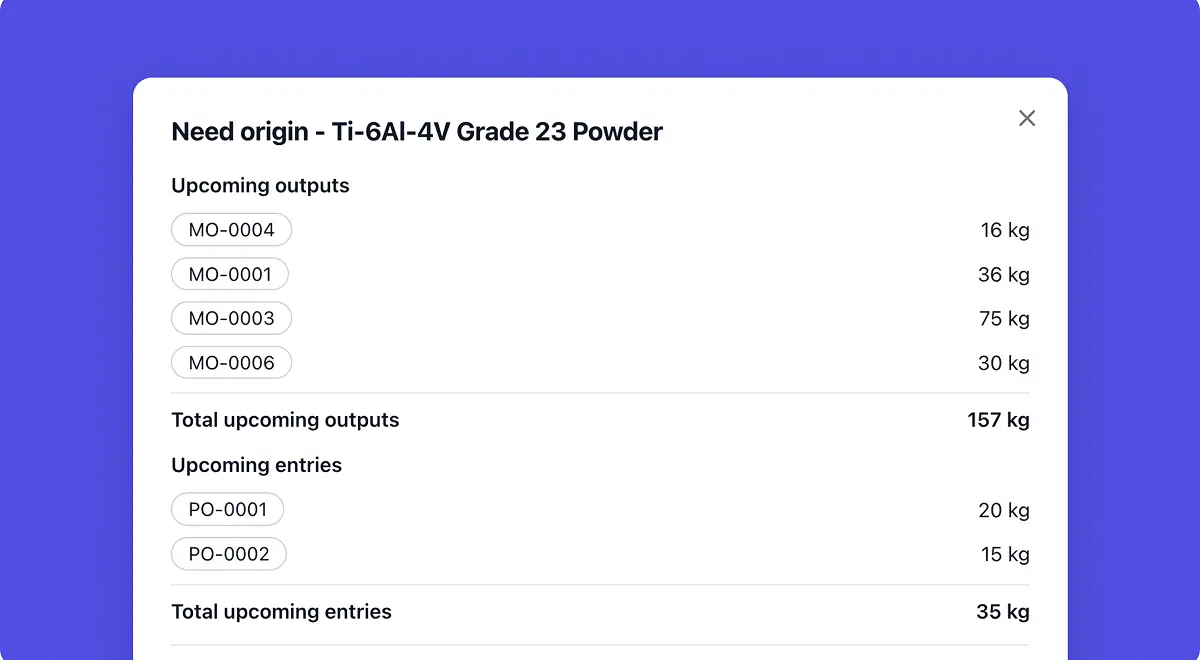
Most procurement software is built for the office, but manufacturing procurement must also be closely intertwined with what’s happening in production. In other words, the biggest challenge is making sure the right raw materials, components, packaging, and subcontracted work arrive before production needs them.
This article goes under the hood on procurement software for manufacturers, including the loop it must close from material requirements planning (MRP) signal to receipt. We’ll also delve into how AI changes procurement for manufacturers today.
Enterprise procurement software is often built around spend control. It helps large companies manage vendor catalogs, approval workflows, contracts, budgets, indirect purchasing, and compliance.
But in manufacturing, procurement is not only about buying at the right price through the right approval chain; it is also about protecting production flow. The buyer needs to know what material is needed, when production will need it, which supplier can deliver, whether stock is actually usable, and what happens downstream if the material arrives late.
Manufacturing procurement software therefore has to stay close to the events that create and change material needs. A purchase need may come from a confirmed customer order, a forecast, a bill of materials (BOM), a production schedule, a safety stock rule, a reorder point, or a supplier delay. It may also change during the day because quality blocks a batch, a customer pulls demand forward, production consumes more material than expected, or a supplier confirms only a partial shipment.
That is the difference between supplier management software as a supplier database and supplier management software as an operating tool. The first stores contacts, terms, and records. The second helps the team understand which supplier, item, purchase order line, production order, and customer promise are exposed.
Procurement software gets tested in the handoffs. A material need has to become a supplier decision, then a purchase order, then a confirmed delivery, then usable stock that planning and production can trust.
This section follows that loop step by step and unpacks the role software plays, where the usual manual work appears, and where AI can help.
In a basic flow, MRP calculates that a material is short. The buyer then checks the surrounding context manually: current stock, open purchase orders, reservations, blocked stock, supplier lead time, production timing, and the urgency of the shortage.
This is the first part of the procurement and purchasing loop where AI should come into play. The system should not only say, “buy this.” It should automatically explain what triggered the need, how much usable stock exists, when the shortage will affect production, and what action it recommends.
At L’Atelier du Ferment, where Bonx connected production planning, batch traceability, Sidely, and Pennylane, purchasing is tied to sales demand, shelf life, and cold storage capacity. Bonx helps the team generate manufacturing orders and procurement suggestions from those constraints while tracking more than 100,000 bottles from fermentation to cold storage.
That is the difference between a purchasing alert and a procurement decision the buyer can actually trust because it is not isolated from the operation but rather fully connected to sales, production, inventory, shelf life, and storage constraints.
Once the need is clear, the buyer has to decide how to source it. If you’re lucky, that’s as simple as choosing the default supplier. But more often than not, one supplier may be cheaper but slower, another may deliver faster but require a higher minimum order quantity. Or a third may look good in the master data but have missed the last three confirmed dates, complicating the sourcing picture.
In many manufacturers, that context lives in buyer memory, emails, spreadsheets, and supplier habits that are not officially documented in the system. AI can therefore help not by replacing supplier judgment, but by helping compare options at scale (with all their qualitative nuance) against the actual material need as well as proactively raising flags.
For example, if the production run starts in 12 days and the default supplier usually takes 21, the system should make that conflict visible and ideally suggest an alternative. If a supplier has a higher price but can ensure a customer promise or deadline is met, the buyer should see that tradeoff. If price or availability is unknown, the system can help draft a request for quote (RFQ) using the item, quantity, required date, and production context behind the need.
For food manufacturers like L’Atelier du Ferment, this kind of context is not optional. Shelf life, cold storage, raw materials, packaging, and production timing all affect whether a supplier choice is actually workable. A generic procurement tool may compare vendors, but manufacturing procurement software has to compare suppliers against production reality.
After the buyer chooses the action, the system should not make them rebuild the purchase order line by line. The item, quantity, supplier, destination, expected date, production need, and approval context already exist somewhere in the system. Therefore, an AI-assisted procurement system should use that context to prepare the purchase order, group needs where it makes sense, apply supplier rules, and route exceptions to the buyer.
This distinction is important: routine purchasing can be prepared or performed under approved rules, but risky purchasing still needs human judgment. A buyer may need to split the order, change supplier, delay a quantity, approve a higher price, or reject the suggestion because cash, quality, or customer priority changes the decision.
This is the operating model Bonx supports in production at Something Added, where Bonx deployed in two months with a native HP 3D printer integration. Orders are grouped automatically, manufacturing orders are generated, and jobs are assigned to machines based on industrial rules, supporting 24/7 production with more than 10,000 parts produced each month.
Procurement needs the same shift. At Bonx, we believe that buyers should not spend their time reconstructing routine work from scattered records. Instead, the system should prepare the next action, explain it, and let the buyer control the decisions that deserve judgment.
A purchase order does not ensure production timelines until the supplier confirms what will actually happen. Unfortunately, this is where procurement is most likely to get disconnected from production. For example, a supplier might confirm a different date by email, they might mention a partial shipment, or propose a substitution. The buyer knows, but the enterprise resource planning system (ERP) still shows the original expected receipt date.
AI can help by turning supplier communication into operational updates. If a supplier confirms a partial shipment or changes a date, the system should capture the quantity, expected receipt, and exception, then recalculate what that means for stock coverage and production risk.
Féroce shows the same problem in a different part of the operation. Before Bonx, traceability and coordination depended heavily on the founder manually connecting orders, batches, QR codes, and subcontractors. Bonx deployed at Féroce in 42 days before a national TV appearance multiplied orders tenfold in one day, moving batch traceability, inventory prioritization, material balance, and subcontractor coordination into the operational system.
Procurement has the same requirement. Supplier and subcontractor updates cannot stay in side conversations. A changed supplier date should update expected receipt, shortage risk, and the affected production plan without waiting for someone to manually reconcile.
Receiving is not just closing a purchase order line, of course, because material can arrive late, short, damaged, missing documents, missing lot information, or be blocked by quality. In other words, goods can be physically present and still unavailable for production.
AI can help receiving teams reconcile what arrived against what was ordered, flag mismatches, detect missing information, and route exceptions.
Coming back to the Féroce example, their products move through fresh, frozen, and dry storage, with shelf lives ranging from a few days to 18 months. Bonx gives the team visibility across warehouse zones, cold storage locations, shelf life, and batch status, so pickers know what to pull, where to find it, and in what order.
Procurement software needs that same logic upstream. Material is not truly available just because it arrived. It is available when the system knows the quantity, location, lot, quality status, shelf-life status, and production eligibility.
The procurement loop only closes when the receipt changes the rest of the operation. Inventory should update. MRP should refresh. Production should see whether the material need is now protected. Supplier performance should reflect what actually happened. If the supplier was late, partial, or repeatedly optimistic, future purchasing suggestions should not keep assuming the old lead time.
This is where procurement becomes more than order processing; the system should learn from the loop. For example, at L’Atelier du Ferment, sales orders flow from Sidely into Bonx, production and procurement suggestions are generated from operational constraints, and delivery notes flow to Pennylane. The procurement signal is connected to the same operating system that sees demand, production, traceability, and finance handoffs.
The result is not “AI procurement” as a separate feature. It is procurement becoming part of a system that can see the next operational consequence.
AI does not make procurement better because it can write emails or generate purchase orders. While those are useful tasks that might represent a small gain in productivity, the real shift is when procurement software can move from recording buying work to preparing the next operational action.
That only works when the system sees enough context, including:
If AI only reads purchase orders, it can automate procurement admin. If it sees demand, inventory, supplier lead times, production schedules, quality status, and receipts together, it can help your entire operations run more smoothly.
That is the standard manufacturers should use when they hear “AI for procurement.” The question is not whether the software has an AI assistant, but whether the assistant can see and act on the operational reality surrounding the purchase decision.

Standalone procurement software can make sense when the main problem is spend governance, contract management, supplier catalogs, or indirect purchasing.
But as we’ve already established, manufacturing purchasing is different. The buying decision is tied to production availability, customer promises, inventory status, and supplier reliability. If those signals live outside the procurement tool, someone has to reconcile them.
That is how manufacturers end up with a fragmented flow:
ERP-integrated purchasing works better when the ERP already owns the operational flow, including demand, inventory, purchasing, supplier management, production, quality, traceability, and logistics. In that case, procurement stays close to the data it depends on, and purchase decisions can update the rest of the operation without another handoff.
For a broader view of why this matters, Bonx’s guide to MRP software and where it should live in manufacturing ERP explains why planning calculations depend on live inventory, supplier data, BOMs, and production status. The same logic applies to procurement; a purchase suggestion is only as good as the operational data behind it.
Imagine a packaging supplier delivers 10,000 labels for a production run that needs 10,000. On paper, the run is covered. In reality, receiving finds that several cartons were damaged in transit, quality has not released the labels yet, and the buyer is waiting for the supplier to confirm whether replacement stock can arrive before production starts.
Without software at all, the buyer has to notice the damage, talk to the head of production, explain which part of the receipt is actually usable, and chase the supplier for a replacement plan. With some procurement software, in this situation, the production manager may think the run is good to go because inventory shows 10,000 labels on hand, even though that’s not the full story.
A strong system should answer these operational questions clearly and proactively:
Procurement software for manufacturers should not be judged by how neatly it stores suppliers or routes approvals. It should be judged by whether it protects production from material risk.
That means the system has to understand the loop: MRP signal, supplier check, purchase order, confirmation, receipt, inventory update, and planning impact. It also has to know when AI should act and when a buyer should decide.
If procurement still depends on exports, inbox searches, and buyers manually rebuilding MRP context, the software is not doing enough. The next generation of procurement software will not just record purchase orders but also help manufacturers see what needs to be bought, why it matters, and what should happen next.
Procurement software helps companies manage the process of sourcing, buying, approving, ordering, receiving, and tracking goods or services from suppliers. For manufacturers, procurement software should also connect purchasing to MRP, inventory, supplier lead times, production schedules, quality status, and receipts.
Procurement software usually refers to the broader supplier and buying process, including sourcing, supplier management, purchasing rules, approvals, purchase orders, and supplier performance. Purchasing management software often focuses more narrowly on buying execution, such as purchase requests, purchase orders, supplier confirmations, and receipts.
Supplier management software helps teams manage supplier information, performance, documents, communication, and purchasing terms. In manufacturing, supplier management software should go further by tracking lead times, supplier confirmations, delivery reliability, quality issues, and the production impact of supplier misses.
Sometimes. A standalone procurement tool can make sense for complex indirect purchasing, spend governance, supplier contracts, or enterprise approval workflows. For production-critical purchasing, manufacturers usually need procurement connected to ERP, MRP, inventory, production, quality, and receiving so buyers do not have to reconcile material risk by hand.
MRP calculates what materials, components, or production orders are needed based on demand, bills of materials, inventory, open purchase orders, lead times, and planning rules. Procurement turns those material needs into supplier actions, such as RFQs, purchase orders, supplier follow-ups, and receipts.
AI can help procurement teams detect shortages earlier, prepare purchase suggestions, compare supplier options, draft RFQs, generate purchase orders under approved rules, capture supplier confirmations, and route exceptions to buyers. In manufacturing, AI is most useful when it has access to live operational context, including demand, inventory, production schedules, supplier lead times, quality status, and receipts.
Manufacturers should look for procurement software that can connect purchasing to MRP, inventory, production, supplier lead times, quality status, and receiving. The practical test is whether the system can detect a material risk, explain why it matters, prepare the next buying action, and update planning once the buyer acts.



Contact us
So were we. That's why we built Bonx, the AI-native manufacturing ERP.