What is OTIF and how to maintain it

OTIF stands for on time in full, and it measures whether an order, shipment, purchase order, or delivery line arrived by the agreed date and in the agreed quantity. For customer delivery, OTIF measures whether the customer received the full order on the promised date. For supplier performance, it measures whether the supplier delivered what procurement expected, when procurement expected it.
This article explains how to calculate OTIF, why it degrades in manufacturing companies, and what to change when missed dates or incomplete deliveries start affecting production, supplier relationships, or customer delivery. It focuses especially on supplier OTIF because upstream delivery misses are one of the fastest ways customer OTIF breaks.
The basic OTIF formula is:
OTIF = (number of orders delivered on time and in full / total number of orders) x 100
If 92 purchase orders out of 100 arrive on or before the confirmed date, with the right quantity and no blocking issue, supplier OTIF is 92%.
Of course, the important part is "and." On-time delivery that is incomplete, complete delivery that is late, or delivery that arrives physically but cannot be used for any reason (because the batch is blocked, documents are missing, etc.) is not OTIF.
For supplier OTIF, it should be calculated at the line level, not purchase order level. Why? A purchase order may contain 20 items. If 19 arrive on time and one critical component is late, the whole purchase order may look mostly fine, but production may still stop. Measuring at line level helps procurement see the real operational impact.
At minimum, document these rules before you trust the KPI:
For most manufacturing teams, supplier OTIF usually combines four checks:
You can choose a simpler definition, especially when the company is starting from spreadsheets. But ultimately, OTIF should reflect whether the material arrived in time, in the right quantity, and usable by the team.
Customer OTIF is the outcome people feel, but supplier OTIF is one of the inputs that decides whether that outcome is even possible. Good procurement is not only about buying at the right price but about protecting flow. A buyer can negotiate well and still leave the factory exposed if supplier dates are unreliable, purchase orders are followed manually, or shortages are discovered too late.
Compared with a simple "late orders" count, OTIF gives teams a stricter view of reliability. A late order count only tells the team what already failed. OTIF shows how often the full operational promise was met: date, quantity, quality status, and usable delivery.
For procurement teams, supplier OTIF helps answer larger practical questions such as:
That last question is important. A poor supplier OTIF number does not always mean the supplier is bad. The miss may have started inside the business: procurement sent the order too late, the bill of materials changed after the purchase order was placed, the forecast moved faster than the purchasing cycle, or receiving entered the delivery date late and made an internal admin delay look like supplier failure.
A supplier OTIF score should show the miss, the cause, and the work at risk: the purchase order line, the material, the production order, and the customer promise if one is exposed.
Three patterns usually sit underneath poor OTIF: teams cannot see risk early enough, follow-up lives in spreadsheets and email, and purchasing reacts after production already depends on the material.
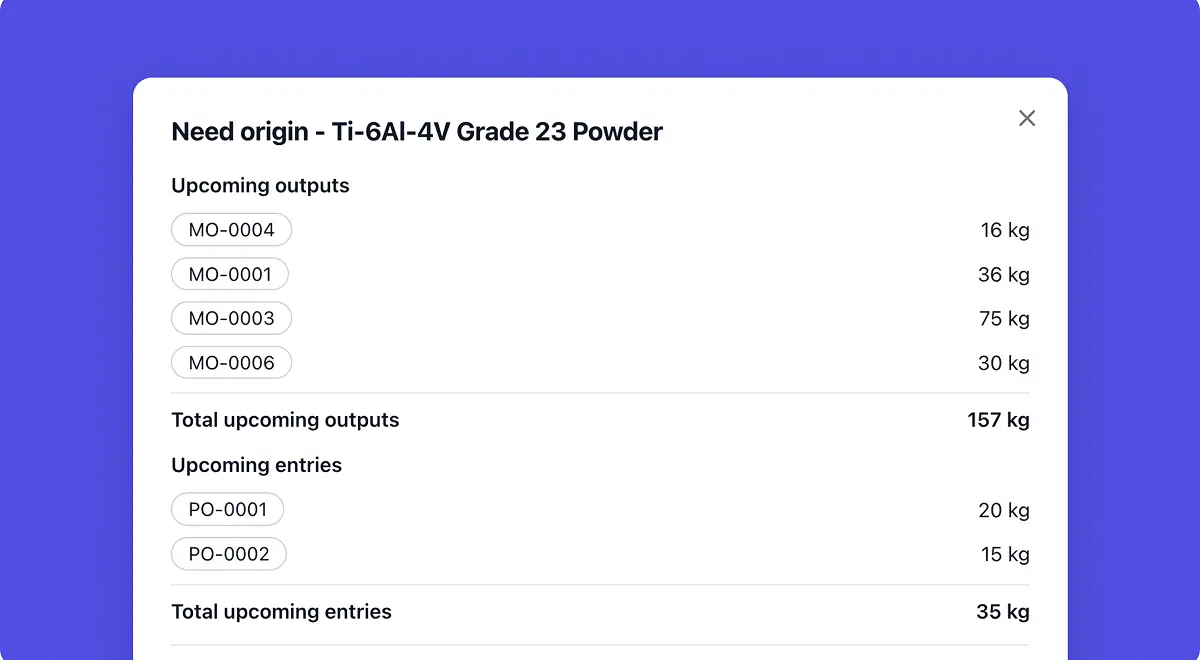
For supplier OTIF, the key information sits around the purchase order: what was ordered, what the supplier confirmed, what changed, what is in transit, what was received, what quality blocked, and which production orders depend on that material. For customer OTIF, the same problem appears around orders, available stock, production status, quality status, picking, and shipment readiness. If those signals live in separate places, the team sees the risk too late.
This is common in growing manufacturing companies. Purchase orders live in the ERP, while supplier updates might live in email, messages, etc., and production needs live in a separate planning spreadsheet. Inventory is corrected after warehouse checks, but quality status lives in another file or another module. Sales promises sit in a customer relationship management (CRM) tool or e-commerce system.
One late supplier receipt can affect three production orders, five customer orders, and a shipment that sales promised this week. If the system only shows "PO late," the team still has to put the pieces together manually, asking planning, production, warehouse, and sales what the delay means.
Supplier follow-up is often held together by good people doing repetitive work. Buyers export open purchase orders, sort by due date, check emails, ask suppliers for confirmations, update expected dates, flag late lines, and tell planners what changed. It works when volume is small enough and the same people remember the exceptions.
Then the business grows and there are more suppliers, more purchase order lines, more product variants, more minimum order quantities, more quality rules, more customer commitments, and more material constraints. The spreadsheet that used to help becomes another thing to maintain.
On top of more business complexity, there’s also system complexity. A promised date is updated in an email but not automatically in the ERP. A supplier confirms a partial shipment, but the buyer does not have time to update the line split. A buyer remembers that one supplier always ships three days late, but the planning parameters still use the official lead time.
Each detail seems manageable, but together, they make both the OTIF number less useful and the operation less predictable.
Reactive purchasing starts when procurement learns about supplier risk after the production plan already depends on the material. The buyer can expedite, pay more, switch supplier, split the order, negotiate a partial delivery, ask production to change the sequence, or ask sales to move the customer promise, but none of those actions are free.
The worst part is that the same misses often repeat. When the same supplier confirms optimistic dates, the same material has unstable lead time, and the same item gets ordered too late because the forecast is not connected to purchasing, it’s time for a change in your system.
In 2026, your system should be learning from those patterns and escalating them to the team, otherwise you will keep reliving them. Tracking OTIF shows the score, but really managing OTIF is about making changes before the score gets worse.
The ultimate goal with OTIF is not a cleaner supplier scorecard or a nicer customer delivery report but rather an earlier warning system.
Teams should know which purchase order lines, production orders, and customer deliveries are likely to miss before they miss. For the supplier side of OTIF, that means connecting supplier dates to inventory, production demand, planning priorities, and customer promises.
The system should be able to show:
Once the team can see those risks, the operating model changes. Buyers stop scanning every open order with the same urgency and instead focus on the lines that matter. Planners stop discovering shortages during scheduling because they see which supplier delay is about to break the plan. Managers stop asking for status updates as a separate ritual because they can see clearly which exceptions need a decision.
OTIF improves when procurement moves from follow-up by habit to follow-up by risk.
Autonomous procurement must, of course, work as supervised action. The system prepares or performs routine purchasing work inside approved rules, then brings a buyer in when supplier judgment, price, quality risk, etc., demands it.
For OTIF, that changes the daily work in a few practical ways because the system — vs. humans, manually — can:
To be clear, adding an AI agent layer to procurement does not replace the buyer. It removes the repetitive checking that keeps buyers from doing the part of procurement that actually needs them: supplier negotiation, risk management, escalation, and judgment.
This is the point of a system of action. A system of record can store purchase orders and calculate OTIF after the fact. On the other hand, a system of action helps the team move the next step while there is still time to protect the plan.
If you are evaluating OTIF inside an ERP or procurement tool, do not stop at whether the dashboard exists to measure OTIF. The system should help the team understand both the customer promise that may fail and the supplier, stock, production, quality, or logistics issue putting it at risk.
Ask whether the system can explain and act on the number:
For the broader dashboard view, OTIF belongs next to other manufacturing KPIs that your ERP should help teams act on, including schedule adherence, inventory accuracy, cycle time, and first pass yield.
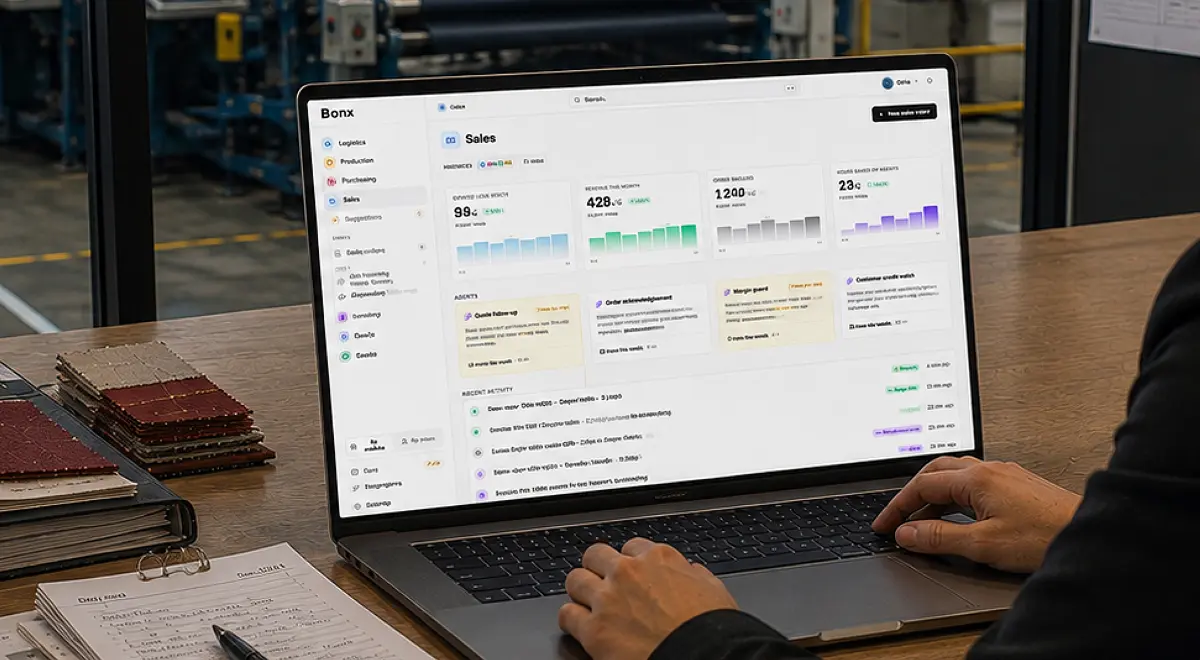
Bonx is an AI-native manufacturing ERP that connects order management, inventory, purchasing and supplier management, planning, production, quality, traceability, and logistics in one operational system, so customer OTIF and supplier OTIF are not treated as separate reporting exercises.
We built procurement control in Bonx because we believe supplier reliability should not depend on buyers manually rebuilding risk from purchase orders, emails, spreadsheets, inventory checks, and planning files. Bonx helps procurement work from live operational context, then act through configured rules and human approval where needed.
That context changes the OTIF conversation. A late purchase order line is not just a late line. It can become a visible exception connected to the material, the supplier, the affected production need, the current stock position, and the customer promise at risk.
Purchasing agents in Bonx can prepare repetitive purchase order work, supplier follow-ups, and key information capture based on defined procurement rules. In practical terms, that means fewer purchase order lines sitting in someone's export waiting for manual review, and more time for buyers to focus on supplier exceptions that need judgment.
For example, food manufacturer L'Atelier du Ferment connected production planning, batch traceability, Sidely, and Pennylane with Bonx. Bonx helps prepare manufacturing orders and procurement suggestions based on sales, shelf life, and cold storage capacity, while supporting traceability across more than 100,000 bottles. That is the kind of operational connection supplier OTIF needs: procurement decisions tied to demand, inventory, production, and constraints in the same flow.
OTIF stands for on time in full. It measures whether an order, shipment, or delivery arrived by the promised date and in the full expected quantity.
The basic OTIF formula is: OTIF = (number of orders delivered on time and in full / total number of orders) x 100. Supplier OTIF is often more useful when calculated at purchase order line level.
A good OTIF score depends on the industry, product complexity, supplier base, and delivery promise. The important point is not only the percentage, but whether the team can see which misses affect production and customer delivery.
Poor OTIF usually comes from unreliable lead times, missing confirmations, partial deliveries, quality blocks, late purchase order creation, poor inventory visibility, manual follow-up, production delays, shipment issues, and planning changes that do not reach the right team early enough.
Manufacturers can improve OTIF by measuring it at the right level, capturing causes for missed dates or incomplete deliveries, connecting purchasing to inventory and production demand, following up before dates are missed, and using supervised automation (such as procurement control within Bonx) for routine checks and escalations.

Contact us
So were we. That's why we built Bonx, the AI-native manufacturing ERP.