Order management software for manufacturers: OMS or ERP?

When you’re growing quickly and thinking about buying software to help manage the demand, one of the first questions is often order management. A standalone order management system, or OMS, can make sense when fulfillment is the main problem. If products already exist, orders arrive from several sales channels, and the work is mostly routing those orders to the right warehouse, third-party logistics provider, carrier, or returns flow, a standalone OMS may be the right layer.
But if customer orders affect inventory, purchasing, production planning, quality, or delivery commitments, order management belongs much closer to the manufacturing ERP. In other words, it’s not a good idea to buy order tracking software if what you really need is order execution. This article breaks down the difference.
The fundamental question when considering OMS or order management as part of your manufacturing ERP is whether you need to simply store demand, or whether you need to connect demand to production exeuction.
A manufacturing enterprise resource planning (ERP) system can treat the order as demand inside the operating system. A sales order may consume scarce material, change the production plan, require a purchase order, reserve a batch, trigger a quality check, or force the team to revisit a delivery date.
If the order sits in a standalone OMS while the consequences live somewhere else, the business has to translate demand into execution through an integration, export, spreadsheet, or manual habit. Of course, this can be costly from a time and risk perspective, with handoffs between sales and the factory introducing the potential for error.
Standalone OMS tools tend to break down when a sales order looks complete, but the factory still has to answer harder questions. Can this stock really be allocated, or is it already reserved? Can this delivery date survive the current production plan? Should purchasing act now, or is supply already on the way? Is the shipment blocked because quality has not released the batch? If the OMS cannot answer those questions, someone else has to, and that work usually lands on customer service, sales operations, or planning.
Integration alone does not solve the ownership problem. A standalone OMS can connect to ERP, warehouse management software, e-commerce, customer relationship management (CRM), electronic data interchange (EDI), and shipping tools. But the more manufacturing constraints sit outside the OMS, the more the team has to decide which system wins when something changes.
For example, if the ERP says a batch is blocked but the OMS still shows it as available, who should sales trust? If the customer changes the delivery split, how quickly does planning see the change? If a manufacturing order is late, does the customer-facing order status explain why, or does someone still have to ask the planner?
At that point, you may have order visibility in theory, but something more like order investigation in practice.
A strong order management system for manufacturers keeps the order connected to the records and decisions around it. That means inventory availability, reservations, bills of materials, routings, purchase orders, manufacturing orders, quality status, shipment preparation, and customer priority all have to stay close to the order.
When the main risk is capacity, sequencing, or timing, order management quickly becomes a production planning software problem. When the risk is whether stock can truly be promised, it becomes the stock-availability question covered in our inventory management guide. The point is that the sales order depends on both.
Let’s, for example, look at a real customer order that is slightly annoying. A customer sends a PDF with several lines, and one item uses the customer's product code instead of yours. In addition, the requested date is earlier than usual, and one component is tight. On top of that, we know that finished stock that would normally cover the order is blocked by quality.
What should your order management system be able to do here?
Good manufacturing order management should help the team answer four practical questions: can we accept this order, what does it require, what is at risk, and what should happen next?
Order management can be a great use case for AI in manufacturing operations, as it can remove manual translation work around the order. Not as a chatbot bolted onto a status page, but as a way to capture messy demand, read context, and help prepare the next operational step.
Let’s look at a few more specific applications for AI in order management:
Manufacturing orders may arrive in emails, PDFs, spreadsheets, customer portals, EDI messages, or documents with customer-specific formatting. A person then has to extract the customer, item codes, quantities, delivery dates, prices, shipping instructions, notes, and exceptions. After that, someone still has to enter or check everything inside the system.
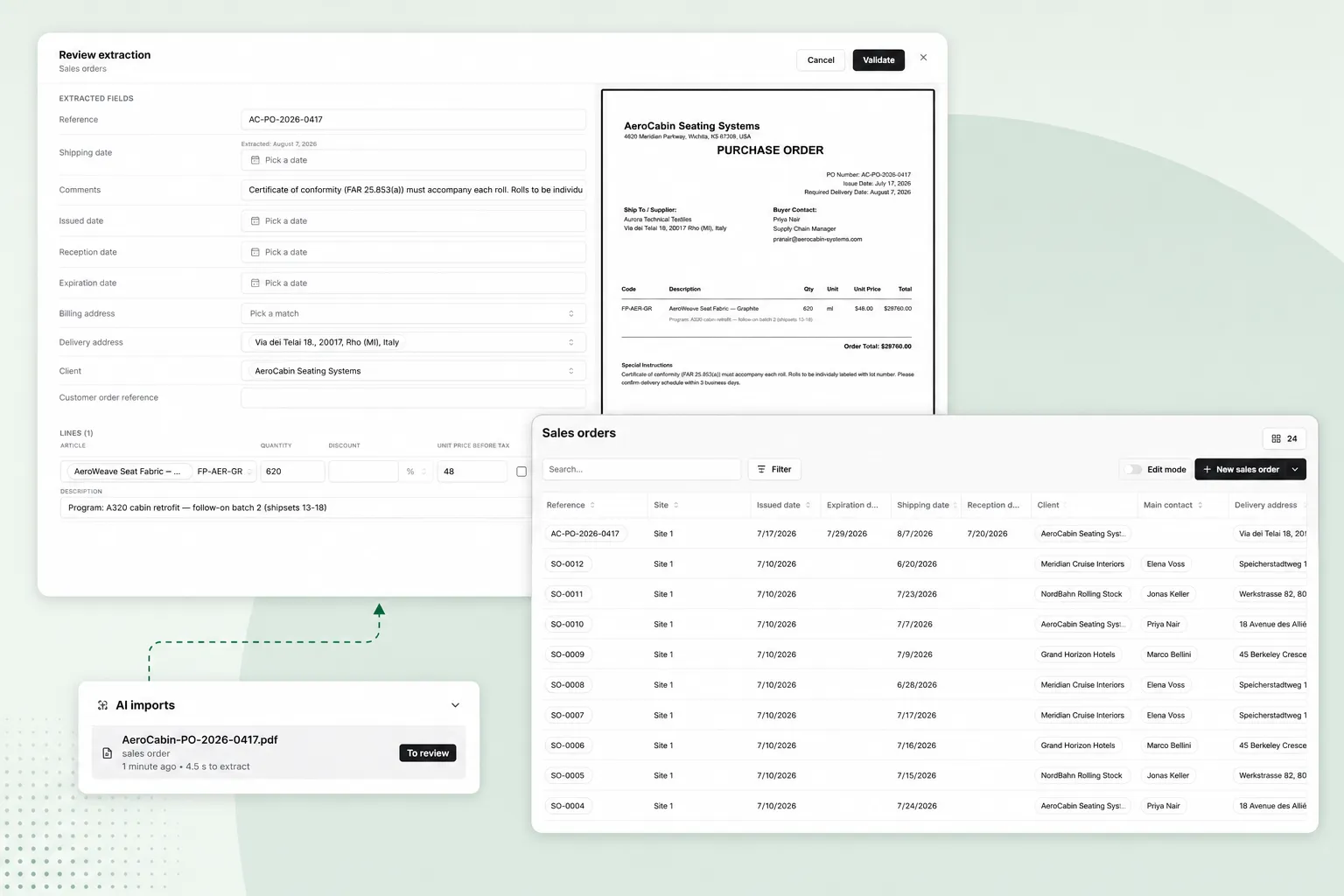
AI can help import sales orders from those messy inputs. It can extract order lines, match them against existing products or variants, detect missing information, flag conflicts, and route uncertain fields for review before the order enters operations.
This is a great use case for AI not only because it saves time, but also it reduces risk, as bad order data moves fast. A wrong item code becomes the wrong production need, a quantity mistake becomes excess stock or a late order, and a delivery-date error becomes a planning problem.
Bonx is the AI-native manufacturing ERP, and one of the ways we help our customers 2x-4x their operational capacity with the same amount of staff is by introducing AI to help import sales orders from customer documents, reducing manual entry, and helping to catch missing or uncertain fields before bad data moves downstream.
Once demand is confirmed, AI can help prepare the work around it, including manufacturing orders, procurement suggestions, stock-allocation checks, delivery-risk alerts, and exceptions for a human to approve.
This only works if the AI sits close to the operational system. A model can read a PDF anywhere, but it can only act responsibly on the order if it understands stock, suppliers, production rules, quality status, lead times, and the current plan.
On the execution side, Bonx can help prepare or perform routine operational actions under configured rules, including generating manufacturing orders, preparing procurement suggestions, assigning work, and surfacing exceptions for human approval when the tradeoff matters.
For example, at L'Atelier du Ferment, a fast-growing food manufacturer, Bonx connects production planning, batch traceability, Sidely, and Pennylane. Bonx helps generate manufacturing orders and procurement suggestions based on sales, shelf life, and cold storage capacity, while supporting traceability across more than 100,000 bottles.
At Something Added, an additive manufacturer that deployed Bonx in two months, Bonx groups orders, generates manufacturing orders, assigns jobs to machines based on industrial rules, and supports 24/7 production with more than 10,000 parts produced each month.
Bottom line: a standalone OMS can be the right choice when fulfillment is the main problem and production is not materially changed by each order. But if customer orders affect inventory, purchasing, production planning, quality, or delivery commitments, order management belongs much closer to the manufacturing ERP.
That is also where AI becomes more useful. Importing a sales order from a PDF or customer document is already a real gain. But the bigger shift happens when the order can move from intake into action: checking stock, exposing missing information, preparing manufacturing orders, suggesting procurement, and surfacing delivery risk before the team has to chase it manually.
So the buying question is not only, “Can this system show order status?” It is, “Can this system help us understand what the order requires, what is at risk, and what needs to happen next?” Manufacturers do not need a better place to track promises, they need order management software that helps them keep order promises.


Contact us
So were we. That's why we built Bonx, the AI-native manufacturing ERP.