AI in manufacturing: what’s real & what’s hype

In a 2026 survey of manufacturing leaders, McKinsey found that 90% of recent Global Lighthouse Network use cases incorporated AI, while only 2% of surveyed companies said AI was fully embedded across operations. Obviously, the gap between those two numbers is enormous and highlights that, while industrial AI is not a side experiment anymore, most companies are still nowhere near scratching the surface on its applications.
If you’re a small manufacturer, you might find this research discouraging. If some of the world’s biggest factories with all the resources at their disposal can’t manage AI transformation, what hope do the rest have?
Here at Bonx, we talk to hundreds of manufacturing SMBs weekly, and we firmly believe that smaller manufacturers actually have a huge advantage when it comes to leveraging AI in operations. Though operationally perhaps no less complex, manufacturing SMBs have the advantage of agility and flexibility, which is critical to being able to test use cases quickly to find the ones that have the most impact with the least risk.
This article looks at where AI is already reliable in manufacturing, where it still needs tight limits, and what is still experimental. Given that Bonx is an AI-native manufacturing ERP, we’ll focus more on operational use cases, providing real examples from some of our customers leveraging advanced techniques, including AI, in their operations.
Manufacturing work is physical, constrained, and expensive when the system gets it wrong. For example, as you well know, a late purchase order can stop production, a batch sent with the wrong traceability can create a quality problem, and a scheduling error can turn a promising week into overtime or missed deliveries.
That is why the strongest manufacturing AI use cases today share a few traits:
Weak or risky AI use cases tend to do the opposite. They try to automate judgment without context, summarize bad data, or produce recommendations that still require someone to do all the real work afterward instead of the system taking action itself.
Bottom line: We’re at a place today where AI can (and should) remove real operational work for the team, so use cases that do that are great places to start.
Scheduling is one of the clearest places where AI in manufacturing help today. However, don’t expect some magic optimizer that solves scheduling for the whole factory in one fell swoop.
Instead, think about scheduling loops where demand, available capacity, material constraints, and production rules are structured enough for the system to prepare or perform routine actions. That can include:
The reason this works is simple: the system is not trying to make every business tradeoff by itself. It carries the repeatable part of scheduling, then brings the planner back in when the decision involves customer priority, margin, quality risk, or a capacity tradeoff the system should not decide alone.
Something Added, an additive manufacturer producing more than 10,000 parts each month with Bonx, shows the pattern in practice. The company deployed Bonx in two months with a native integration to HP 3D printers. Orders are grouped automatically, manufacturing orders are generated, and jobs are assigned to machines based on industrial constraints. The factory runs 24/7 production with a reduced team because the scheduling layer carries repeatable decisions that used to require manual checks, movement between machines, and operator judgment on every cycle.
More automated and AI-based planning doesn’t mean the planner has disappeared, but it does move the planner from repetitive execution to oversight. For a deeper look at that specific workflow, read how AI production planning changes scheduling without replacing planners.
Procurement is another area where industrial AI is already useful, especially for manufacturers that still rely on buyers to manually translate demand into purchase needs. A buyer does not need AI to tell them that stock is low. They need the system to connect demand, inventory, supplier lead times, minimum quantities, shelf life, quality status, and production timing, then prepare the next action.
In practice, that might look like AI:
This is where a lot of ERP automation has historically disappointed manufacturers. A fixed reorder point can be useful for stable materials, but manufacturing demand rarely behaves cleanly. The system has to understand why the material is needed, when the batch will run, whether stock is usable, whether a substitute is allowed, and whether the supplier can realistically deliver in time.
Let’s look at another example: L'Atelier du Ferment uses Bonx to generate manufacturing orders and procurement suggestions from sales, shelf life, and cold storage capacity, while keeping batch traceability across more than 100,000 bottles. That is the sort of context procurement AI needs before it becomes useful. The system is not just reading a stock level, but rather connecting operational demand to the constraints that decide whether purchasing should act.
The buyer still owns the supplier relationship, price changes, risk, and exceptions. The system handles more of the checking and preparation, which is exactly the kind of work software should be doing.
Anomaly detection is one of the oldest industrial AI use cases, and in the right environment, it is one of the most credible.
If a machine produces sensor data, quality readings, cycle times, temperatures, vibration patterns, pressure values, or other regular signals, AI can help detect patterns humans would miss. The system can flag drift, spot unusual behavior, warn that a machine may fail, or catch quality variation earlier than a manual inspection process.
That does not make anomaly detection easy. A 2025 systematic review on condition monitoring-based technologies notes that condition monitoring can support anomaly detection, fault diagnosis, and failure prediction, but also found that many studies lack detail on models and economic evaluation, with few evaluation studies focused specifically on manufacturing systems. In plainer terms: the technology is real, but manufacturers still need to prove the operational and financial case in their own environment.
The strongest deployments tend to have:
The last point is worth reiterating, as an anomaly alert that lives in a dashboard is not much better than a report no one reads. The system has to connect the signal to a next action: inspect the machine, block a batch, adjust the plan, trigger maintenance, or ask a quality lead to review the case.
This is where AI often fails for small and mid-sized manufacturers. They buy the alerting layer before the operational response is ready. The result is another system producing another queue, while the team still has to decide what to do by hand.
Not every useful AI use case needs to act autonomously. Some of the fastest wins come from helping teams ask better questions of their own operations.
Natural language search, production summaries, supplier follow-up drafts, root-cause suggestions, and report generation can all save time when they sit on top of reliable operational data. For example:
This kind of AI is useful because it reduces the time between noticing a problem and understanding where it came from, but it also has a ceiling. If the AI can only answer questions and cannot actually update the plan, prepare the purchase order, block the stock, or route the exception, the team still carries the operational work.
That is not a reason to dismiss these use cases, but it is a reason to be honest about what it is. AI search and analysis can make people faster, but AI-native operations software should eventually move work forward, too, for real impact.
The manufacturing AI hype usually starts when vendors skip the constraints. They describe fully autonomous planning, self-optimizing factories, agentic procurement, predictive quality, and AI supervisors as if the hard part were the model.
In reality, the hard part is usually the operating context: dirty data, partial integrations, undocumented rules, supplier variation, unstable routings, quality exceptions, and decisions that depend on customer promises or commercial judgment.
Let’s dive into several AI claims deserve extra skepticism.
Some factories can automate deeply. Something Added is a good example because additive manufacturing gives the team a constrained, machine-heavy environment where job grouping and machine assignment can be governed by clear industrial rules.
Most manufacturers do not have that level of structure across the whole operation. Materials vary, people move between tasks, suppliers miss deadlines, customers change requirements late, quality exceptions require judgment, subcontractors add another layer of uncertainty — the list goes on.
Most manufacturers should not be thinking about instant or total autonomy, but rather progressive autonomy. That means the system earns more responsibility as records improve, rules become clearer, integrations deepen, and the team learns which actions are safe to automate.
It’s easy to show a clean demo of an impressive AI scheduling tool, but the reality is obviously much more complex and depends on what the system does when constraints collide.
In other words, if a machine is full, a strategic customer is late, a cheaper production sequence increases delivery risk, and a quality hold blocks the easiest batch, the system cannot resolve that neutrally. Someone has to decide what the business values most in that moment.
Good AI scheduling exposes the tradeoff and prepares options; bad AI scheduling hides the assumptions inside an output that looks confident.
Predictive maintenance works best when machines produce enough usable signal, the failure modes are understood, and the company has a workflow ready to act before failure. Without that foundation, the AI either misses problems, creates too many false alarms, or produces alerts that maintenance teams learn to ignore.
For some manufacturers, basic condition monitoring and better maintenance data will create more value than jumping straight to predictive AI. That may sound less exciting, but it is often the starting point.
Generative AI can draft supplier emails, summarize late orders, explain stock movements, and help people query the system. Those are useful tasks, to be sure.
But if the purchasing process is disconnected from production, if batch status is not reliable, or if planners still run the real schedule in spreadsheets, generative AI mostly writes nicer words around the same broken process. It reduces friction at the edge while the center stays manual.
The test is whether the AI reduces the work itself at the core, not just creates some marginal productivity gains around the edges.
An AI-native ERP is not simply a legacy ERP with an assistant in the corner. A chatbot that can answer questions about stock or an AI-based reporting layer that can summarize what happened last week may be helpful, but they’re not fundamentally changing your operations. These use cases give you productivity around the edges, as mentioned in the previous section, not at the core.
An AI-native manufacturing ERP has to be built so the system can use operational context, act inside approved workflows, and keep people in control when judgment matters. That requires four things.
If the AI layer can act inside the workflow with the right data, rules, and controls, it starts to change how the operation runs.
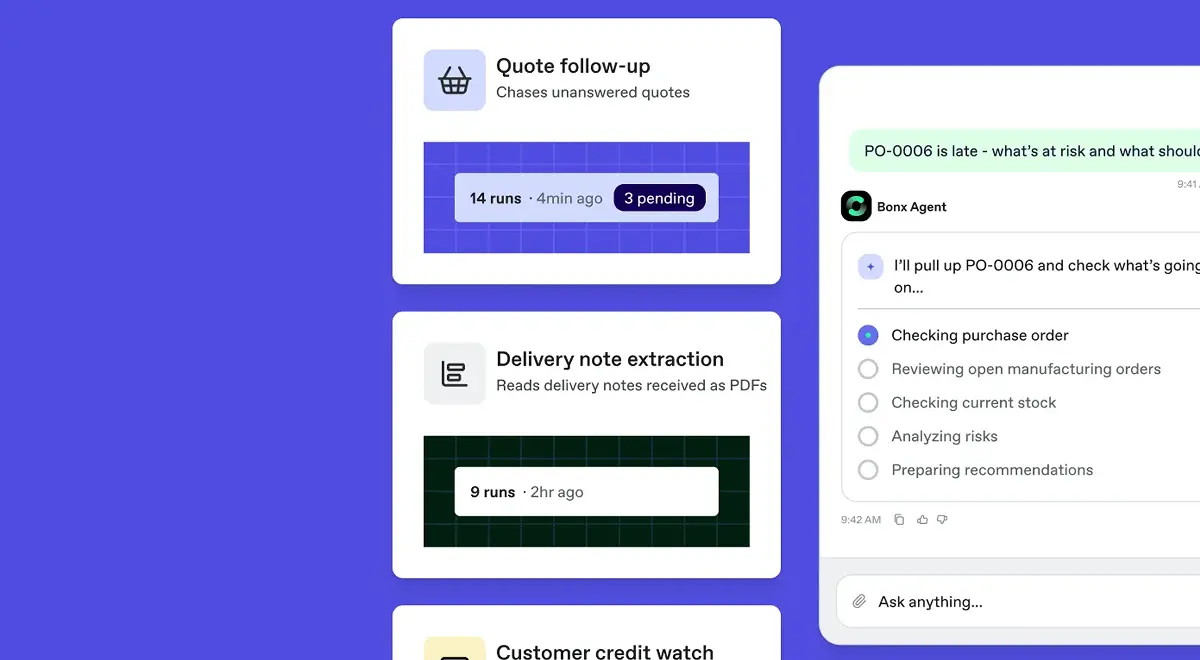
Bonx is an AI-native manufacturing ERP that cconnects the operational core of manufacturing, including order management, inventory, purchasing and supplier management, planning, production, quality, traceability, and logistics, then helps routine work move through the system instead of waiting for people to update records after the fact.
At Bonx, we’re not trying to bolt a chatbot onto a legacy ERP model. The product is fundamentally built around the idea that manufacturing software can, and should, carry routine work under human supervision and bring people in for the decisions that need judgment.
The strongest manufacturing AI use cases right now are practical, bounded, and close to daily operations: scheduling where rules are clear, procurement triggers tied to real demand, anomaly detection with strong signals, and faster access to operational knowledge. The experimental edge is still worth watching, but it should not distract from the work manufacturers can remove today.
The best way to evaluate industrial AI is to force every claim back into the workflow. Ask the vendor to show the exact operational action the system can perform or prepare. Ask what data it needs, what happens when data is missing, and which decisions require approval. Ask how the system logs actions for traceability. Ask whether the team can change the operating logic after go-live without starting another consulting project.
The bottom line is that AI in manufacturing is not hype, but a lot of what gets sold under that label is. Some of the most promising use cases aren’t necessarily the most sexy, but the result — being able to do more, with less, and freeing people from day-to-day monotony of work machines can handle — has the opportunity to be a step-change for your business.
AI in manufacturing means using artificial intelligence to support or automate manufacturing work across planning, scheduling, procurement, production, quality, maintenance, traceability, and logistics. The most useful applications connect AI to real operational data and workflows, not just reports or chat interfaces.
Industrial AI works well today in bounded use cases, including production scheduling inside clear constraints, procurement suggestions tied to demand and stock, anomaly detection from sensor or process data, quality alerts, and natural language access to operational information.
No, but the hype is real. AI becomes useful when it removes or prepares operational work inside a controlled workflow. It becomes hype when vendors promise autonomous factories, perfect scheduling, or predictive maintenance without the data, integrations, and human approval model required to make those claims safe.
A chatbot answers questions. An AI-native ERP can act inside operational workflows under approved limits. In manufacturing, that can mean generating manufacturing orders, preparing procurement suggestions, assigning routine production work, surfacing exceptions, and routing decisions to people when judgment matters.
Start with a recurring operational task that already has enough data and clear enough rules to evaluate. For many manufacturers, that means shortage prevention, production order generation, scheduling support, anomaly detection on a specific process, or faster operational search across orders, stock, batches, and supplier commitments.
AI should move planners, buyers, and production managers away from repetitive execution and toward oversight, which eventually allows you to handle more volume and work with the same number of people. For example, Bonx customers tend to 2x-4x their existing team capacity. The system can prepare routine actions, monitor signals, and flag exceptions, while people keep control of customer tradeoffs, supplier judgment, quality risk, capacity decisions, and business priorities.


Contact us
So were we. That's why we built Bonx, the AI-native manufacturing ERP.