Textile industry
Nervures cut manual data re-entry by 95% by unifying production & finance with Bonx
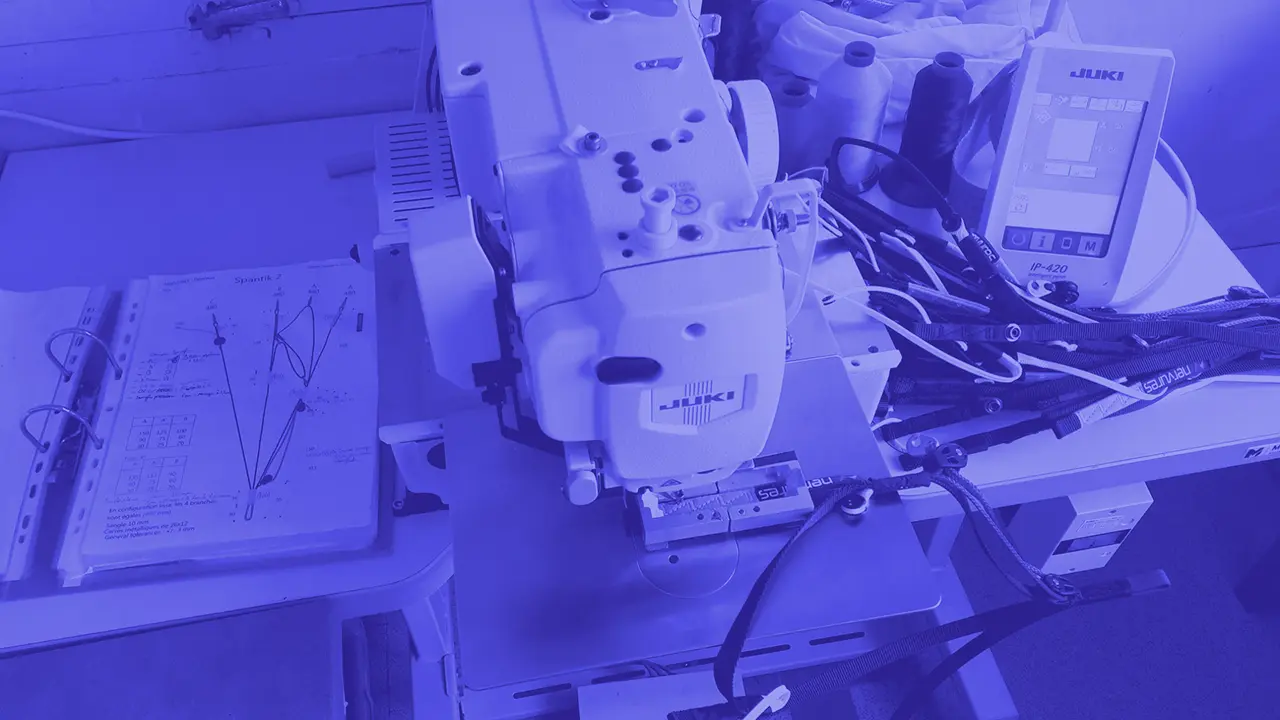
Nervures has spent thirty years building a reputation on precision. Every paraglider it makes is certified aviation equipment, where the tolerance for error is zero. With plans to double revenue in three years, the friction between that standard and its manual production tracking was becoming a growth problem.
Bonx connected the existing tools, automated what didn't need human intervention, and gave production and management a single real-time view of operations without disrupting what already worked.
For years, Nervures ran production through Google Sheets and finances through Sage. The tools each did their respective jobs well, but they didn't talk to each other.
That meant that whenever Nervures CEO Jean-Marie Bernos or his team wanted to analyze production costs or understand how a scheduling decision affected margins downstream, the data had to be manually extracted, reconciled across two disconnected systems, and re-entered.
Today, that's an hour here and an hour there, but the team knew that every new order, every new SKU, and every new operator would add to that load. Doubling revenue in three years doesn't come with twice the hours to spend on manual reconciliation, so at some point, the time required to keep everything aligned was time the business simply couldn’t afford to give.
In addition to the team’s inability to generate operational analytics quickly (e.g., cost of goods, stock levels, quality metrics), additional pressure points were starting to stress the system. In particular, production scheduling and capacity planning as well as logistics flow predictability were not as scalable as the team would have liked.
Nervures didn't wait for the system to fail; rather, they acted while it was still working.
Nervures evaluated its options carefully. A full ERP migration would have been the standard answer, but also the most disruptive one. Replacing their legacy ERP, rebuilding production logic from scratch, retraining every operator on a system designed for a company three times its size: the cost, the delay, and the risk were all disproportionate.
What the team needed was not a replacement for what worked. It was a layer that could connect the pieces already in place, eliminate the manual reconciliation in between, and give production and management teams a shared operational picture without requiring them to change how they worked.
That is the problem Bonx was built to solve.
Faced with the challenge of doubling revenue while maintaining the zero-tolerance precision its products demand, Nervures deployed Bonx to eliminate manual data reconciliation and build a unified operational layer across production, logistics, and finance.
Bonx was deployed in three structured sprints, each targeting a distinct operational perimeter:
Throughout the deployment, Bonx adapted to Nervures' processes, not the other way around. Existing workflows were preserved and the tool was layered on top of what already worked, filling the gaps that created friction.
The north star metric from Nervures' deployment is a 95% reduction in manual data re-entry, the single most tangible measure of how much operational energy was being absorbed by coordination work rather than production work.
But the more significant result is structural. Nervures now has a single source of truth across production, logistics, and finance.
For example, a change in the production plan is immediately visible in inventory projections, a quality event on the floor is captured in the same system that generates cost-of-goods reporting, and planning decisions and financial outcomes are no longer separated by a manual reconciliation process.
For a company whose product demands precision at every step, this is not a convenience. It is the operational foundation that makes scaling possible without compromising their standards. The work done with Bonx ensures that the precision Nervures is known for remains intact as the company grows.

Contact us
So were we. That's why we built Bonx, the AI-native manufacturing ERP.