Why ERP implementations fail
Most explanations of failed ERP implementations start at the end: a delayed go-live, a budget overrun, a team that refuses to use the system. But the project usually starts breaking much earlier.
The reality is that enterprise resource planning (ERP) projects rarely fail from one dramatic mistake. Therefore, the useful question is not simply why ERP implementation fails; rather, it is where and how the project becomes fragile before anyone calls it a failure.
The sections below look at six red flags that appear before go-live, then the checks that reduce ERP implementation risk before the project hardens around the wrong assumptions.
Most ERP implementation projects begin with discovery. The team interviews department leads, documents workflows, defines requirements, and turns the company into a map.
That work is necessary, but it comes with a trap: the map starts aging as soon as it is finished.
A new wholesale customer changes delivery rules. A supplier lead time moves from two weeks to six. A production cell gets reorganized because the old layout cannot handle the new volume. The company keeps adapting, but the ERP project keeps implementing the version of the business that existed during workshops three months ago.
By the time the system is ready to test, operators see screens that technically match the signed-off requirements and practically miss how work now happens. Then the project team has to choose between delaying go-live to reconfigure the system or pushing the team onto software they will immediately work around.
That is the first failure mode of ERP implementation: treating operations as a static object.
Traditional ERP implementation assumes that the business must define most of its rules before go-live. That includes routings, purchasing logic, stock rules, quality checks, approval flows, customer exceptions, pricing cases, and planning constraints.
For stable, standardized environments, that can work. However, many manufacturers are no longer operating in that world, especially mid-market factories that are changing quickly. Product lines expand, customers ask for more variation, suppliers become less predictable, and the team invents small exceptions to keep orders moving. Some of those exceptions should become formal rules. Some should disappear. Some only matter for one customer, one season, or one product family.
Legacy ERP projects struggle because they force too much of that living operational logic into fixed configuration. Consultants ask the team to decide everything upfront because changing it later will be slow and expensive. The result is either over-modeling or under-modeling:
That is why an ERP implementation can pass user acceptance testing and still fail in daily use. The test cases cover the clean process, but the factory runs on exceptions.
Most ERP implementation projects include a data cleanup phase. The item master gets corrected, bills of materials are imported, supplier codes are aligned, stock is reconciled, and open orders are moved into the new system.
That work matters, but it only proves the data was clean on migration day.
The harder question is how the data will stay trustworthy once production starts using the ERP. If stock movements are still captured late, if operators need paper notes before updating the system, or if sales and production keep their own versions of the same order, the numbers will drift again.
This is where go-live becomes dangerous. The new ERP looks official, but the floor may already know which numbers are approximate. Planning starts making decisions from stock levels, routing times, or order statuses that people quietly work around.
After a few bad experiences, teams rebuild the parallel system they were trying to leave behind. Operators keep the paper note or spreadsheet that helps them run the shift, then update the ERP later. By then, planning has already lost the real-time view it needed.
ERP training often teaches people where to click: create a manufacturing order here, receive stock there, close the batch on this screen, escalate through that workflow.
That is useful, but it does not answer the questions users actually face during production.
Which stock figure should I trust when the ERP and the shelf disagree? What happens if the material arrives late but the customer order is urgent? Who can change a routing? When do I stop the line for a quality issue? What should I do when the system asks for information I do not have?
If those decisions are unclear, users will protect the operation in the ways they already know. They will keep a paper note, message the planner, update the spreadsheet, or wait for the one person who understands the exception.
The ERP implementation then appears to have an adoption problem, when in reality, it has a decision-design problem. People do not reject systems because they dislike change; they reject systems that make it harder to keep the factory moving.
A manufacturing ERP rarely lives alone. Orders may come from Shopify, a customer portal, electronic data interchange, a CRM, or a sales tool. Invoices may flow to finance software. Forecasts may sit in another planning file. Shipping data may come from carriers or warehouse tools.
When integrations are treated as a late technical task, the ERP implementation misses the daily rhythm of the business.
The sales team keeps selling in one system, production plans in another, finance closes in a third, and everyone assumes the ERP will connect it all later. Then "later" arrives with edge cases: customer codes do not match, order statuses mean different things, units of measure are inconsistent, and no one has decided which system owns which field.
This is a common reason ERP implementation projects look fine in module testing and break in end-to-end testing. Each department's process works inside its own boundary. The business fails in the handoffs.
In manufacturing, the handoffs are the operation: sales to production, production to purchasing, purchasing to stock, stock to logistics, and logistics to finance. If those flows are only tested at the end, integration problems arrive when there is little time left to fix ownership, statuses, or data flow.
A long implementation gives the business more time to drift away from the version being configured.
A 12-month project gives the company 12 months to change before the system is live. An 18-month project gives it 18 months. For a manufacturer growing 20%, 30%, or 50% a year, that delay is significant. Order volume changes, the product catalog expands, the team grows, and the process assumptions behind the project get weaker.
Long timelines also drain internal energy. The first workshops get senior attention. The fourth round of validation gets tired answers. By the time training starts, the people who were supposed to champion the project may be busy with a new warehouse, a new customer, or a production issue that cannot wait.
This is why ERP implementation failure often feels sudden from the outside and slow from the inside. The project does not collapse all at once; it loses relevance month by month.
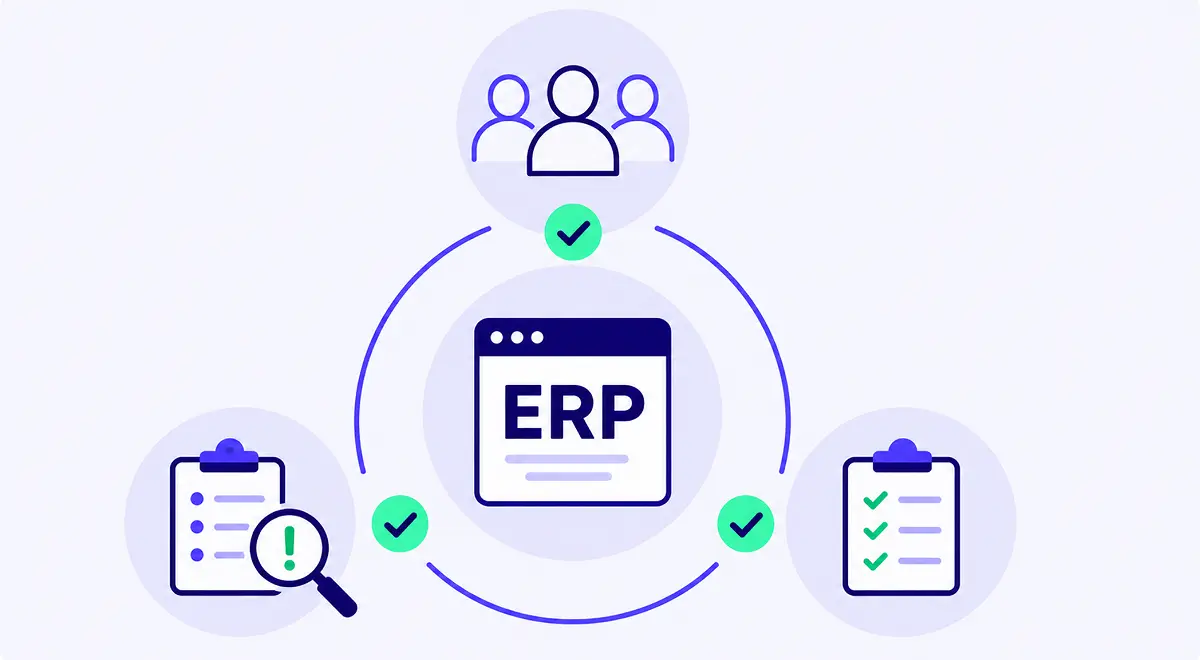
A better ERP implementation starts with a few uncomfortable checks.
The most important check is timing. If implementation takes longer than the business can stay still, the project is already exposed.
If an ERP vendor cannot pass these checks, that should not be treated as the normal cost of doing an ERP implementation. It should be treated as a reason to look for a system that can deploy quickly, adapt after go-live, and connect the real flow of work.
There are better options now. A 12- to 18-month implementation is not a law of manufacturing software; it is a symptom of systems that need the business to slow down, standardize, and wait while the project catches up. The first live version should cover the flows that matter most, then improve with the team as the business evolves.
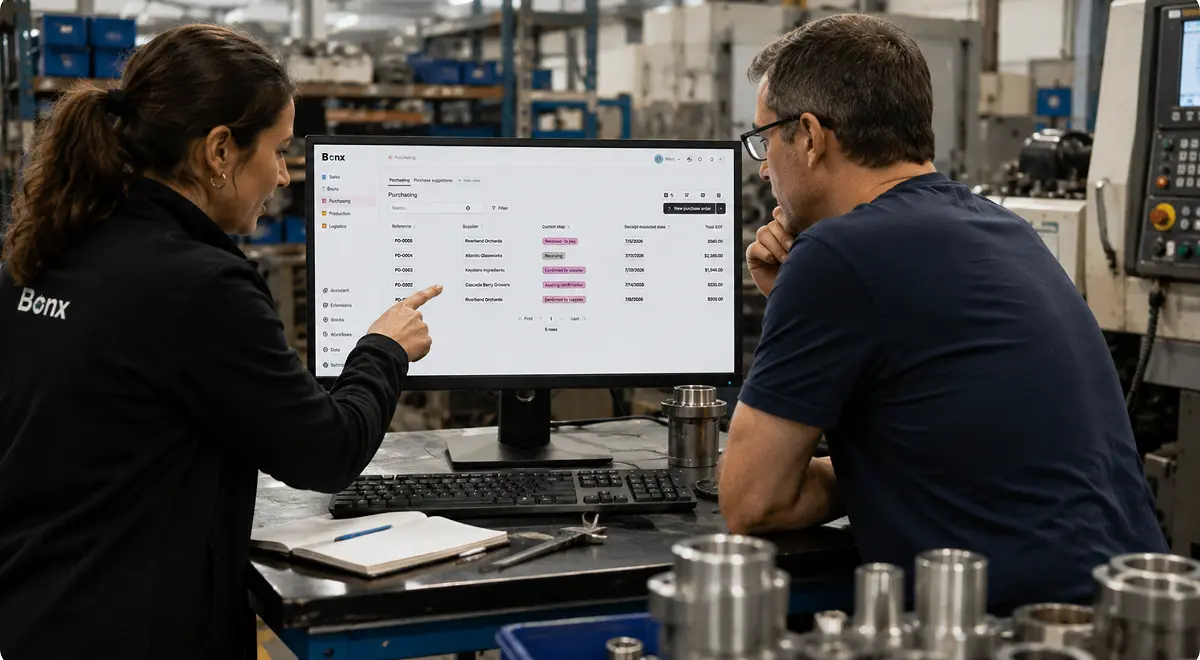
Bonx is an AI-native manufacturing ERP that customers implement in weeks, not months, while keeping the system adaptable after go-live. Implementation is not treated as a one-time attempt to freeze the business, but as the start of a system that keeps learning from real operating conditions.
The proof is in the customer rollouts. Féroce went live with Bonx in 42 days, without interrupting operations, before a national TV appearance multiplied orders tenfold in a single day. At L'Atelier du Ferment, as production, shelf-life management, and traceability grew more complex, the company implemented Bonx to structure sales, procurement, and manufacturing, including connections with Sidely and Pennylane. Bonx also helps generate manufacturing orders and procurement suggestions based on sales, shelf life, and cold storage capacity.
These examples show more than speed. They show what an ERP implementation has to prove: the business can keep moving, the system can connect the real flow of work, and the team can keep adapting after go-live.
For a deeper look at the architecture behind that shift, read AI ERP vs traditional ERP.
ERP implementations fail when the project models a clean version of the business that does not match daily operations. Legacy ERP vendors, including SAP, have normalized this problem by treating long timelines, rigid configuration, late integrations, and heavy consulting work as the cost of doing ERP. They are not. They are the reasons many projects become fragile before go-live.
ERP implementation timelines depend on scope and complexity, but long timelines raise risk for growing manufacturers. Traditional projects often stretch across many months because most rules must be modeled upfront. Bonx customers usually reach time to value in under a month and full deployment in one to three months, depending on operational complexity.
The biggest risk is implementing a system that works in the project room and fails on the factory floor. If operators still need spreadsheets, paper notes, or unofficial workarounds to keep production moving, the ERP has not become the operating system of the business.
ERP implementation risk drops when you test real flows early, involve operators before training, prove integrations before go-live, and choose a system your team can adapt after deployment. Bonx is built around that model: it fits how your operations work, connects with the tools already in your stack, and can be changed without turning every process update into a consultant project.
A manufacturer should start an ERP implementation before the current system becomes the bottleneck. Warning signs include stock figures no one fully trusts, production plans rebuilt manually, order delays with unclear causes, traceability spread across paper and spreadsheets, and one or two people carrying too much operational knowledge. For a more detailed analysis of when the right moment is for an ERP, read when is the right time to implement an ERP?

Contact us
So were we. That's why we built Bonx, the AI-native manufacturing ERP.