An ERP offers you 100 modules? Run.
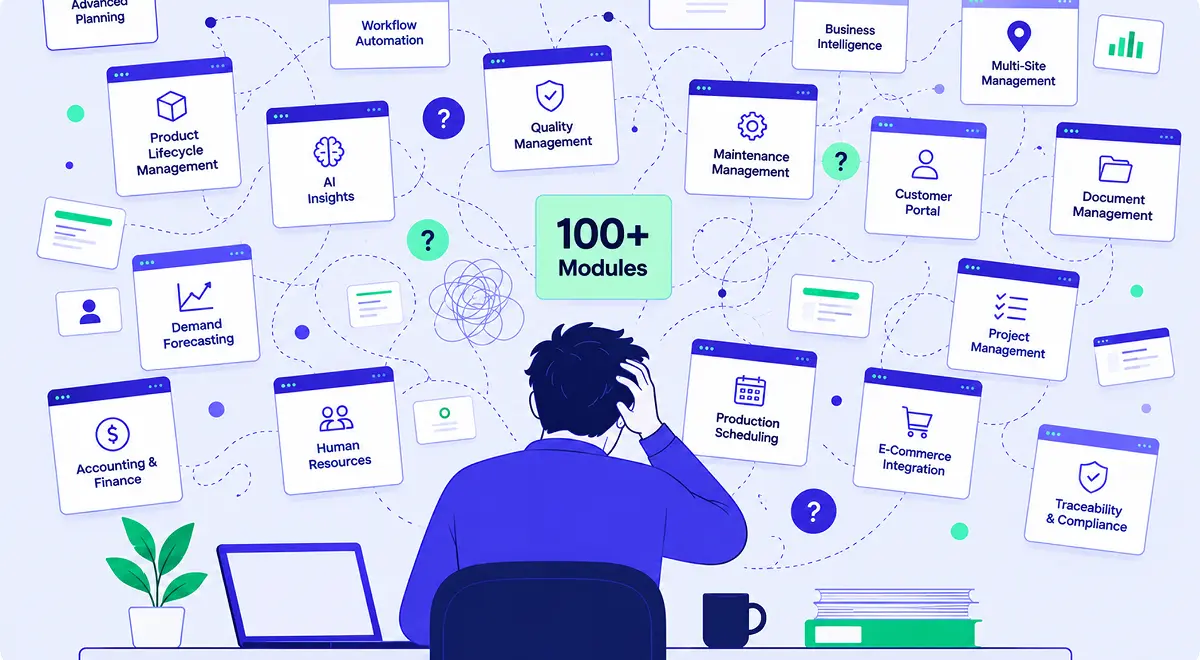
If an enterprise resource planning (ERP) vendor leads with a catalog of 100 modules, be careful. That catalog is not proof that the system will run your factory well, but it may be proof that the vendor has learned to sell breadth when the business needs depth.
This article looks at why giant ERP module catalogs are often a warning sign, where the all-in-one promise breaks for small and midsize manufacturers, and what to ask instead when a vendor tries to make quantity sound like maturity.
The classic ERP sales move is to show the menu: finance, production, quality, planning, maintenance, CRM, human resources, project management, document management, reporting, e-commerce, business intelligence, advanced analytics, artificial intelligence, then another 80 modules with names that sound reassuring because someone, somewhere, once asked for them.
The implied argument is that more coverage means less risk. If the ERP claims to cover everything, surely it will be safer than buying a narrower system, with one vendor, one database, one contract, one roadmap, and one place to call when something breaks.
That story sounds clean until you ask what each module actually does in real work. Can the production module handle your routings, rework, subcontractors, batch rules, and last-minute priority changes? Can the inventory module tell the difference between available, reserved, blocked, expired, quarantined, and physically present stock? Can quality block a batch before logistics ships it? Can purchasing see demand early enough to prevent the shortage, not just record it?
A broad ERP is impressive in a demo because the demo is designed around the software.
The sales team clicks from a quote to an order, from the order to production, from production to stock, from stock to delivery, from delivery to invoice. The flow is tidy. The screens connect. The module names appear exactly when they should.
The demo stops being useful when real constraints arrive: a supplier misses the date, a customer changes the delivery split, a batch is held for quality, a production order needs to be partially closed, or a subcontractor can take overflow for one product family but not another. The sales order may be clean in the demo, while the factory still has to make three practical decisions before anything can move.
This is where broad-but-thin systems start to show their cost. They can represent the clean version of the process, but they struggle when the valuable part of the business lives in exceptions, constraints, and decisions made during the day.
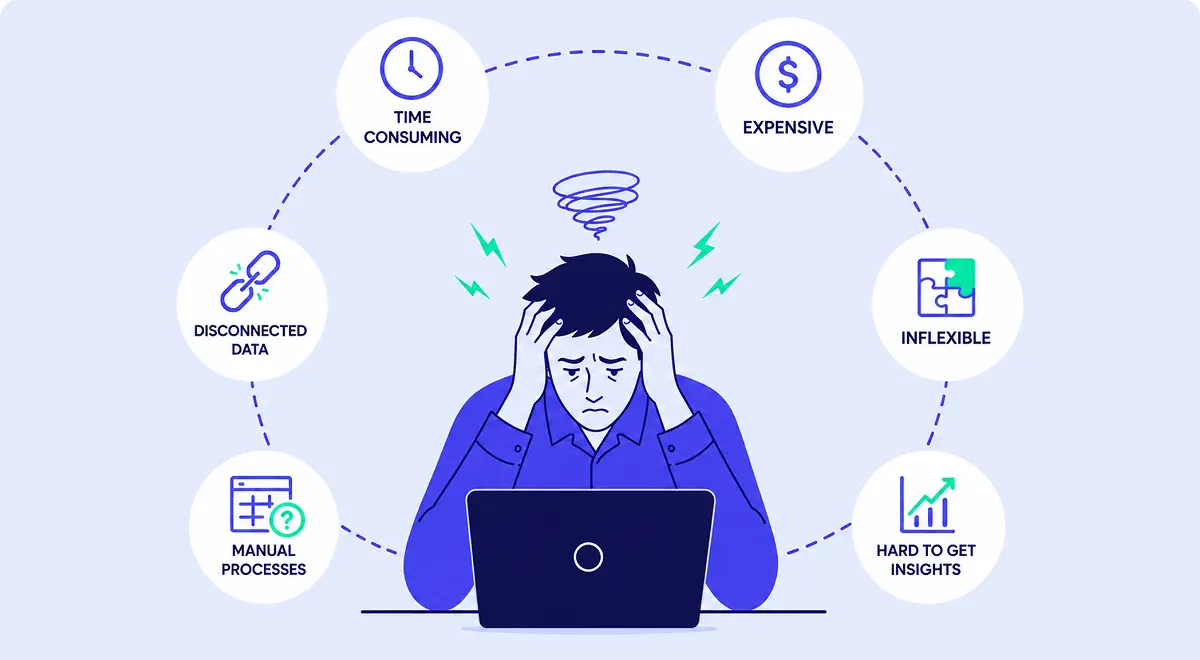
When the ERP cannot handle those details, the team does not stop working. It works around the system. The production plan moves back into a spreadsheet. Operators keep notes on paper. Purchasing checks shortages manually. Finance reconciles the result later and wonders why the ERP never quite matches reality.
The vendor still has 100 modules, but you do not have operational control. This is one reason traditional ERP projects become so painful for manufacturers: the system can look complete in the catalog while the daily work keeps happening outside it.
Software teams know a painful truth that ERP buyers are rarely told clearly: every serious module is a product.
A useful CRM is a product. So is accounting. So is payroll. So is warehouse management, production planning, quality, maintenance, document control, and business intelligence. Each one needs product management, engineering, design, support, security, integrations, documentation, testing, and a roadmap.
Now imagine a vendor maintaining 100 of them. The problem is not that large software companies cannot hire people. The problem is focus. A company whose attention is spread across a huge catalog has to decide where depth matters and where "good enough" will do. In practice, many modules exist because the market expects the checkbox, not because the vendor has built something that can compete with a specialist tool.
That matters for small and midsize manufacturers because the weak module is never free. A mediocre CRM module creates sales work. A mediocre finance module creates reporting work. A mediocre manufacturing module creates operational risk. A mediocre shop floor experience creates adoption problems that leadership later misdiagnoses as resistance to change.
The catalog may reduce vendor count on paper, but it can increase manual work inside the business.
There is a reason companies use HubSpot, Pipedrive, Salesforce, Shopify, Pennylane, QuickBooks, Stripe, and other specialized tools. Those products exist because entire teams spend years improving one job.
An ERP vendor can add a CRM module, but it is unlikely to outbuild a company whose whole business is CRM. It can add accounting features, but that does not mean finance should abandon a tool that already handles accounting well. It can add e-commerce connectors, reporting screens, workflow tools, document storage, and dashboards, but each addition raises the same question: is this actually good enough for the team that needs to use it every day?
For manufacturers, replacing good tools with average ERP modules is often a bad trade. The business gives up adoption, depth, and speed in exchange for the comfort of one logo.
The buying question becomes sharper: which system should own operational truth, and which tools should stay in the stack because they are already strong?
That distinction changes the buying process. The manufacturing ERP should own the factory flow: order management, inventory, purchasing and supplier management, planning, production, quality, traceability, and logistics. CRM, e-commerce, finance, and accounting tools can remain where they are strong, provided the handoffs are clean.
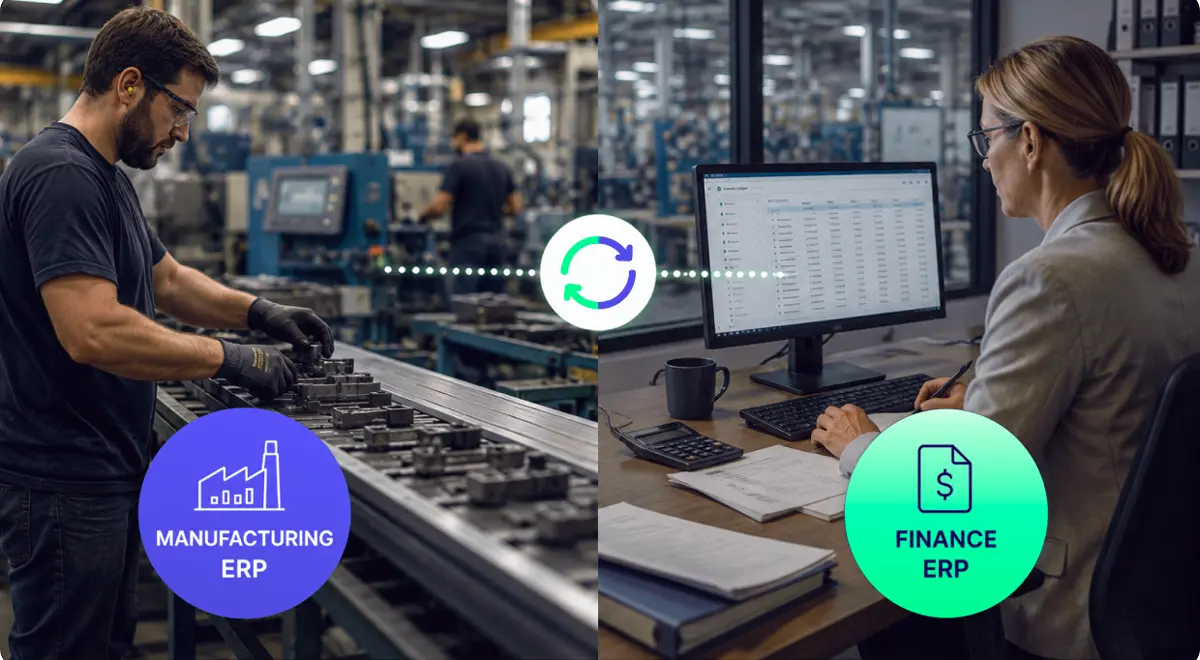
Integration is not a compromise when ownership is clear. It is how the business avoids replacing working software just to satisfy an outdated all-in-one story. This is also why it often makes sense to separate manufacturing ERP from finance ERP: finance needs clean records, but operations needs a system that helps the factory act while there is still time to change the plan.
The highest-value ERP questions are usually boring in the best possible way. Can the system tell planners what can actually be made this week? Can it show buyers which shortages will break the plan? Can operators update work during the shift without fighting the interface? Can quality block, release, and trace batches without a parallel spreadsheet? Can logistics trust stock status before preparing shipments? Can the team change a workflow after go-live without waiting for a consultant? Can operational events move cleanly to finance without re-entry?
None of these questions require a 100-module suite. They require a deep operational system that fits the way manufacturing work actually moves.
The all-in-one ERP promise looks efficient from a distance. One vendor should mean fewer integrations, fewer contracts, fewer system boundaries, and fewer decisions.
In real life, the hidden cost usually appears in three places. First, the project becomes too large. Instead of fixing the operational flows that are actually hurting the business, the company tries to replace finance, CRM, reporting, purchasing, stock, production, quality, logistics, and sometimes human resources in one program. Scope expands. Stakeholders multiply. Every department gets a say because every department is now part of the same ERP project.
Second, the business accepts weaker tools. A team that loved its CRM moves into an ERP CRM because "it is included." Finance leaves a system it trusts because the suite has an accounting module. Operators inherit screens built around administrative completeness rather than shop floor speed.
Third, change becomes heavier than it should be. When one system tries to own everything, every adjustment can feel risky. Will the workflow change affect finance? Will the integration break? Will the field be used elsewhere? Who owns the configuration? Can the consultant fit it into the next phase?
The all-in-one promise turns into a coordination tax. Manufacturers do not need a software suite that wins a coverage spreadsheet. They need an operating backbone that can change with the factory. If the system you already have is forcing more workarounds every quarter, the useful question may no longer be whether the module catalog is large enough, but whether it is time to switch ERP in 2026.
Bonx is an AI-native manufacturing ERP. We focus on the operational core of manufacturing: order management, inventory, purchasing and supplier management, planning, production, quality, traceability, and logistics. Bonx connects to the tools already in the stack instead of forcing manufacturers to replace every tool with a weaker internal module.
That model only works if the handoffs are real. Orders, delivery notes, stock movements, production decisions, supplier actions, and quality events have to move through the system without leaving the team to rebuild the flow by hand. The proof is in customer rollouts where Bonx keeps the operational core connected while other tools keep doing their jobs.
At L'Atelier du Ferment, a fast-growing food manufacturer whose volumes were doubling every year across four workshops, Bonx connected operations to Sidely and Pennylane while supporting full batch traceability across more than 100,000 bottles. Orders created in Sidely feed into Bonx, delivery notes generated in Bonx are sent to Pennylane, and Bonx helps generate manufacturing orders and procurement suggestions based on sales, shelf life, and cold storage capacity.
Something Added deployed Bonx in two months with a native integration to HP 3D printers. Before Bonx, production depended on manual checks, order grouping, machine selection, and print job launches. With Bonx, orders are grouped automatically, manufacturing orders are generated, and jobs are assigned to machines based on industrial rules. The factory now runs 24/7 and produces more than 10,000 parts each month with a lean team.
Feroce deployed Bonx in 42 days before a national TV appearance drove a tenfold order surge. Bonx adapted to the existing QR code traceability logic, connected to Shopify, and helped automate batch traceability, stock visibility across cold storage, material balance, and subcontractor coordination without interrupting operations.
None of these examples depend on Bonx having the longest module catalog. They depend on manufacturing depth, clean integration, and a system that acts where operational work happens.
What to ask instead of "how many modules?"
The next time an ERP vendor shows you the module catalog, do not be impressed too quickly. Ask harder questions.
Treat module count as a weak buying signal. Operational coverage, adaptability after go-live, adoption by the people doing the work, and clean ownership between systems all tell you more about whether the ERP will actually run the business.
If a vendor's best answer is still "we have 100 modules," you have learned something useful: that is your signal to run.
No. Modules are a normal way to organize ERP functionality. The problem starts when the module catalog becomes a substitute for operational depth. A manufacturing ERP can have fewer modules and still run the factory better if it handles order management, inventory, purchasing, planning, production, quality, traceability, and logistics in one reliable flow.
An all-in-one ERP can work when operations are simple and the included modules are good enough for the teams using them. Growing manufacturers should be more careful. Replacing strong CRM, e-commerce, finance, or accounting tools with average ERP modules can create more work than it removes. The better model is clear ownership: the manufacturing ERP owns operational truth, and specialist tools stay where they are strong.
A small or midsize manufacturer does not need a specific number of modules. It needs reliable coverage of the operational chain: customer demand, purchasing, inventory, planning, production, quality, traceability, logistics, and the handoff to finance. If those flows work well, the module count matters less. If they do not, a large catalog will not save the project.
Look for depth in the flows that decide whether the business can deliver. Test whether the system can manage real orders, material constraints, stock statuses, production progress, quality blocks, batch traceability, shipment preparation, and operational data handoffs. Then test whether your team can adapt those flows after go-live without starting a new consulting project.
Bonx is an AI-native manufacturing ERP focused on the operational core of manufacturing, not a giant suite trying to replace every business tool. It connects order management, inventory, purchasing and supplier management, planning, production, quality, traceability, and logistics, while integrating with CRM, e-commerce, and accounting systems that manufacturers already use.
Contact us
So were we. That's why we built Bonx, the AI-native manufacturing ERP.