Manufacturing ERP vs. finance ERP: why separate them
A manufacturing ERP should help run the factory. That sounds obvious until the buying process starts and the conversation gets pulled toward finance: chart of accounts, invoicing, reporting, month-end close, controls.
Those subjects matter, but they are not where manufacturing usually breaks.
For a growing manufacturer, the harder questions are operational. What can we make this week? Which materials are missing? Which supplier delay is going to break the plan? Which batch is blocked? Which customer order changed since this morning? Which warehouse location is telling the truth?
The expensive mistake is assuming one ERP has to own finance and manufacturing to be useful. This article looks at why manufacturers should consider separating the operational ERP from the finance ERP, how the boundary should work, and what to ask vendors before a factory software project turns into a company-wide replatforming exercise.
The all-in-one ERP pitch is appealing for obvious reasons: one vendor, one database, one contract, one implementation, and one system that supposedly covers finance, sales, purchasing, inventory, production, quality, logistics, reporting, and everything in between.
On paper, that sounds simpler than separate systems. In practice, it often makes the project larger, slower, more political, and weaker where the factory needs depth.
Finance wants control, consistency, and clean reporting. It works with periods, rules, approvals, and records that need to stand up to audit, tax, and management review.
Operations lives in motion. Customer demand changes. Suppliers miss deadlines. Materials move across locations. Production runs late. Quality blocks a batch. A subcontractor confirms one date and ships on another. The plan is never finished because the factory keeps moving.
Trying to manage both worlds through the same buying lens creates bad ERP projects. Finance asks for stability, and that is reasonable. But if the manufacturing ERP project is designed mainly around financial control, the factory becomes a downstream data source for accounting instead of the place where the business is run.
That inversion is costly. Operators still need a system that works during the shift, planners still need live constraints, and managers still need to see what is happening before the month is closed.
If your accounting tool works, replacing it is extra work. If your customer relationship management (CRM) system works, replacing it is extra work. If e-commerce, invoicing, payroll, or reporting tools are already adopted by the right teams, forcing them into a single ERP adds migration, training, integration, and political cost without necessarily solving the factory problem.
This is where "one system" can become more complex than a smaller project with clear boundaries. The stakeholder group expands. Every migration has dependencies. Every integration becomes part of the critical path. The project moves slowly because it is no longer trying to fix manufacturing, it is trying to reorganize the company's entire software stack.
Tool count is not the real issue. Ownership is. Each tool needs a clear job, a clear owner, and a clean handoff to the next system.
A manufacturer does not get a stronger operating system just because every module sits under the same vendor logo. If the finance module is good but production planning is weak, the factory pays for that weakness every day. If the shop floor interface is slow, operators will work around it. If quality, traceability, or inventory does not match the real flow, someone will rebuild the truth in a spreadsheet.
That is the part all-in-one ERP demos tend to hide. The cost of a weak module does not stay inside the module. It shows up as manual re-entry, delayed decisions, duplicate checks, and people doing work the ERP was supposed to remove.
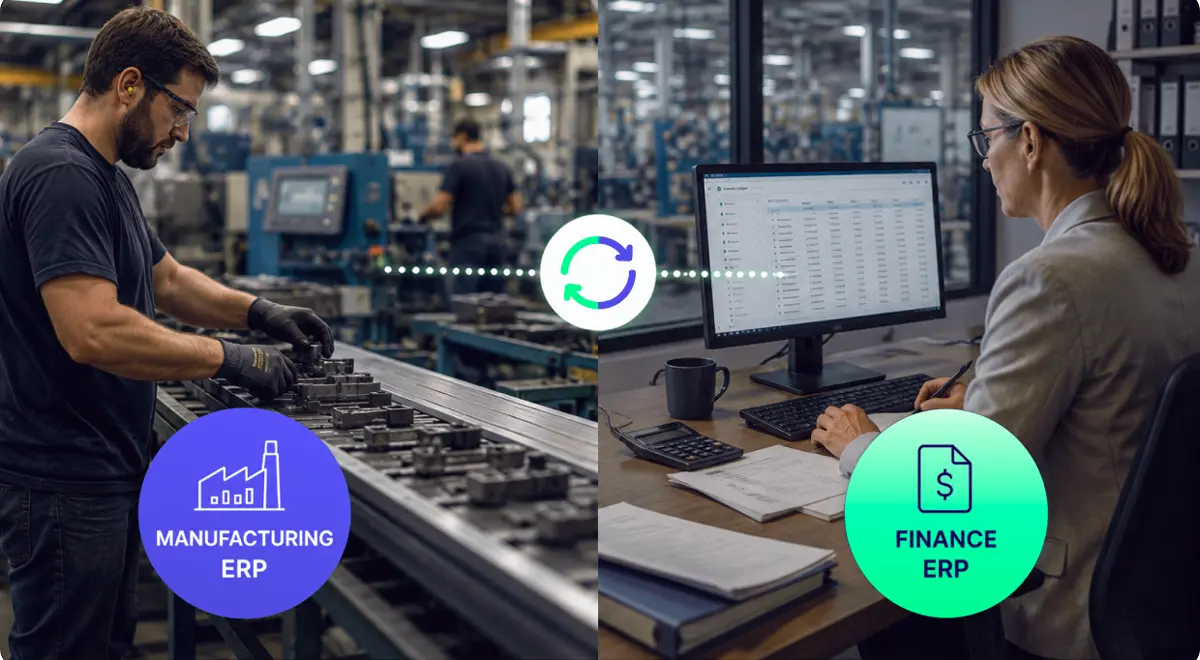
Separating manufacturing ERP from finance ERP only works if the boundary is clear. The goal is not to scatter the business across disconnected tools. The goal is to put operational truth in the system where operational work happens, then send finance the reliable data it needs.
The manufacturing ERP should answer the questions that decide whether the business can deliver.
Which orders are confirmed? What stock is available, reserved, blocked, or expired? Which purchase orders are late? Which manufacturing orders are ready to start? Which machines, lines, workshops, or subcontractors have capacity? Which batches, lots, or serial numbers were used? Which deliveries are at risk?
Those are production, supply chain, quality, and logistics questions. Finance needs the result, but operations needs to act on the situation while there is still time to change it.
This is where many ERP projects get the boundary wrong. They treat operational detail as something finance needs to record instead of something the factory needs to use. A batch number, for example, is not just an audit field. It tells the team what can ship, what must be blocked, what can be recalled, and which material history belongs to a product. A stock movement changes what planning can promise. A production delay changes purchasing, delivery, staffing, and customer communication.
Manufacturing ERP should own that operational truth because that is where decisions happen.
Finance does not become an afterthought when manufacturing has its own operational ERP. It keeps the system it needs for invoicing, accounting, payroll, reporting, tax, controls, and financial close.
The finance tool should receive clean operational events from the manufacturing ERP: confirmed orders, delivery notes, purchase receipts, stock movements, production consumption, scrap, returns, blocked stock, and anything else finance needs to turn activity into accurate records.
That split is not fragmentation. Fragmentation is when sales, production, warehouse, and finance each rebuild their own version of the same order because no system owns the flow. A clear split says where operational truth lives, where financial truth lives, and how the two stay aligned.
For example, many Bonx customers use Bonx for operations and Pennylane for finance: Bonx runs orders, stock, purchasing, production, quality and delivery, while Pennylane keeps accounting, invoicing, reporting and close where they belong.
The result is a cleaner split between operational truth and financial truth, without asking operators to work inside a finance tool or finance teams to rebuild factory data by hand.
ERP projects become dangerous when they try to solve every department's software problem at once. A manufacturing or operations-only ERP project can move differently because the scope is tied to the flows that make or break delivery: customer demand, purchasing, inventory, planning, production, quality, and logistics.
Finance is still involved, especially on controls, reporting needs, and the accounting handoff. But the project does not have to replace finance software to improve manufacturing execution.
That distinction matters. Are you trying to close the books? Then buy or improve finance software. Are you trying to run production, stock, purchasing, quality, and delivery with less manual work? Then buy a manufacturing ERP that is strong where operations are hard, and connect it properly to finance.
A tighter scope works when it keeps the project anchored to the work that actually needs a new system: production, stock, purchasing, quality, and delivery.
The objections are worth taking seriously because a bad split really can create more mess. The answer is not "use more tools." The answer is to make the boundary explicit before the project starts.
They will if nobody owns the boundaries. They will not if each system has a defined job and the integration is part of the project from day one.
Complexity does not come from having an accounting tool and a manufacturing ERP. It comes from unclear ownership, manual re-entry, weak integrations, and teams using spreadsheets because the official system does not fit the work.
Reporting suffers when the sources of truth are unclear. Finance does not need to own every production task to trust the numbers. It needs reliable operational events: what was ordered, received, consumed, produced, delivered, scrapped, returned, or blocked.
When those events are captured live in the manufacturing ERP and passed to finance cleanly, reporting improves because the source data is better.
Finance should be involved in defining the data handoff, approval points, controls, and reporting needs. It should not be asked to design the factory's operating model alone.
The goal is not an operations tool finance cannot govern. The goal is an operational system that creates better data for finance because the factory actually uses it.
Bonx is an AI-native manufacturing ERP. It covers the operational core of manufacturing, including order management, inventory, purchasing and supplier management, planning, production, quality, traceability, and logistics, then connects those operations to the tools already in the stack, including CRM, e-commerce, and accounting tools.
Bonx is not a financial ERP. It does not replace accounting, payroll, or financial close. It gives manufacturers a system of action for operations, then syncs the operational data finance needs with the finance tools that already do their job.
The cleanest proof is in the handoffs. Sales can stay in the customer relationship management tool, finance can stay in the accounting system, and Bonx can run the operational work between them: orders, production, stock, quality, traceability, and delivery.
Food manufacturer L'Atelier du Ferment connected Bonx to Sidely and Pennylane while supporting full batch traceability across more than 100,000 bottles. Orders created in Sidely feed into Bonx, delivery notes generated in Bonx are sent to Pennylane, and production uses Bonx to manage shelf life, cold storage, procurement suggestions, and manufacturing orders.
Custom jewelry house Amantys connected HubSpot, its workshop, and Pennylane through Bonx. Sales teams kept the customer relationship layer, finance kept Pennylane, and Bonx became the production-centric backbone for custom work orders, material traceability, and workshop coordination.
Additive manufacturer Something Added deployed Bonx in two months with a native integration to HP 3D printers. The value was not a broader administrative suite. It was operational execution: automatic order grouping, manufacturing order generation, machine assignment rules, 24/7 production capacity, and more than 10,000 parts produced each month with a reduced team.
That is the useful separation: a manufacturing ERP that owns the factory flow, a finance system that owns the books, and a reliable handoff between the two.
If you are evaluating ERP, do not start with the vendor's module list. Start with ownership.
If a vendor keeps steering every answer back to one system owning everything, ask what happens when one module is weak. The risk is not theoretical. In manufacturing, a weak operational module becomes manual work, and manual work becomes the real system.
Manufacturers do not need ERP for the sake of ERP. They need a system that helps run the part of the business where work is hardest to coordinate.
For many manufacturers, that part is operations. Finance needs clean records, but clean records depend on the factory producing reliable data in the first place. If production, stock, purchasing, quality, and logistics are still held together by spreadsheets, paper, and the memory of experienced people, putting finance at the center of the ERP project will not fix the problem.
Choose the manufacturing ERP for manufacturing. Keep finance where finance is strong. Connect the two properly. That is a clearer project, and a much better bet than replacing half the software stack just to get control of the factory.



Contact us
So were we. That's why we built Bonx, the AI-native manufacturing ERP.