Textile production tracking: how Bonx changes the floor
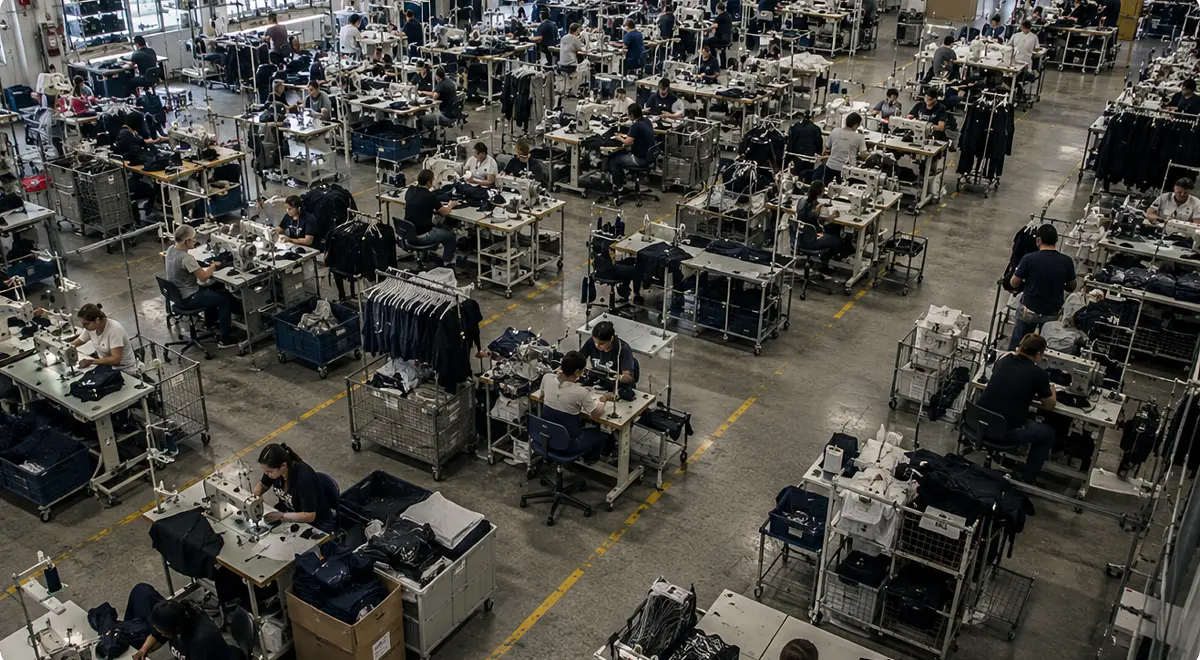
Textile production tracking becomes difficult when the work stops being linear: a single order may move through cutting, printing, embroidery, sewing, finishing, quality control, subcontracting, packing, and shipping, while materials move separately and customer approvals arrive late. By the time production needs to know what has been done, what is blocked, which batch is affected, or whether a delivery promise still holds, the answer may be split across the workshop, the office, the warehouse, a subcontractor, and the customer's inbox.
That is where spreadsheets, paper work orders, and disconnected tools start to cost real time. The problem is not that textile teams lack discipline, it is that the information they need does not live where the work is happening.
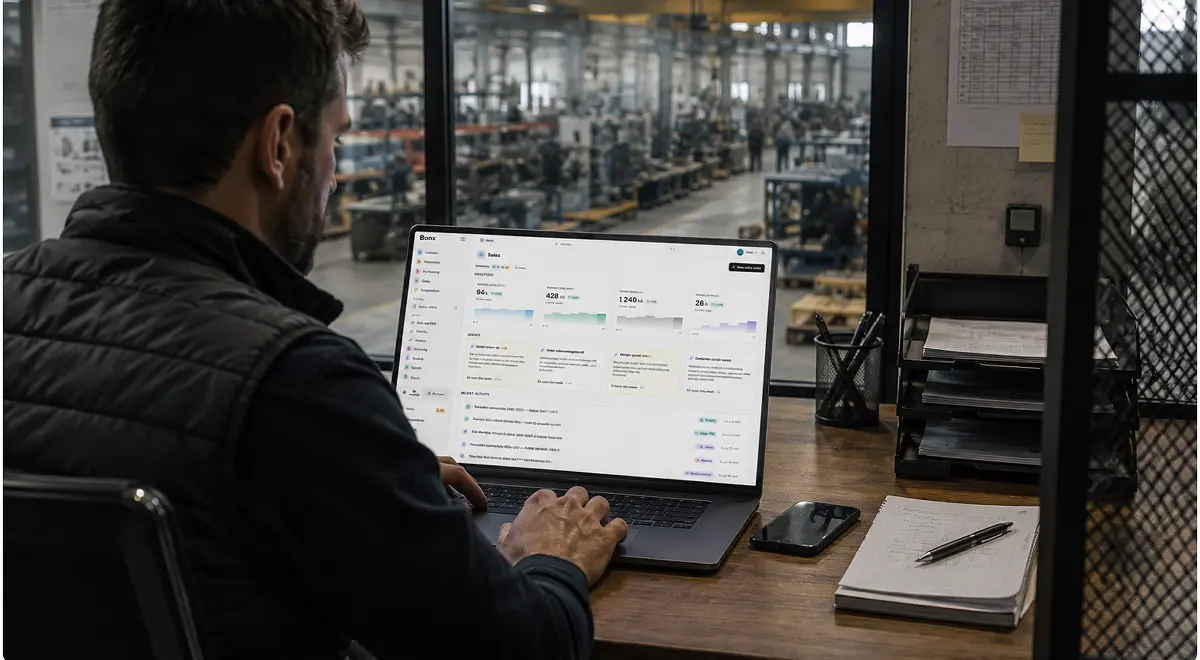
Bonx is an AI-native manufacturing ERP made for textile production units by connecting order management, planning, production, inventory, quality, and logistics in one operational system, all while adapting to the way each workshop actually runs.
Bonx's dedicated ERP for textile manufacturers and production units page covers the broader sector use case. Here, the focus is narrower: how production tracking changes when textile teams can follow orders, materials, quality, and handoffs in the same system.
For example, at LCS Groupe, a textile customization atelier in Perpignan, one order can move through heat transfer, screen printing, embroidery, digital finishing, and sewing. Each workshop depends on the previous one, so a delay in the press workshop can affect the sewing team, and a last-minute customer change only makes sense if the commercial team knows whether production has already started.
For years, LCS managed that complexity with paper work orders and team knowledge. It worked while the business was smaller. But as the company prepared to double order volume and headcount, the system had a ceiling.
LCS implemented Bonx for real-time production tracking so that work orders are generated automatically from confirmed quotes, each production step is scanned as it happens, and customer-facing teams can answer order status questions without walking the floor. The published results are concrete: 95% fewer production errors, 90% less paper, and a full day recovered on average lead time.
That is what production tracking has to do in textile: make the route visible while the work is moving.
For a deeper look at what to test before selecting software, Bonx also has a guide on how to choose the right ERP for a textile SME.
A handoff is not an administrative detail in textile production. It is where delays, missing context, and quality issues often appear.
Bonx helps textile teams track what has happened at each production step, who completed it, what quantity moved forward, and what still needs attention. This matters for a workshop with five stations, but it matters even more when production is distributed.
For example, Résilience coordinates 80 independent textile workshops across France. A production order may be split across several sites, with cutting in one place, assembly in another, and finishing somewhere else. The platform also needs to track quality, production quantities, material movements, and social reporting across workshops where some operators are learning their first industrial job.
Résilience leverages Bonx to coordinate 80 textile workshops, so production declarations, inter-workshop transfers, and quality non-conformities follow guided flows, while the central team gets a live view of production by site, order, and operator. Résilience saves 10 hours per week per employee and standardizes four operational flows across the network.
For a textile production unit, that is the difference between asking for updates and having the update already in the system.
Tracking an order is only useful if it connects to the rest of the operation. If production advances but inventory is not updated, planning cannot trust the stock view. If a quality issue is captured outside the manufacturing order, the team loses the link between the defect, the batch, and the production step. If logistics data has to be re-entered elsewhere, every shipment creates more reconciliation work.
Nervures, France's leading paraglider manufacturer, faced that problem while preparing to scale. Its products are certified flight equipment, so production decisions, materials, component assemblies, quality checks, and traceability records cannot be reconstructed later. For years, the company managed production in Google Sheets and finance in Sage. The tools worked, but the reconciliation between them consumed time as the business grew.
Nervures uses Bonx for production and logistics tracking so that the system generates manufacturing orders, tracks production progress, supports scheduling by operator, adds quality checklists, and creates production dashboards. Nervures reduced manual data re-entry by 95% across production and logistics workflows.
For textile production tracking, this is the point: the order status should not live alone. It should update the information that planning, stock, quality, and logistics already depend on.
The best production tracking system is the one operators use while the work is happening. If updating the ERP means leaving the station, typing into a complex form, or doing admin after the shift, the system will always lag behind the floor. Textile production units need simple shop-floor actions: scan a QR code, declare a quantity, flag a defect, move a batch, confirm a step.
La Maillecotech, a Made in France knitwear accessories producer in Tourcoing, had a clear problem before Bonx: operators were spending nearly an hour every day manually entering production data. The company needed better traceability and efficiency, but it did not want to impose a rigid process from above.
La Maillecotech uses Bonx to streamline shop-floor data entry. The team gained digitized production records, real-time production data, traceability of operations, and a way for operators to suggest improvements based on daily use. La Maillecotech achieved a 12x improvement in data entry time and a 10% productivity increase. That matters because textile production tracking is not just a management dashboard. It depends on what operators can capture without slowing down the work.
The same logic runs through Bonx's article on how textile manufacturers become more efficient with Bonx: efficiency comes from removing duplicated data entry, making production progress visible, and giving teams a system they can actually use during the day.
Textile customers often ask the hardest question at the worst moment: where is my order?
Without real-time production tracking, answering means interrupting someone. A sales rep calls the workshop. A planner checks the spreadsheet. Someone walks to a station. The answer may still be approximate.
At LCS, Bonx gave customer-facing teams and clients access to order status at production milestones. That changed the role of tracking from internal control to customer promise. The team could respond faster, handle modification requests with better context, and protect the reactivity that made the business valuable in the first place.
This is especially important in textile personalization, workwear, event merchandise, and made-to-order production, where customer approvals and deadlines drive the production rhythm.
A textile ERP or production tracking system should match the way textile work actually moves. Before choosing a tool, ask whether it can handle the real operating pattern of your unit.
Ask:
Bonx is a strong fit when textile production has become too complex for paper, spreadsheets, and disconnected tools, but the company still needs a system that can adapt to its own process. The proof is already visible across textile customers: 95% fewer production errors at LCS, 10 hours saved per week per employee at Résilience, 95% less manual re-entry at Nervures, and a 12x improvement in data entry time at La Maillecotech.
Modern textile production units do not need more reporting after the fact. They need production tracking that helps the team run the day.
Bonx gives textile manufacturers a shared operational layer for orders, production steps, inventory, quality, and logistics. It makes handoffs visible, turns shop-floor updates into usable data, and gives teams the information they need before a delay becomes a missed delivery.
For textile SMEs trying to grow without losing control of quality, deadlines, and customer trust, that is the real transformation: production stops being something the team has to reconstruct, and becomes something the whole business can see as it happens.

Contact us
So were we. That's why we built Bonx, the AI-native manufacturing ERP.