FIFO vs. LIFO: what they mean for manufacturing inventory
First, FIFO and LIFO are usually explained as accounting methods. That is accurate, but their implications go much deeper on the production side.
For an operations leader, the real question is not only how inventory is valued at month-end. It is whether the system understands which material should be consumed, which batch can be shipped, which costs should flow into work in progress, and what finance should receive after production actually happens.
That is why the FIFO LIFO conversation gets messy. People use the same terms to talk about warehouse rotation, costing, compliance, tax, shelf life, and enterprise resource planning (ERP) logic. Those are related, but they are not the same problem.
This article separates the operational meaning from the accounting meaning, then looks at what changes when inventory valuation logic runs automatically through connected inventory instead of being rebuilt later in spreadsheets.
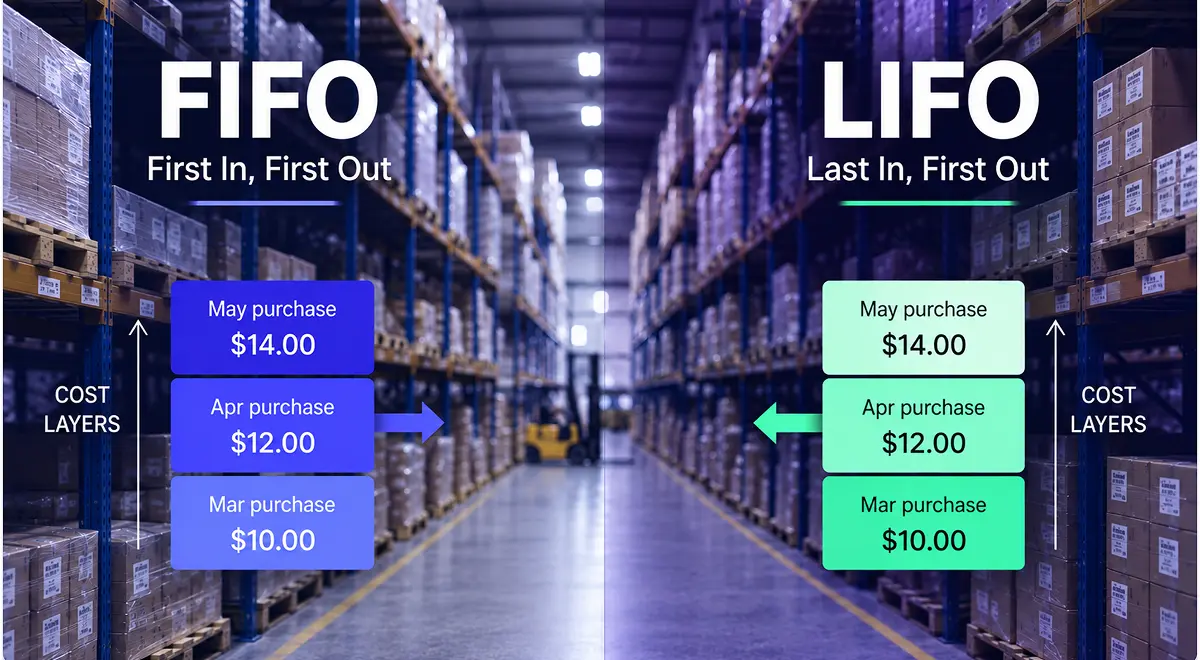
FIFO means first in, first out. The oldest inventory costs are assumed to leave inventory first. LIFO means last in, first out. The newest inventory costs are assumed to leave inventory first.
In accounting, these methods are cost-flow assumptions. They decide which cost is assigned to cost of goods sold (COGS) and which cost remains in ending inventory when items are interchangeable.
Say you buy the same raw material in three receipts:
If production consumes 100 units, FIFO assigns the $10 cost to consumption first. LIFO assigns the $14 cost first. The physical unit pulled from the shelf may be the same in both cases, but the cost assigned to that movement changes.
FIFO and LIFO do not automatically tell the warehouse which pallet to pick. They tell the accounting system which layer of cost to relieve from inventory when stock is consumed or sold.
In manufacturing, the physical flow and the cost flow often need different rules. A food company may physically rotate stock by first expired, first out (FEFO), while finance values inventory using FIFO. A manufacturer using LIFO for accounting in a jurisdiction where it is allowed may still physically consume older stock first to avoid obsolescence.
If the ERP cannot hold those rules separately, the team ends up negotiating with the system.
FIFO matters operationally because many manufacturers need older stock to move before newer stock.
That can be about shelf life, but the same logic shows up in less obvious places. Packaging can become obsolete after a label change. Electronic components can sit under moisture sensitivity rules. Chemicals can degrade. Textile lots can vary by dye batch.
The physical FIFO rule is simple: use the oldest suitable stock first.
The oldest stock is not always the right stock if it is blocked by quality, reserved for a customer, sitting in the wrong location, too close to expiry for the order, missing required certificates, or incompatible with the production order being prepared.
That is where manufacturing inventory gets more complicated than a textbook example. Ideally, your ERP should know:
If those details live in separate systems, FIFO becomes a rule people have to enforce from memory. The ERP may say stock exists, but the operator still has to ask which stock can actually be used.
LIFO matters most when finance wants the cost of goods sold to reflect the newest cost layers first.
In periods of rising material prices, LIFO can make COGS higher because the newest, more expensive purchases are relieved first. Ending inventory may then carry older, lower costs. That can affect reported margin, inventory value, and tax outcomes in countries where LIFO is allowed.
For most manufacturing operations teams, that does not mean the newest physical stock should be consumed first.
Physically pulling the newest material while older stock sits untouched can create avoidable waste, expiry, quality risk, write-offs, and customer service problems. There are exceptions, of course. Some materials have technical reasons to use the newest stock first, or the business may intentionally reserve older stock for a specific order. But as a default warehouse rule, LIFO is rarely the operational behavior leaders want.
This is where the finance and operations split matters: finance may care about LIFO as a valuation method, while operations may still need FIFO or FEFO as a stock-rotation rule. A serious manufacturing ERP should let both be true when the business and reporting rules allow it.
There is also a compliance boundary. LIFO is permitted under U.S. generally accepted accounting principles (GAAP) in certain contexts, but it is not permitted under International Financial Reporting Standards (IFRS). If your company reports under IFRS, operates across jurisdictions, or expects future financing or acquisition scrutiny, do not treat LIFO as a purely operational preference. Finance and tax need to own that decision.
Operations still needs the ERP to execute the rule cleanly once the decision is made.
Manufacturers often talk about FIFO and LIFO as if they are the whole menu. In practice, inventory logic usually combines several methods.
| Method | What it answers | Where it matters |
|---|---|---|
| FIFO | Which cost layer or physical stock should move first, starting with the oldest | Inventory valuation, stock rotation, aging control |
| LIFO | Which cost layer should be relieved first, starting with the newest | Accounting and tax in jurisdictions where allowed |
| FEFO | Which physical stock should move first based on earliest expiration | Food, beverage, cosmetics, chemicals, pharma-adjacent manufacturing |
| Weighted average | What average cost should be assigned across similar units | Stable costing environments, high-volume interchangeable inventory |
| Specific identification | Which exact item or lot cost should be assigned | Unique, serialized, high-value, or customer-specific production |
The right choice depends on what the rule is trying to control.
If the question is "which material should the operator consume," FIFO or FEFO usually matters more than LIFO. If the question is "which cost should finance recognize," FIFO, LIFO, weighted average, or specific identification may be relevant depending on the accounting framework. If the question is "which batch can this customer receive," neither FIFO nor LIFO is enough without shelf life, quality, reservation, and traceability logic.
This is why inventory valuation should not be treated as a finance-only setting buried in the ERP. The costing method depends on operational events, and those events depend on the system knowing what happened in the factory.
In a distributor, FIFO can often be explained through receipts and shipments. In manufacturing, inventory changes shape.
Raw material becomes work in progress. Work in progress becomes finished goods. Finished goods may be packed, relabeled, quarantined, reworked, split, merged, subcontracted, scrapped, or shipped. Each movement can change quantity, location, status, and cost.
That means FIFO has to survive production, not only warehouse picking.
Imagine a cosmetics manufacturer receives the same ingredient in three lots. The oldest lot should be consumed first, but one drum is on quality hold, another has a shorter retest window, and the production order is for a customer with a restricted supplier list. If the ERP only looks at receipt date, it may suggest the wrong stock. If the planner works around that suggestion outside the ERP, inventory and costing start to drift.
The same problem appears in food and beverage. A pallet may be older, but too close to expiry for a retailer that requires 70% remaining shelf life. In that case, the oldest eligible lot for one customer is not necessarily eligible for another. Good FIFO logic in manufacturing needs event history and eligibility rules. It should know what came in, what changed status, what was reserved, what was consumed, what was produced, and which cost moved with each step. Without that, FIFO becomes a label on a report rather than a control the operation can trust.
Inventory valuation breaks when the system records the official version of events after the operation has already moved on.
The pattern is familiar. Operators consume material during production, but declarations are entered later. A quality hold is recorded in a separate file before it reaches inventory. A batch is split manually. Scrap is adjusted at the end of the shift. A warehouse transfer is captured in the warehouse management system but not synchronized with the ERP until later. Finance receives a month-end export and has to reconcile cost movements against production reality.
No single delay looks catastrophic. Together, they create a valuation problem.
The ERP still has a costing method. The spreadsheet still has formulas. The warehouse may even follow FIFO physically. But the movement history is incomplete or late, so the accounting logic runs on a version of inventory that nobody fully believes.
That is when teams start carrying the process manually:
Automatic inventory valuation does not mean finance disappears from the process. It means the ERP has enough connected operational data to apply the approved costing logic as inventory moves.
The workflow should look more like this:
The point is not that every decision should be automatic. Some decisions need approval, especially when the system sees an exception: a substitute material, a blocked batch, a large variance, a customer-specific rule, or a cost movement outside tolerance.
But the routine logic should not require someone to rebuild the cost chain after the fact. If the ERP knows the receipt, the movement, the batch, the production order, the status, and the approved valuation method, it should be able to carry the accounting consequence through the operation.
That is the difference between an ERP that stores inventory and an ERP that actually runs connected inventory.
Connected inventory gives operations leaders a cleaner way to separate three questions that often get blurred:
The first question is quantity. The second is availability. The third is valuation.
Manufacturing teams get into trouble when the ERP treats those as one number. A batch can be physically present but unavailable because quality blocked it. Stock can be available but wrong for a customer because the remaining shelf life is too short. A component can be consumed physically but not relieved financially because the declaration has not been posted. Finished goods can exist but carry the wrong cost because a raw material receipt was late or a subcontracting cost was entered manually after the order closed.
Connected inventory does not remove manufacturing complexity. It makes the relationships visible enough for the system to act on them.
For the COO, that means fewer month-end surprises. For planning, it means material availability reflects real constraints. For warehouse teams, it means picking logic is guided by eligibility rather than memory. For finance, it means COGS and inventory value are tied to the same movements operations used to run the factory.
That is where FIFO and LIFO stop being abstract accounting vocabulary and become part of the operating model.
Bonx is an AI-native manufacturing ERP that connects order management, inventory, purchasing and supplier management, planning, production, quality, traceability, and logistics in one operational system. For FIFO, LIFO, and manufacturing inventory valuation, the relevance is simple: valuation logic works better when the ERP sees the operational events that create the valuation.
That includes purchase receipts, stock movements, batch status, production consumption, manufacturing orders, quality holds, scrap, finished goods, reservations, shipments, and the handoff to accounting tools. Bonx does not replace finance or own financial close; as we explain in why manufacturers should separate operations ERP from finance ERP, it keeps the operational flow clean enough for finance systems to receive better data.
Let's look at a few real-life examples.
At L'Atelier du Ferment, a fast-growing food manufacturer where volumes were doubling every year across four workshops, Bonx helps generate manufacturing orders and procurement suggestions based on sales, shelf life, and cold storage capacity, while supporting full batch traceability across more than 100,000 bottles. That matters because stock rotation is not a warehouse afterthought when shelf life affects production, purchasing, and customer promises.
Feroce deployed Bonx in 42 days before a national TV appearance multiplied orders tenfold. Bonx helped the team keep traceability and logistics under control through the surge, while managing cold storage locations, batch status, and stock visibility across fresh, frozen, and dry products.
Those are not accounting case studies, but they show the operational layer valuation depends on. If the system cannot trust which batch moved, where it moved, whether it was available, and what production did with it, FIFO or LIFO logic will eventually become a reconciliation exercise.
Bonx is strongest for manufacturers that want the ERP to apply approved operational rules during the flow of work, then surface exceptions for human review. Inventory costing still needs finance ownership, but the system should carry the routine logic and leave people to decide the cases that actually require judgment. FIFO and LIFO belong in the same conversation as production, quality, planning, and finance handoff because in a real factory, inventory value is created by the work itself.


Contact us
So were we. That's why we built Bonx, the AI-native manufacturing ERP.