When trust in your ERP vendor breaks

We talk to hundreds of manufacturers a month, and one thing we unfortunately hear over and over again is: we do not trust our ERP vendor anymore. So if you’re feeling that way, you’re not alone.
This article looks at the ERP vendor failure modes we hear about most often (usually from legacy ERP), why teams stay too long after the warning signs appear, and how to decide whether to patch the current ERP or replace it.
ERP vendor trust rarely disappears because of one bad meeting. It usually breaks when the manufacturer realizes the vendor's incentives, product, or delivery model no longer match the business they are trying to run.
In our conversations, we see four main patterns show up again and again.
An acquisition can be harmless. Sometimes the new owner brings more resources, better product discipline, and stronger support.
But it can also mean just the opposite, including slower support and account ownership changes, as a start. Then, slowly the product roadmap starts serving the acquirer's portfolio strategy instead of the factories using the software every day.
For a manufacturer, slow support is not simply a minor annoyance. If the ERP blocks production, shipping, quality release, stock movements, or customer delivery, the business cannot wait. One industrial site we spoke with put the risk in hard numbers: a single system failure could expose the company to €330k per day in site penalties.
Forced upgrades are dangerous because they often come disguised as maintenance. The vendor announces that an old version will be replaced, support will stop, or the company must migrate to the new platform. The messaging is made to sound routine, but the impact can be anything but.
For a manufacturer, a version migration might mean remapping workflows, rebuilding customizations, retesting integrations, retraining users, cleaning data, and revalidating processes that took years to stabilize. In practice, you are being asked to fund and manage a new ERP project just to keep using the ERP you already bought.
The breaking point is not always the upgrade itself, but finding out too late. If the vendor knew the migration was coming and your team discovered it when the timeline was already tight, it’s a massive trust issue.
Bottom line: a forced migration should trigger a real choice, not automatic compliance with the vendor's timeline.
One manufacturer framed the decision this way: if we have to redo the work anyway, maybe we should restart with a system we trust.
End-of-life software is similar to forced migration or acquisition, though with some nuance. The positive side is that at first, nothing explodes. The ERP still technically works, and the business can keep moving.
The problem is that the system is no longer a place where the company can build for their future. Security might get weaker, new integrations become harder (if they’re even still possible). What’s more, you have new employees learning outdated processes on an end-of-life software. In this scenario, the vendor may still answer the phone, but the product is no longer being meaningfully improved.
Running end-of-life software is not always reckless, and sometimes it is the least bad option for a period of time. But it’s important to recognize that every month on unsupported or barely supported software is a month where you’re not improving or able to scale the business or your operations at the speed you’d like.
The fourth failure mode is less dramatic, but it may be the most common. The vendor sells a clean project — of course the ERP can handle your industry! Of course, you can adapt the ERP any way you need to!
Then the project starts. Workflows that sounded standard become workshops. Industry requirements become custom development. Each exception creates another estimate. The ERP was supposed to support the business, but instead, the business spends months adapting itself to the ERP. Two years later, the company has paid for customizations on a platform that was never really built for its production model.
This is especially dangerous in manufacturing sectors where the operational logic is specific. Chemical manufacturing, cosmetics, food and beverage, textile production, metal fabrication, and made-to-order workflows all carry constraints that generic ERP demos can hide: batches, formulas, shelf life, quality holds, subcontracting, traceability, variants, routing changes, and customer-specific rules.
Bad implementation is not always a bad project manager; sometimes it is a bad fit that the vendor sold too confidently. It’s worth understanding which situation you’re in, because if the implementation failed because of governance, missing ownership, poor data, or unclear scope, the current system may still be salvageable. If it failed because the product cannot fundamentally support the way the business actually runs without years of expensive adaptation, more implementation work will not fix the foundation.
If your ERP vendor has let you down, leaving can still feel irrational because ERP replacement is not a normal software switch. The system is high risk, touching orders, purchasing, stock, production, quality, logistics, reporting, and the handoff to finance.
Plus, the people who would lead the change are usually the same people already busy with daily operations. They don’t have spare time for a second full-time job called ERP migration.
So many companies stay not because they are naive, but because the alternatives look dangerous.
ERP switching costs are not just license comparisons. They include data migration, process redesign, integration work, testing, training, and the attention of your best people.
Those costs are non negligible, and a rushed replacement can hurt the business as much as a bad legacy ERP. If the current system is painful but stable, many leaders decide to postpone the decision until a quieter period.
The problem is that the quieter period rarely arrives. Growth brings more products, more exceptions, more sites, more channels, more suppliers, and more reporting pressure. The ERP that was barely acceptable at one size becomes actively risky at the next.
Manufacturers do not fear change in the abstract. They fear late orders, blocked production, failed traceability, confused operators, wrong stock, and a month-end close that turns into manual reconciliation.
That fear is rational. A bad ERP transition can damage customer trust and exhaust the team. It can also make leaders look back fondly at a system they disliked, simply because it was familiar.
But disruption is not only a switching risk. Staying with a vendor you no longer trust also creates disruption, only it arrives in smaller pieces: late support answers, fragile integrations, undocumented workarounds, data nobody trusts, and process changes that keep getting delayed because the ERP cannot handle them.
Many manufacturers have already spent years and six figures making their ERP usable. They have paid for customizations, trained teams, connected other tools, and built internal habits around the system.
That investment makes replacement feel wasteful. Yet it’s also important to ask not just how much you have spent, but how much more the system will ask from you in terms of money as well as your team’s time before it becomes fit for purpose again.
When leaders compare stay vs. replace, they often compare the visible costs: subscription, maintenance, consulting, migration, and implementation.
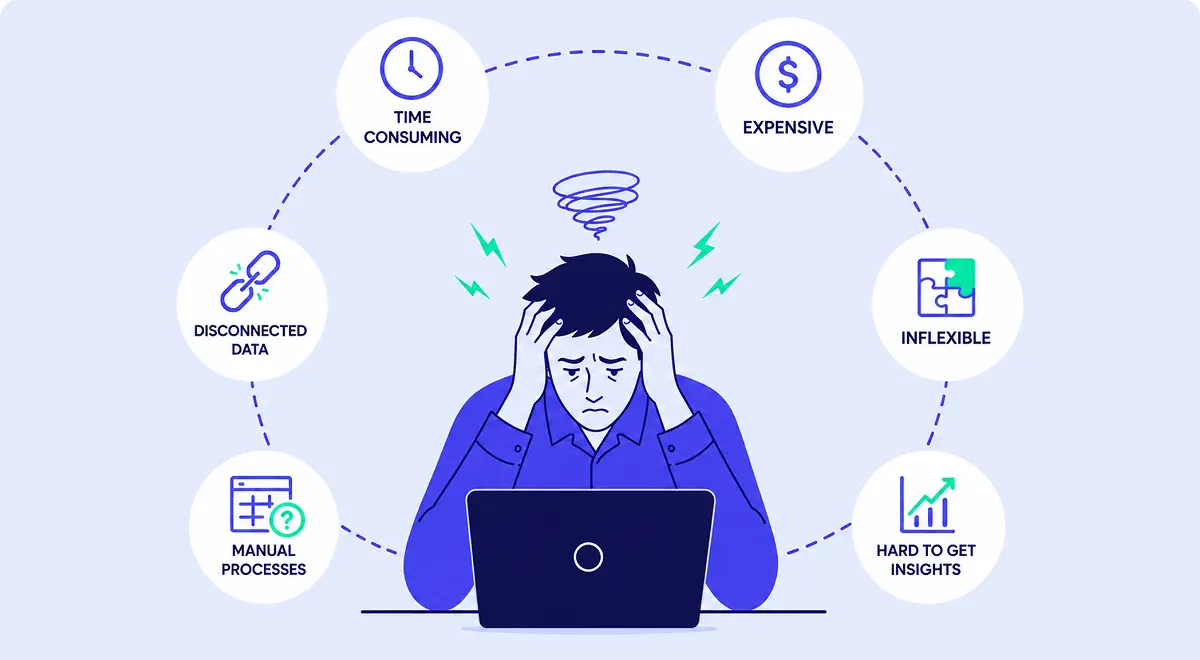
Those costs matter, but they are not the full bill. The larger cost is the tax the system puts on the team every week.
When the ERP does not fit the work, experienced people start filling the gaps. They remember which field means what, they know which stock number to verify manually, they understand which customer rule is not really captured in the system, they know when the ERP says available but the factory says not yet.
That knowledge is valuable, but it should not be trapped in human memory because the vendor failed to keep the system adaptable.
Once your best people become the integration layer, the ERP is no longer reducing dependency but rather creating a new one.
If updating production takes too long, operators do it later. If stock is often wrong, planners check outside the ERP. If quality workflows do not match the real process, teams keep parallel records.
These things don’t happen because they are careless. They happen because it’s either impossible or too expensive (usually in terms of time) to do it another way. The result is not one big failure but a slow collapse in confidence. The ERP remains the official system, while the real operating truth moves into spreadsheets, messages, paper, and people.
The most dangerous cost is the one that looks like normal busyness. Meaning, your team spends more time checking, correcting, chasing, and explaining. Managers spend more time asking for updates. Operators spend more time entering data after the fact. Finance spends more time reconciling. Leaders spend more time waiting for reliable numbers before making decisions.
Each task is small enough to tolerate, but together, they cap how much the company can grow without adding people.
That is the hidden cost of a vendor relationship gone bad. You are not only paying for software. You are paying with the operating capacity of the team.
For a deeper cost breakdown, read how much an ERP actually costs a manufacturer.
Not every vendor disappointment means you should replace the ERP. Sometimes the system is still the right foundation, and the right move is to renegotiate support, clean up the implementation, or scope a controlled upgrade.
The decision depends on whether the problem is temporary, contained, and solvable. Ask these questions before you commit to another patch:
If the answers are mostly positive, patching may be reasonable. Tighten the support contract, document the workarounds, clean the data, and set a review date. A controlled extension can be a good decision when the business has higher-priority operational risks.
But if the answers are mostly negative, patching is just delay with an invoice attached.
Ultimately, a forced upgrade, acquisition-driven support decline, end-of-life notice, or failed implementation should not automatically be a replacement project, but it should definitely be a decision point.
The right transition does not start with a giant specification. It starts with the parts of the business where the current dependency is most dangerous. For most manufacturers, that means order management, purchasing, inventory, planning, production, quality, traceability, logistics, and the handoff to finance.
Start identifying which flows are the most critical to get right and that are currently costing you the most time and effort in manual or repeated work (i.e., where you could see the most return on investment from a better system). For most manufacturers, this includes:
Center your ERP search and transition around your most complex or your most critical workflow.
Replacing a broken ERP relationship does not mean replacing every tool around it. If your accounting tool works, keep it. If your customer relationship management (CRM) system works, keep it. If e-commerce, invoicing, payroll, or business intelligence tools are already adopted by the right teams, the new manufacturing ERP should connect to them instead of turning the project into a full software-stack replacement.
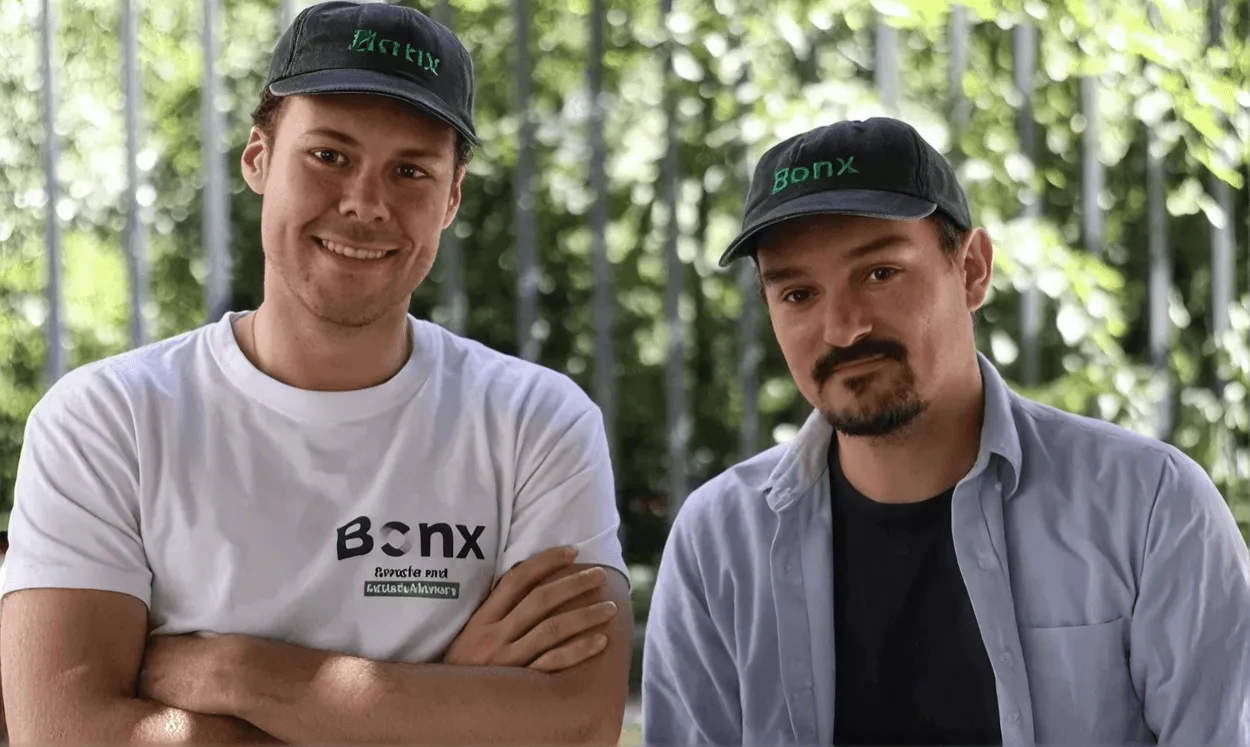
“Keep what works for you” is exactly the Bonx philosophy. Our AI-native manufacturing ERP covers the operational core, then connects to the tools already in the stack, including CRM, e-commerce, and accounting tools. For example, at food manufacturer L'Atelier du Ferment, Bonx connected operations to Sidely and Pennylane while supporting full batch traceability across more than 100,000 bottles.
A good transition should prove three things early:
This is where deployment timeline comes in. Bonx customers go live in 1 to 3 months, which changes the risk profile of replacement. Feroce deployed Bonx in 42 days with no operational interruption, then absorbed a tenfold order surge after a national TV appearance. Something Added deployed Bonx in two months with a native integration to HP 3D printers, automated order grouping, and 24/7 production capacity.
The lesson is not that change is easy but that ERP replacement does not have to mean waiting 18 months before you see whether the choice was right.
When manufacturers say they want a better ERP, they often mean something more specific: they want to stop being trapped.
They want a system that adapts when the business changes. They want fewer consultants between their team and their own workflows. They want data and a system people use and trust.
After ERP trust breaks, you have two options. You can treat the problem as a technical event: an upgrade, an end-of-life notice, a support issue, a failed implementation, a migration. Or you can treat it as a dependency problem and ask whether the next decision reduces that dependency.
The next step is not to launch a massive ERP selection project tomorrow but to map the cost of staying, including the time your team spends compensating for the system, then compare that with the cost of a transition.
If the current vendor can earn back trust, give them a clear path to do it. If they cannot, do not let familiarity make the decision for you. The moment trust breaks is the moment you get to choose whether the next system gives control back to your team.
Contact us
So were we. That's why we built Bonx, the AI-native manufacturing ERP.