Bonx product updates for July 2026
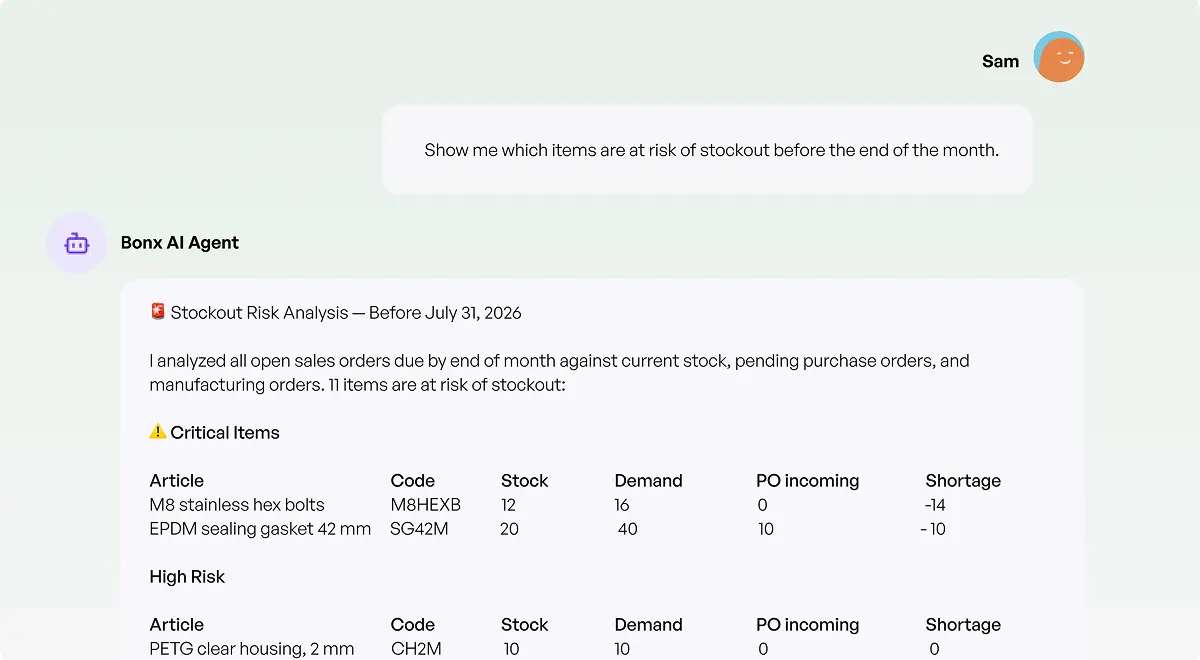
Welcome back to the monthly Bonx product roundup! In June, the team shipped big improvements around the AI assistant, document extraction, stock accuracy, audit trails, and global search. In July, we shipped smarter AI import workflows, clearer lot traceability, and a more complete invoicing experience.
Here’s more detail on the three most impactful updates from July, plus a wider set of improvements across automation, stock, purchasing, integrations, usability, and more.
In June, we improved how Bonx reads documents. In July, we improved what happens after the first extraction: the review, correction, and learning loop that turns a document into a reliable Bonx record.
The new review panel lets you compare extracted data alongside the original document, resolve ambiguities, make edits, and only then create the final record. And when you correct extracted data, Bonx can now learn from the change: the assistant analyzes your edit and suggests a new rule for your import instructions.
That means each correction can become a reusable improvement, helping future imports better match your supplier formats and business rules.

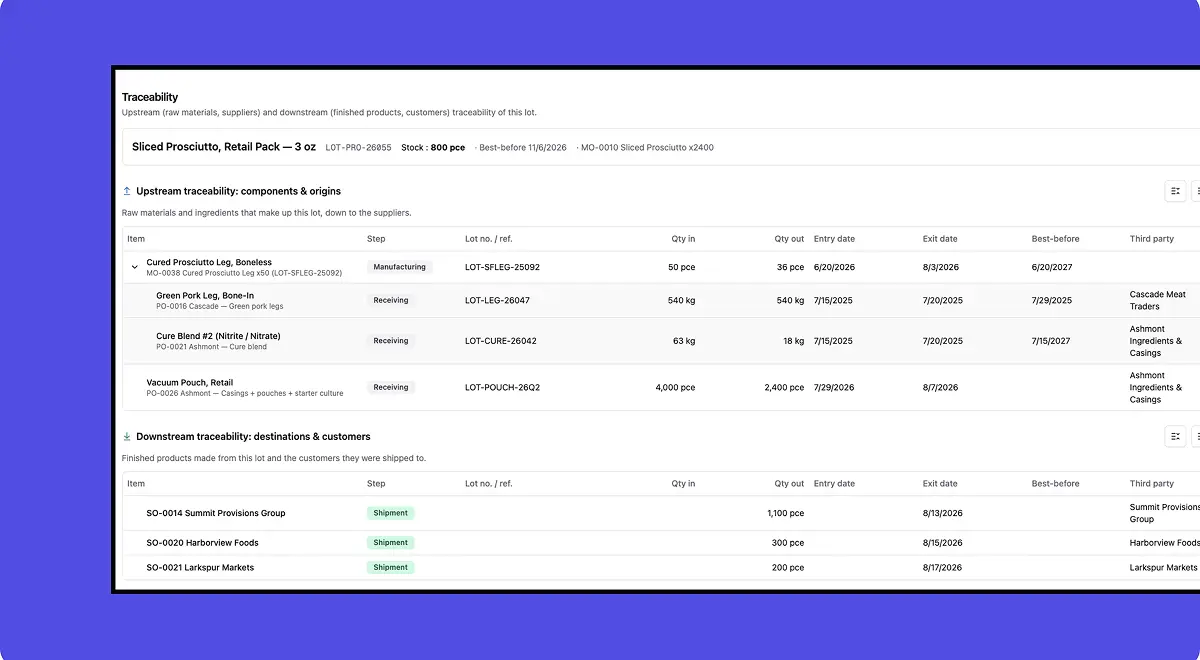
In July, Bonx improved both speed and depth of traceability with the on-demand traceability tool available directly from the lot page. With one click, you can generate a full upstream and downstream genealogy graph for a lot, showing its journey from raw material reception to finished product shipment.
The traceability report itself also became more reliable. Bonx now considers the timeline of events when building the report, so movements that happened after a component was consumed no longer appear in the history of an older batch. This is especially useful when lot numbers are reused over time.
The sheet was also redesigned for readability, grouping movements for the same lot into expandable rows, with expand-all and collapse-all controls. For teams in food and beverage, cosmetics, chemicals, electronics, or any regulated manufacturing environment, this makes traceability easier to investigate and easier to trust.

July brought a series of improvements to invoicing in Bonx, especially around templates, credit notes, PDFs, and e-invoicing readiness.
Teams can now create multiple invoice templates with custom titles, text sections, footers, and a live PDF preview. French companies now generate Factur-X compliant hybrid PDFs, while Italian e-invoice validation catches issues earlier and explains them more clearly. Bonx also added credit note deductions, automatic PDF archiving, country-specific invoice actions, and more control over bank account and issuer address details.
Bonx still isn’t replacing your accounting ERP. The goal is to make the operational handoff cleaner, from customer order to invoice to accounting. For the full walkthrough, see From customer order to invoice: how Bonx hands off to accounting.
Alongside the bigger launches above, July brought a wide set of improvements across workflows, stock, purchasing, integrations, and daily usability.
July introduced automatic process steps. When a record enters an automatic step, Bonx can complete the related stock tasks, such as reserving stock for a sales order, then immediately move the record to the next step.
Teams can also automate the creation of related documents. For example, when a sales order reaches a configured step, Bonx can automatically create the corresponding shipment or receiving record.
These changes reduce handoffs and help repetitive operational workflows move forward with less manual work.
Warehouse workflows got more precise. Advanced palletization is now available for shipments and receptions, on both desktop and mobile. Teams can build pallets, assign lots and quantities, track progress, and make sure every article is palletized before moving to the next step.
Inventory work also became more targeted. You can now run partial inventories based on article filters, such as article family or custom fields, so only in-scope stock levels are adjusted.
Stock corrections are easier too, with relative adjustments for stock entries and issues, multi-location deposits for total-quantity articles, and more reliable location-driven corrections. Bonx also now supports multiple lots with the same name for the same article and location, as long as they have different expiry dates.
Supplier data became easier to manage and use in purchasing decisions. A new supplier catalog tab gives teams one place to manage the articles a supplier provides, including references, prices, tiered pricing, and lead times.
Bonx now also supports quantity-based supplier pricing and lead times, visible when creating purchase orders. That helps purchasing teams choose more economical options without hunting through spreadsheets or supplier emails.
The integration engine kept improving across Shopify, Odoo, Sage50, and EDI.
Shopify can now generate separate shipments for multi-location orders, assign orders to a default process, control article publication by sales channel, and export only active articles. Stock synchronization is also compatible with the latest Shopify API updates.
Odoo improvements include draft invoice syncing, credit note export, better links between Bonx invoices and Odoo sales order lines, payment term management, and broader organization imports. Sage50 now imports confirmed orders only, and EDI settings gained configurable sync modes and failed DESADV export notifications.
A long list of smaller updates made Bonx easier to use day to day. For example, search is now accent-insensitive, and global search can find records like article families and defect types by code as well as by name. Record pages also became clearer, with a redesigned sidebar separating History, Comments, and Emails into dedicated tabs.
All of that shipped in one month, without a version upgrade to plan, a migration project to schedule, or a consultant-heavy rollout. Bonx just keeps getting better while you work!

Contact us
So were we. That's why we built Bonx, the AI-native manufacturing ERP.