What is demand forecasting, and why does it keep failing planners?
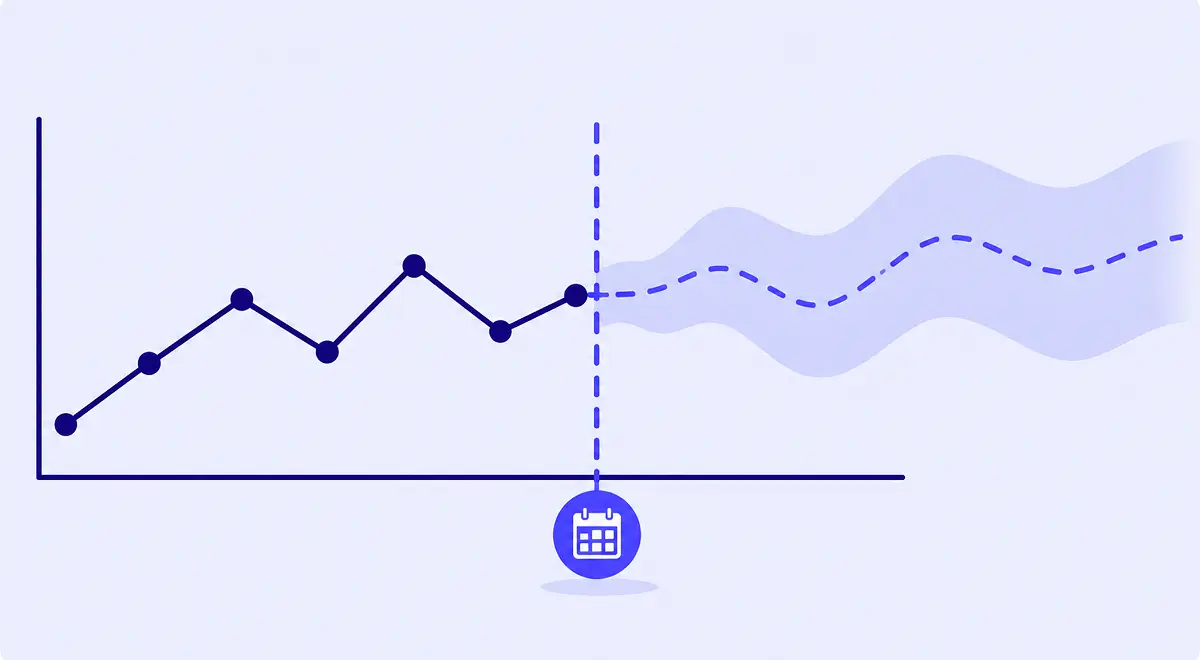
Demand forecasting is the process of estimating future customer demand so the business can prepare stock, purchasing, production, and capacity before orders arrive. In manufacturing, the forecast may come from sales history, customer commitments, seasonal patterns, distributor signals, marketing plans, replenishment rules, or a sales team estimate. A planner might forecast finished goods, raw materials, product families, regions, channels, or production volume by week or month.
The basic job is simple: help the company decide what demand is likely enough to prepare for. In theory, demand forecasting software is supposed to give planners exactly that — a clean view of what customers will need next. But the hard part starts immediately after that. A manufacturer cannot ship a forecast, which means someone has to turn expected demand into operational decisions:
That is where demand forecasting becomes a planning problem rather than a math problem. This article explains how demand forecasting differs from demand planning, why spreadsheet-based forecasting breaks under variability, and what connected demand planning software should change for a manufacturing SME.
Demand forecasting estimates future demand, while demand planning turns that estimate into an operational plan the company can act on. The distinction is important because many manufacturers buy demand forecasting software when the real pain sits one step later. The forecast may improve, but planners still carry the work of connecting demand to materials, inventory, capacity, production, quality, and logistics.
A forecast answers, "What do we think customers will need?" while demand planning asks, "What should we do now because of that expectation?"
In a manufacturing SME, good demand planning often includes:
If those steps happen outside the system, better forecasting alone will not rescue the planner and help him or her be more efficient.
Forecasting fails planners when the company treats the forecast as the answer, when in reality, a forecast is only an input into a chain of decisions, where every decision depends on operational context. A forecast for 10,000 units next month means something different if the raw material lead time is 10 days, six weeks, or unknown. It means something different if stock is available, reserved for another customer, blocked by quality, or sitting in the wrong warehouse. It means something different if production can run one large batch or has to split volume across several lines, shifts, recipes, or workshops.
The forecast can be directionally right and still fail the planner because the surrounding system cannot answer the practical questions fast enough. This is why planners keep building their own files. They are not resisting software because they love Excel. They are protecting the business from the gaps between what the official forecast says and what the factory can actually do.
The common failure pattern looks like this:
At that point, demand planning software has not replaced planner work, it’s just that the planner has become the integration layer.
Spreadsheets are useful because they are flexible. A spreadsheet can absorb one exception quickly, e.g., a supplier delay, a customer pull-forward, a quality hold, a seasonal spike, a manual allocation, a one-off substitution. That is exactly why teams keep using them.
The problem is that exceptions do not stay isolated. One late supplier changes material availability, material availability changes what production can start, a production delay changes finished goods stock, stock changes what sales can promise, a customer priority change changes the production order, a quality hold makes stock visible but unusable, etc.
In a spreadsheet, every link in that chain depends on someone updating the right cell, at the right time, with the right context, which creates several problems for planners:
That last point is the real failure. Spreadsheet-based forecasting may help planners think, but it does not run the operation.
Demand planning software should do three things better than spreadsheets. First, it should keep demand close to operational data. A forecast should not sit apart from inventory, open orders, bills of materials, supplier lead times, production status, quality status, and capacity constraints. If those inputs move, planners should see how the plan is affected without rebuilding the model by hand.
Second, it should explain recommendations. A buyer should know whether a procurement suggestion comes from a confirmed sales order, a forecast, a safety stock rule, or a planning scenario. A planner should be able to trace a manufacturing order back to the demand that created it. And last, but not least, demand planning software should connect planning to action. If the system calculates that more product is needed, the next step should not be a meeting and a manual copy-paste. The system should help prepare manufacturing orders, procurement suggestions, stock reservations, alerts, and approval paths, depending on the risk of the decision.
This is the difference between a system of record and a system of action. A record system stores the forecast and the transactions around it. A system of action helps the team make and carry out daily decisions from the same operational truth.
For manufacturers, the planning question is rarely, "Can this tool produce a forecast?" The better question is, "What happens in the tool after the forecast changes?"
For a manufacturing SME, demand forecasting usually fails in smaller, more painful ways than enterprise software vendors admit.
The planner does not have a large planning department behind them. The sales forecast may come from one commercial lead, a distributor call, a retail promotion, a reorder pattern, or a customer who is almost certain but not yet committed. Production capacity may depend on a few critical operators, one bottleneck machine, a subcontractor, or a supplier whose lead time changes without much warning.
The company still needs structure, but it cannot afford an 18-month planning project or a demand planning tool that only a specialist can maintain. The system has to fit how the team already makes decisions, then make those decisions easier to run every week.
That usually means:
The goal is not to remove judgment from planning, but rather to stop wasting judgment on reconciliation.
Bonx is an AI-native manufacturing ERP connecting order management, inventory, purchasing, supplier management, planning, production, quality, and logistics in one operational system, rather than leaving planners to carry the handoffs between separate tools.
Bonx is a strong fit for manufacturing SMEs that want demand forecasting and demand planning to feed daily operational decisions. It does not treat the forecast as a report that waits for a planner to interpret it. When configured to do so, Bonx can help generate manufacturing orders, prepare procurement suggestions, surface exceptions, and route higher-risk choices back to a person for approval.
At food manufacturer L'Atelier du Ferment, where Bonx connects production planning, batch traceability, Sidely, and Pennylane, the company doubled volume every year, ran four workshops, and had to manage shelf life, cold storage, procurement, and traceability at the same time. Bonx helps generate manufacturing orders and procurement suggestions based on sales, shelf life, and cold storage capacity, while supporting traceability across more than 100,000 bottles.
That is the planning shift manufacturers should look for. The system is not only showing what demand may be. It is helping the team decide what to make, what to buy, what to watch, and when a human should step in. For a closer look at this operational layer, explore Bonx planning capabilities.
Demand forecasting is the process of estimating future customer demand so a manufacturer can prepare inventory, purchasing, production, and capacity before orders arrive.
Demand forecasting software helps companies calculate expected future demand using inputs like sales history, confirmed orders, seasonality, customer commitments, and commercial assumptions. In manufacturing, it is most valuable when it connects directly to production, procurement, inventory, and capacity decisions.
Demand forecasting estimates what customers are likely to need. Demand planning turns that forecast into operational decisions, including what to buy, what to produce, when to produce it, and which exceptions need human review.
Demand forecasts fail when the forecast is disconnected from the operational data around it. Even a reasonable forecast can lead to bad decisions if inventory, supplier lead times, quality status, production progress, or capacity constraints are stale or missing.
Planners use spreadsheets because spreadsheets capture exceptions quickly. They can add supplier notes, customer priorities, quality holds, substitutions, and manual assumptions faster than many planning systems. The problem is that spreadsheets become fragile when the plan has to stay connected to purchasing, production, inventory, quality, and logistics.
Demand planning software should connect forecasts to live operational data, explain why the system recommends an action, and help turn demand into manufacturing orders, procurement suggestions, alerts, reservations, or approval workflows.
Bonx includes planning capabilities inside an AI-native manufacturing ERP. Bonx connects demand, inventory, purchasing, production, quality, and logistics so planners can move from manual reconciliation to supervised operational decisions.


Contact us
So were we. That's why we built Bonx, the AI-native manufacturing ERP.