Process manufacturing software should fit how batches actually run
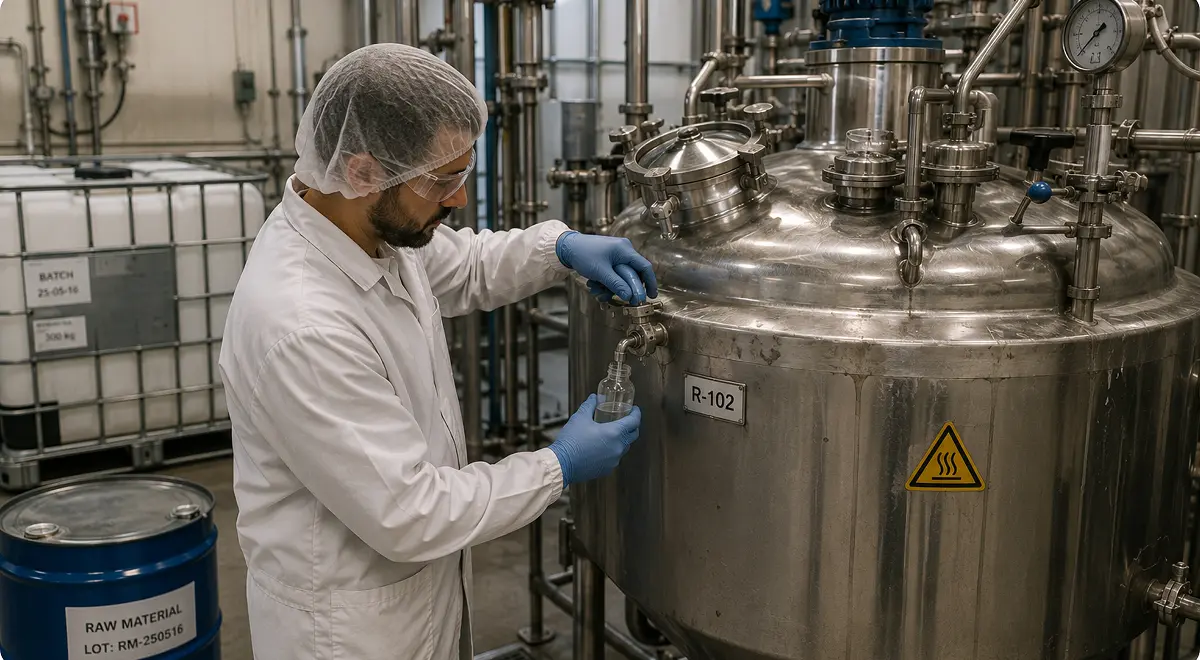
Process manufacturing software gets tested when the ERP has to understand material that changes state, not just parts that move from one assembly step to the next.
That is the difference legacy ERPs often miss. They can model a finished product as a clean set of components, operations, quantities, and costs. But batch and process manufacturers run on recipes, actual yield, variable weights, quality status, raw material lots, and production decisions that can change while the batch is moving.
This article looks at why discrete ERP logic breaks for batch producers, where the mismatch shows up in daily operations, and how Bonx supports manufacturers whose production depends on recipes, yield variance, catch weight, and lot-level traceability.
Process manufacturing software supports companies that make products through recipes, formulas, and batch-based transformations. This requires a different operating model and therefore different criteria than many generic legacy ERPs can offer.
To illustrate the difference, let's first look at discrete manufacturing, which starts from a product structure. A bill of materials (BOM) says which components go into a finished unit, a routing says which operations happen, and the system expects the result to behave like a countable item. There can be scrap, rework, and variance, of course, but the underlying logic is still component-to-assembly.
Process manufacturing, on the other hand, starts from transformation. Raw materials are received in lots, consumed into a batch, transformed by a recipe or formula, tested, held, released, packed, split, sometimes reworked, and then traced forward into finished goods and customer shipments. The system has to understand that the batch is not just an order quantity. It is the object carrying production, quality, inventory, and traceability context.
That is why generic manufacturing ERP can create daily friction, because while software may have item masters, BOMs, work orders, and stock movements, batch production needs those records to carry different meaning.
A BOM is usually trying to answer a precise question: what components are needed to make this product?
A recipe or formula has to answer a more fluid one: how should this batch be made under today's constraints, and what does that mean for the materials, quality checks, output, and traceability record?
In cosmetics, for example, a cream formula may have approved ingredients, tolerances, packaging formats, version history, and quality steps that matter as much as the theoretical input quantities. If a formulation changes, the effect is not limited to purchasing. It may affect production instructions, compliance records, labels, customer promises, and which finished batches can be released.
This is where forcing recipes into BOM logic becomes cumbersome. The team can still make the ERP accept the data, but the system does not really understand the work. People start carrying the missing context in spreadsheets, quality documents, side notes, and habits that never become part of the operational flow.
Batch producers rarely live in the neat world of planned output matching actual output.
A fermentation run may produce less than expected because the process behaved differently, the batch spent longer in a step, or quality released only part of the output. The ERP record cannot treat that as a small correction after production. Actual yield changes stock, cost, replenishment, availability, and sometimes the next production plan.
This is one of the reasons batch process software has to be close to inventory and planning. If the system only learns about yield variance after someone reconciles production manually, the plan is already stale. Purchasing may think enough raw material is available, sales may think finished goods are coming, and production may launch the next batch with inaccurate data.
The issue is not whether the ERP can store an actual quantity, because most systems can. The issue is whether actual yield changes the rest of the operation quickly enough for the team to act on it.
Catch weight creates a similar problem at the inventory level. Many process manufacturers do not operate in a single neat unit. They may buy by kilogram, consume by percentage, produce by liter, store in drums, sell by case, and reconcile the actual weight at shipment.
A discrete ERP can usually handle unit conversions in a narrow sense. Catch weight goes further: it affects what is available, what can be allocated, how cost is understood, and how production or shipment records should be read later.
For process manufacturers, inventory accuracy depends on the system respecting the unit reality of the business, not forcing every movement into the unit that happens to be easiest for the database.
In discrete production, traceability often follows components into finished goods. In process production, the system needs to track raw material lots into a batch, through transformation, testing, quality release, packing, storage, shipment, and sometimes recall. If a supplier lot is later flagged, the team needs to know which batches consumed it, what finished goods came out, where they went, and which customers received them.
That history cannot depend on someone reconstructing stock movements after the fact. If a batch goes into quality hold, if only part of it is released, or if material is reworked into a later batch, traceability has to survive the exception.
This is especially visible for chemical manufacturers that need batch control, compliance workflows, and traceability connected to daily operations. A formula change, supplier lot issue, safety data sheet update, or customer-specific documentation requirement can affect production and shipment at the same time. The ERP has to keep those consequences connected in real time.
Imagine a batch comes out below expected yield and part of the output goes into quality hold. In a batch business, that one event can change finished goods availability, customer promise dates, raw material replenishment, the next production run, and the traceability record. If the ERP treats the event as a quantity adjustment plus a quality note, the team still has to connect the operational meaning, as well as map out downstream actions, by hand.
Bonx is the AI-native manufacturing ERP connecting order management, inventory, purchasing and supplier management, planning, production, quality, traceability, and logistics in one operational system, while adapting to the way the company actually works.
Batch production does not fail in isolated modules. A recipe decision can change procurement, actual yield can change inventory and customer availability, and a raw material lot can affect release, traceability, and documentation. Bonx gives those relationships a place to live in the flow of work instead of leaving the team to rebuild them between tools.
At L'Atelier du Ferment, a fast-growing food manufacturer whose volumes were doubling every year across four workshops, production tracking, shelf-life management, cold storage constraints, purchasing, and batch traceability had become too heavy for Excel, Access, and paper. Bonx connected operations to Sidely and Pennylane, helped track more than 100,000 bottles from fermentation to cold storage, and supported full batch traceability as the company prepared for a factory three times larger.
The team knew that sales, production, procurement, shelf life, stock status, and traceability could not be handled as separate records and that the team needed to make good decisions while production was moving. With Bonx, L'Atelier du Ferment can generate manufacturing orders and procurement suggestions based on sales, shelf life, and cold storage capacity. Each stock movement feeds the batch history, so the traceability record is created as work happens rather than reconstructed later.
That same logic is why Bonx is a strong fit for process manufacturers beyond food and beverage, including cosmetics and chemicals. The specific constraints change by sector, but the software standard is similar: recipes, batches, quality, inventory, purchasing, and traceability need to work together inside the operating system.
If the business runs on formulas, actual yield, catch weight, raw material lots, shelf life, quality status, or customer-specific requirements, those details are not edge cases. They are the production logic.
Legacy ERP often turns that logic into workarounds because it was built around a different model of manufacturing. The system can store the records, but the team still has to carry the meaning between them. The right process manufacturing software does the opposite, treating recipes, batches, units, quality, planning, and traceability as connected parts of the same operation.


Contact us
So were we. That's why we built Bonx, the AI-native manufacturing ERP.