How much does an ERP actually cost?
For a legacy enterprise resource planning (ERP) system, the least useful answer to "How much does it cost?" is the license price. Licenses matter, of course. But so do implementation fees, data migration, integrations, training, and the coordination work required to make a heavy system fit the business. In legacy ERP projects, the real cost is bigger than the number in the proposal.
Not every ERP model works this way anymore. In the old model, you pay for the software, pay for the implementation, lend your best people to the project, then keep paying whenever the business changes. A system that looked expensive at the start can become more expensive over time, while the value it creates flattens or even declines.
This article follows the four layers of ERP cost, then shows why legacy ERPs make the last two layers balloon. It ends with the better model: one where return on investment can start during implementation and keep growing because the ERP takes work off the team instead of creating more work to maintain.
It is useful to think about ERP cost in terms of four layers. The first two are usually visible in proposals and budgets. The last two are easier to underestimate, and they are where legacy ERP models become exponentially more expensive over time.
Software includes subscription or license fees, user seats, modules, hosting, support, and sometimes infrastructure if the system is on-premise. The number may still be large, but at least the buyer knows what is being priced.
That clarity can be misleading. A legacy ERP proposal may make software look like the main cost because it is the easiest line to compare. One vendor charges more per user, another charges more per module, another bundles more into the base package. The buyer can build a spreadsheet and feel like the decision is becoming concrete.
The problem is that software price does not tell you how expensive the ERP will be to use, adapt, or keep aligned with the business.
A cheaper license can still become expensive if the system needs months of configuration before anyone can use it. A more expensive license can still be a better economic choice if it reduces implementation time, removes consulting dependency, and takes routine work off the team. The license price matters, but it is not the cost of the ERP.
Implementation covers scoping, workshops, process mapping, configuration, data migration, integrations, testing, training, go-live support, and the project management needed to hold the whole thing together. In legacy ERP projects, these services can become the largest part of the first-year cost, especially when the system needs months of configuration before anyone can use it.
Some of that work is legitimate. No serious ERP vendor can implement an operational system without understanding the manufacturer's products, stock, purchasing, quality, production, logistics, reporting, and tools already in use. The problem is that legacy ERP implementation often turns that understanding into a long translation exercise: the team explains how the business works, the partner translates that into the ERP's structure, and everyone repeats the loop when a process exception, integration, or data problem appears.
During that time, the business keeps moving. Customers ask for different delivery promises. Suppliers change lead times. Production changes routing. The quality team adds a control point. Sales opens a new channel. The ERP project keeps implementing the company described in early workshops, while the actual company keeps adapting because it has orders to ship.
By go-live, the system can match the signed-off scope and still be behind the business. That is how implementation cost creates catch-up cost immediately after launch. It also creates the next cost layer, because the longer implementation takes, the more time it consumes from the people who still have to run the company.
The clean ERP budget usually ignores the time spent by the people who understand the business best. During implementation, consultants need your operations team to explain how work happens. They need finance to explain controls, reporting, and month-end constraints. They need planners to explain exceptions, and production managers to explain capacity, sequencing, and how the factory behaves on a bad day as well as a clean one.
This is necessary up to a point, but legacy ERP projects can turn knowledge transfer into months of extraction. Your team spends time translating operational knowledge into process maps, requirement documents, field definitions, workflow decisions, test scripts, and training materials. Meanwhile, those same people are still expected to manage production, suppliers, customers, quality, hiring, and improvement work.
Internal time does not stop at go-live. If the system is hard to use, people keep paying with data entry, manual updates, reconciliation, exception handling, and daily corrections. Internal time belongs in the ERP cost calculation because a system that takes 18 months to implement and then demands hours of admin every week is expensive to deploy and expensive to operate.
A better system gives that time back. La Maillecotech, a textile SME in Tourcoing producing Made in France knitwear accessories, cut daily production data entry from nearly one hour to a few minutes with Bonx, a 12x improvement, while increasing productivity by 10%. That is what internal time looks like when the system gives time back instead of asking the team to feed it.
The worst part of legacy ERP cost usually arrives after the first invoice. As the business evolves, the system keeps finding new ways to charge for change.
Growth is movement. A manufacturer with 30 people does not operate like the same manufacturer at 80 people. The product catalog expands. Customer promises become more specific. Quality requirements get heavier. Stock locations multiply. Production steps become more specialized. More people need to touch the same order without losing the thread.
A good ERP should absorb that movement. A legacy ERP often turns it into a new project.
Need to change a workflow? Open a ticket. Need to add a field? Check whether it affects reports, permissions, integrations, and training. Need to connect a new sales channel? Scope an integration. Need to handle a new exception? Decide whether to customize the ERP, force the team into a workaround, or keep the exception outside the system.
None of those decisions look catastrophic on their own. Together, they create the ERP tax. That is the same pattern behind why legacy ERPs are a nightmare: the pain does not end at go-live because the system keeps turning normal manufacturing movement into extra work.
The operational cost is harder to see than the consulting cost, but it is often more expensive. The planner rebuilds the production schedule in a spreadsheet because the ERP cannot handle the real constraints. The warehouse checks stock manually because nobody trusts the number. Operators write on paper first because entering data during the shift takes too long. Quality decisions happen in email because the batch information is split across tools. Finance reconciles at month-end because the operational truth and the system record drifted apart.
No vendor invoice says "manual workaround caused by poor fit." But the cost is there every day.
It appears as:
This is why the cheapest ERP on paper can become expensive in practice. If the software saves money in licensing but creates daily manual work across planning, production, stock, quality, and logistics, the company is not saving money. It is moving cost from the vendor invoice to the factory.
Bonx is an AI-native manufacturing ERP. We categorically reject the old bargain: long implementation, rigid configuration, heavy consulting, late integrations, and a system that mostly waits for humans to feed it.
With Bonx, the price is the license price. We believe manufacturers should not have to buy software, then buy a permanent consulting dependency every time the business changes.
We believe return on investment should not wait for a distant go-live. It should start on day one of implementation, then keep increasing as real operational flows move into the system and the ERP absorbs routine work the team used to carry manually.
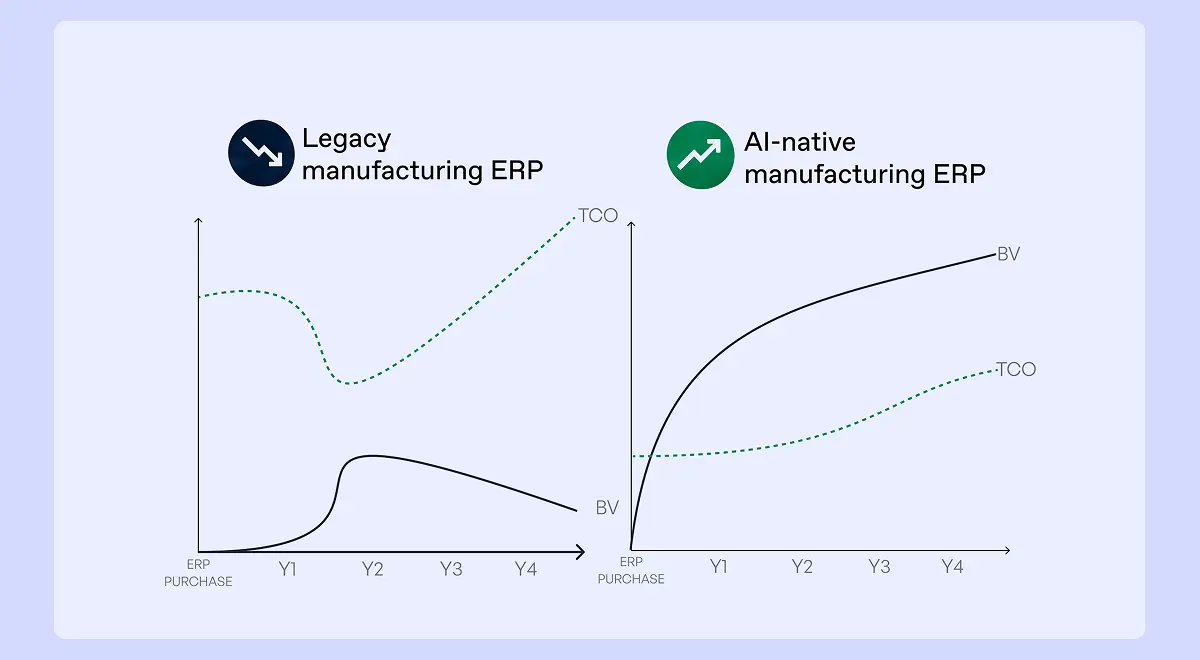
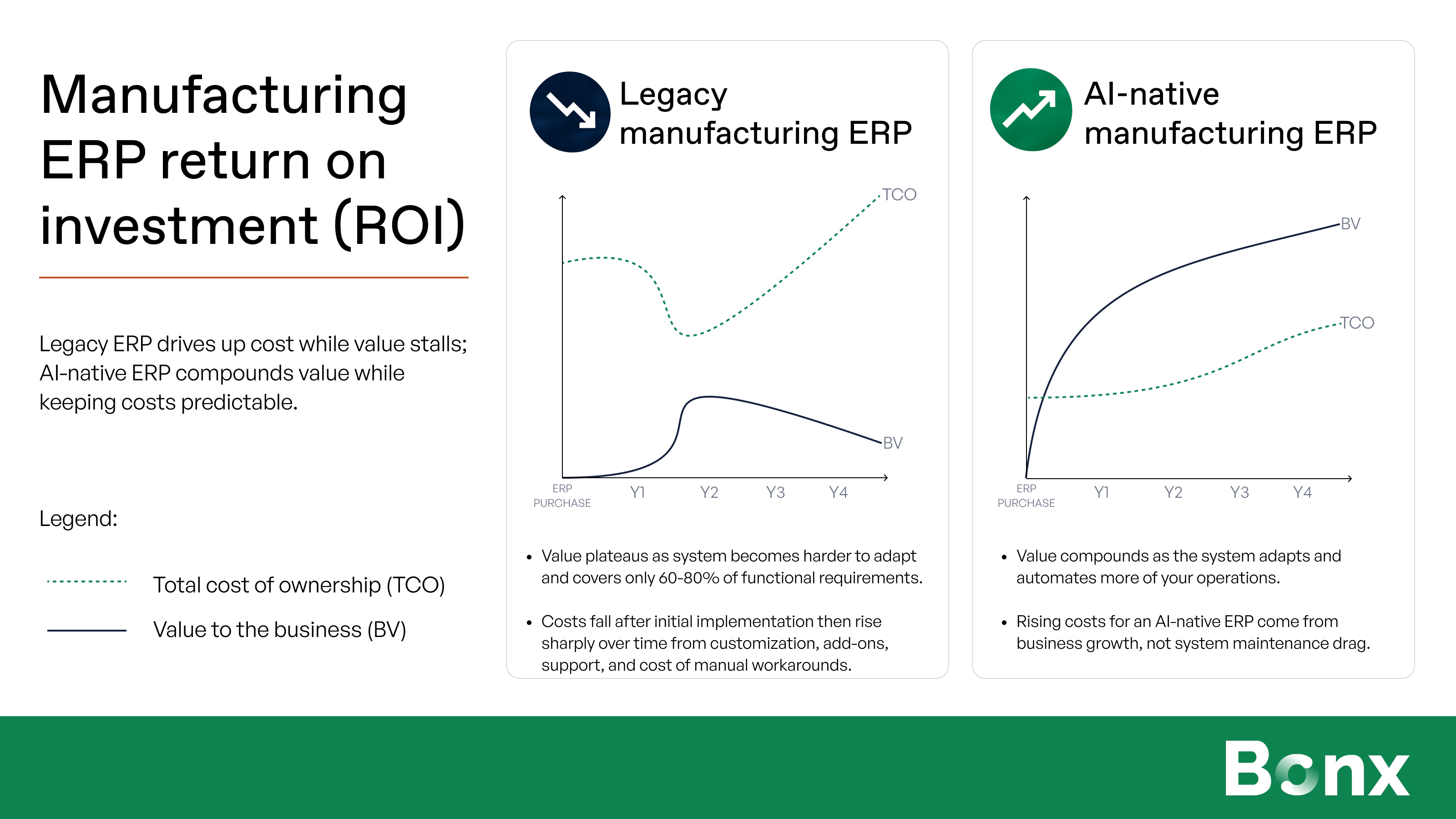
That is the value curve legacy ERP rarely delivers. In the old model, cost rises as the business asks the system to change, while value often flattens because the ERP becomes less central to how work actually happens. ERP coverage gaps are well documented; Plant Engineering, for example, has reported that ERP systems typically reach only 60% to 80% coverage of functional requirements. In the better model, the system becomes more useful over time because it keeps adapting, connects more of the operation, and acts on more routine work without asking humans to feed it every step.
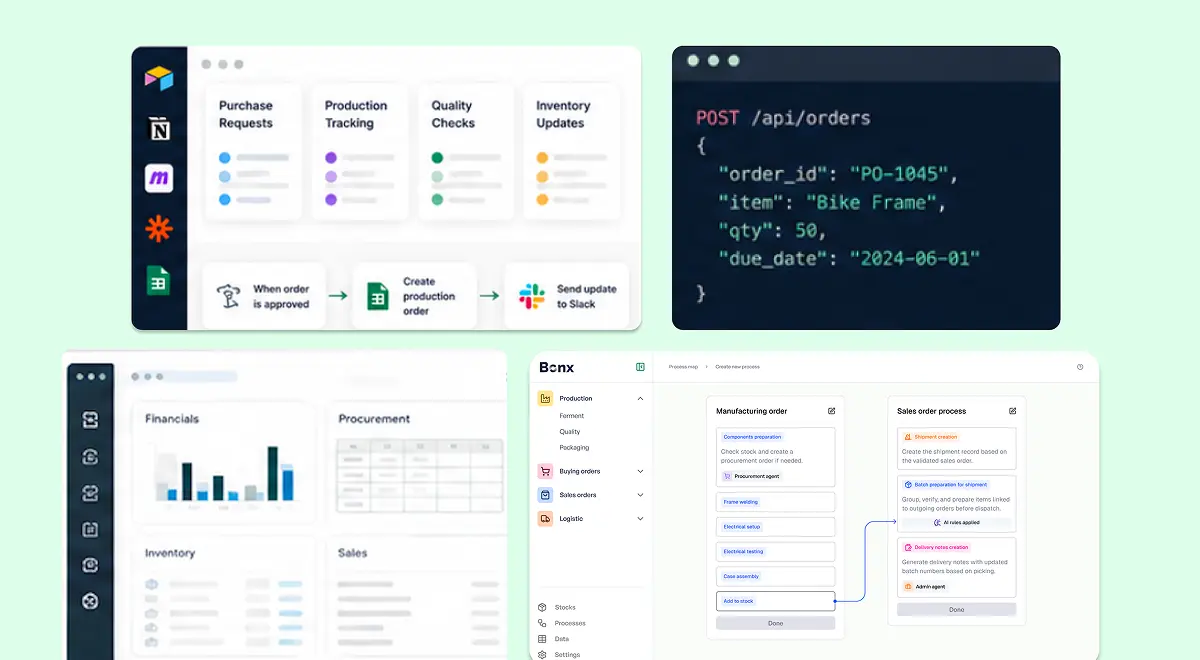
Bonx customers go live in 1 to 3 months, connect the tools already in their stack, and keep order management, inventory, purchasing, planning, production, quality, and logistics in one operational system. That faster project matters because it changes what happens after go-live: the system can keep taking work off the team instead of becoming a second business to maintain.
At Feroce, Bonx went live in 42 days without operational interruption. That mattered when a national TV appearance multiplied orders tenfold overnight. The team kept every package traced and shipped to the same standard instead of discovering that the system could not handle growth under pressure.
At Something Added, Bonx deployed in two months with a native integration to HP 3D printers. Before Bonx, production depended on manual checks, grouping orders, selecting machines, and launching print jobs. After deployment, orders were grouped automatically, manufacturing orders were generated, and jobs were assigned to machines based on industrial rules. The factory moved to 24/7 production with more than 10,000 parts produced each month.
At L'Atelier du Ferment, a fast-growing family business where volumes were doubling every year across four workshops, Bonx helped create more reliable operations, better production visibility, and a stronger foundation for multi-channel distribution. Bonx generates manufacturing orders and procurement suggestions based on sales, shelf life, and cold storage capacity, while keeping batch traceability connected across the operation.
Deployment speed is only one part of ERP cost. After launch, the system should make coordination cheaper, make adaptation easier, and take routine manual work off the team. That is how ERP value grows over time: not by adding more modules for people to maintain, but by giving the system more of the routine operational work humans should not have to carry.
For a legacy ERP, the answer is: software, implementation, internal team time, and the cost of change after go-live.
But the better answer is this: a legacy ERP costs whatever it forces your team to keep doing manually.
If the ERP makes planners rebuild schedules outside the system, that is cost. If operators write on paper before updating software, that is cost. If every process change becomes a consultant ticket, that is cost. If managers hire coordinators because the system cannot connect order management, stock, production, quality, and logistics, that is cost.
The right ERP should make the business easier to run over time. If the system gets more expensive every time the company grows, changes, or improves, while the value stays flat or declines, the real problem is the legacy ERP model behind the price.
ERP implementation cost depends on company size, number of users, scope, data migration, integrations, customization, and training. For a manufacturer, the more useful question is what the project includes and what it excludes. A low implementation price can become expensive if integrations, process changes, support, and internal time are pushed outside the quoted scope.
ERP projects go over budget when the scope is unclear, data needs more cleanup than expected, integrations are underestimated, teams discover exceptions late, or the business changes during the project. Legacy ERP projects are especially exposed because they try to define too much upfront, then spend months implementing assumptions that may already be aging.
Legacy ERP hidden costs include internal team time, data cleanup, training, post-go-live support, consultant fees for changes, integration maintenance, manual workarounds, duplicate data entry, and lost productivity when teams avoid the system. The hardest hidden cost to see is operational drag: the daily work people do because the ERP does not fit how the business runs. Bonx has no hidden costs: the price is the license price.
Cloud ERP can reduce infrastructure and upgrade burden, but it is not automatically cheaper. The total cost still depends on implementation scope, subscription pricing, integrations, customization, support, and how easily the system adapts after go-live. For a deeper comparison, read cloud-based ERP vs on-premise ERP for manufacturers.
Manufacturers can reduce ERP cost by avoiding the old habit of modeling the whole business upfront. Start with the operational flows that create value quickly, move them into the system, then adapt from there. The biggest lever is choosing an ERP that your team can change after go-live without turning every normal business change into a new project.


Contact us
So were we. That's why we built Bonx, the AI-native manufacturing ERP.