Cloud-based ERP vs. on-premise ERP for manufacturers

For years, manufacturers were told that serious enterprise resource planning (ERP) had to live inside the building, with servers in a locked room, scheduled upgrades, and a local database. It was a system your team could point to, even if half the factory still worked around it.
That version of control is starting to look expensive because the real question is not where the server sits. It is whether the ERP can keep up with customer orders, supplier delays, inventory movement, production changes, quality issues, and the thousand small decisions that decide whether the business delivers on time. On that test, traditional on-premise ERP looks less like a safe choice and more like a relic from a slower manufacturing era.
This article looks at why on-premise ERP has become such a poor fit for growing manufacturers, where cloud-based ERP changes the operating model, and what to check before replacing server ownership with a system that can actually move with the factory.
On-premise ERP made sense in a different operating environment. Companies wanted software they could host themselves. Internet access was less reliable. Security teams were more comfortable with systems inside their own infrastructure. Manufacturing processes changed, but often at a pace that could survive a yearly upgrade cycle and a long list of consultant-led changes.
Modern manufacturing does not work that way. A growing manufacturer might add a new sales channel, move into contract manufacturing, change warehouse logic, introduce new quality steps, onboard a supplier, open a new workshop, or change its production priorities within the same quarter. The business does not have time to treat every operational change as an IT project.
The on-premise model asks manufacturers to run a moving business on a system that expects stability. That mismatch is where the pain starts.
The strongest argument for on-premise ERP has always been control. The company owns the infrastructure, manages the environment, and decides when changes happen. But control over infrastructure is not the same as control over operations.
If the ERP is too slow to change, the team loses control in practice. If planners rebuild schedules in spreadsheets because the system cannot handle the new production rule, the company does not have control. If operators write notes on paper and enter them later because the screen flow slows the shift down, the company does not have control. If stock is technically in the ERP but nobody trusts it before making a purchasing decision, the company does not have control.
The control that matters is control over the operational system: live data, connected workflows, usable screens, and processes the team can adapt when the factory changes. Owning the machine that runs the ERP does little good if the system itself is rigid.
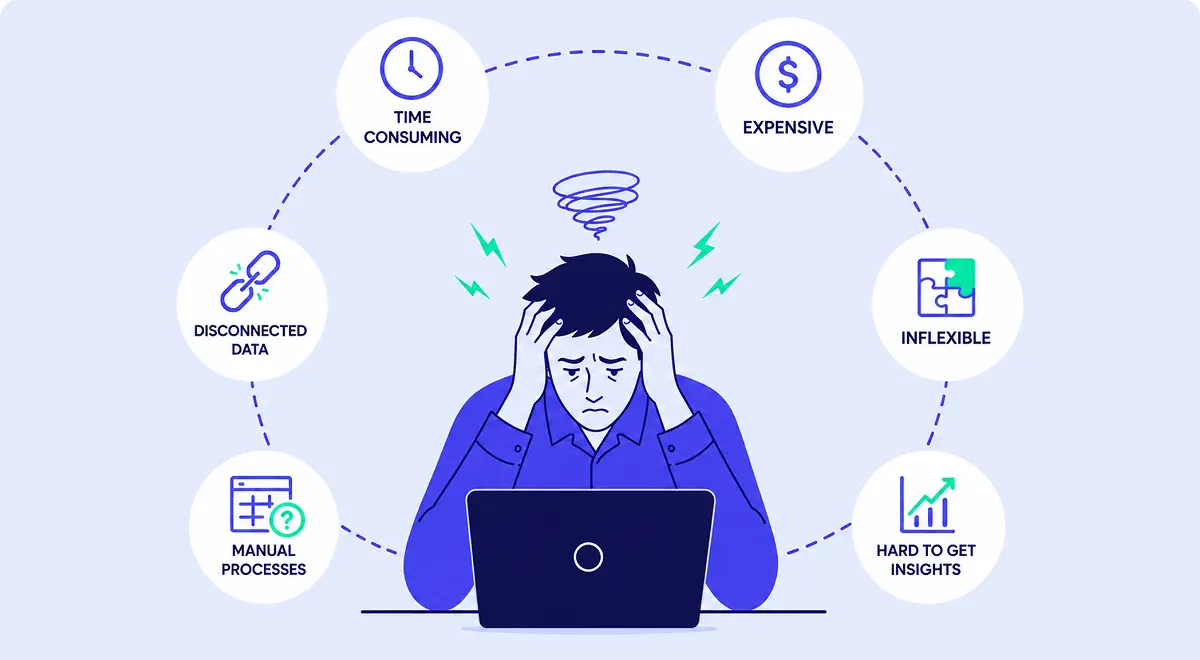
Traditional on-premise ERP projects are heavy because too much has to be defined before the system can help. Hardware, hosting, environments, integrations, custom configuration, migrations, reporting, permissions, training, and support all become part of the same long project.
While the project moves, the factory moves faster. The team documents a process in month one. By month six, a key supplier has changed lead times, sales has promised a new delivery model, and production has found a workaround the future ERP scope does not include. By month 12, the system may still match the signed-off requirements, but the business has already moved on.
That is the absurdity manufacturers have been asked to accept. The ERP project becomes a snapshot of the company at the moment the workshops happened, then arrives late to the version of the company that actually exists.
To be clear, cloud-based ERP does not magically remove implementation work. Any serious manufacturing system still needs process understanding, data migration, integrations, testing, and adoption. The difference is that the infrastructure burden is lighter, environments are easier to manage, and deployment can focus sooner on the operational flows that matter: orders, inventory, purchasing, planning, production, quality, and logistics.
On-premise ERP turns updates into events. Someone has to plan the upgrade, check compatibility, test customizations, schedule downtime, coordinate users, and hope nothing breaks in the parts of the system that nobody has touched in years. If the ERP has been heavily customized, the upgrade can become so painful that the company delays it. Then the system falls behind, security patches stack up, and new features remain theoretical.
This is how manufacturers end up running old software by choice. Not because anyone thinks old software is better, but because the cost of changing it feels worse than living with the pain.
Cloud-based ERP changes that rhythm. Updates are managed by the provider, shipped more frequently, and applied without turning every release into an infrastructure project. The best cloud ERP systems make improvement a normal part of the product, not a yearly negotiation with risk.
On-premise ERP assumes the center of work is the site. That is still partly true in manufacturing because production happens in physical places, with real materials, machines, operators, and constraints. But the decisions around that work are now distributed.
Sales might be remote. Management might travel between sites. Suppliers, subcontractors, warehouses, finance teams, and customer service all need reliable information from the same operational flow. Even inside one building, people need access from tablets, shop floor terminals, office laptops, and sometimes phones.
Cloud-based ERP makes access less dependent on being inside the network. The useful result is not simply the fact that everyone can log in from anywhere. What is really useful is fewer delays between an operational event and the people who need to act on it.
If a batch is blocked, logistics should know before a shipment is prepared. If a supplier receipt arrives short, planning should see the constraint before promising the next order. If sales changes priority, production should not wait for someone to export a file or send a message.
Live access only matters when the data is trusted, but trusted data is much easier to build when the system is available where the work happens.
Some manufacturers still treat cloud ERP as the riskier security choice because the data is not sitting on their own hardware. But on-premise ERP puts more responsibility on the manufacturer: backups, disaster recovery, patches, access controls, monitoring, infrastructure hardening, and incident response.
That is a serious burden for companies whose specialty is manufacturing, not IT infrastructure. Large enterprises may have the internal team to manage it properly. Many small and mid-sized manufacturers do not have dedicated IT depth, and even when they do, hiring and keeping security or infrastructure talent is hard. A system that is not updated, backed up, or monitored well is not safer because it is local.
Cloud ERP providers build security, backups, redundancy, and recovery into the service. That does not mean every provider is equal, and buyers should ask hard questions about hosting, permissions, data protection, availability, and recovery time. But the old assumption that local automatically means safer no longer holds.
The practical question is simple: who is better equipped to protect and maintain the ERP environment every day, your internal team or the provider whose job is to do exactly that?
The obvious cost of on-premise ERP is infrastructure: servers, hosting, databases, storage, backups, maintenance, and IT time. Moving to cloud-based ERP reduces much of that burden and turns more of the cost into a subscription.
But the real cost of on-premise ERP is the drag it creates around change. New processes, integrations, version upgrades, and reporting changes all cost money. Internal time costs money too, especially when the people pulled into the project are the same people who understand production, purchasing, inventory, and quality well enough to keep the business running.
Manufacturers should look beyond the software bill and ask which everyday changes the ERP makes expensive: integrations, training, reporting, or simple operational work that takes five screens when it should take one action.
That said, cloud ERP is not cheaper by definition. A bad cloud ERP can still be expensive, rigid, and poorly adopted. But a good cloud ERP removes infrastructure ownership from the manufacturer and reduces the cost of adapting the system as the business changes.
The next ERP model is not just on-premise software moved to a cloud server. That is hosting, not a meaningful operating model change.
The future belongs to ERP systems that connect with the tools manufacturers already use and take more routine work off the team. Customer relationship management (CRM), e-commerce, accounting, supplier tools, shipping systems, machines, scanners, and shop floor devices all need to pass operational events without manual re-entry.
Recording those events is only the first step. Manufacturers need systems that can act on them.
If an order changes, the ERP should help update production priorities. If stock drops below the rule, it should help trigger purchasing action. If shelf life affects what can be produced, the system should account for it in planning. If capacity is constrained, the system should show the tradeoff early enough for a person to decide.
Traditional ERP mostly asks humans to feed the database. Modern cloud ERP should reduce that burden, then surface the moments where human judgment matters.
This is why cloud-based ERP is not just an IT preference. It is the foundation for a different kind of operations system: connected, adaptable, and able to do more than wait for someone to type the next update.
Cloud is not a guarantee; a cloud ERP can still carry the same old problems in a newer delivery model.
If the system cannot handle real production flows, people will create workarounds. If operators hate using it, adoption will fail. If integrations are weak, the team will still re-enter data. If changing a workflow requires a consultant every time, the business will still move faster than the software.
The point is not to buy cloud because cloud sounds modern. The point is to reject the old on-premise bargain: long projects, infrastructure weight, slow updates, rigid configuration, and an ERP that becomes harder to change every year.
A serious cloud-based ERP for manufacturing should meet a higher bar. It should:
Cloud is the delivery model. The real decision is whether the ERP can become the system the factory actually runs on.
Bonx is an AI-native manufacturing ERP. We are a strong fit for manufacturers that want the benefits of cloud-based ERP without accepting the old ERP model underneath it: long implementation, rigid workflows, heavy consulting, and software that mostly records what people already did.
Bonx customers go live in 1 to 3 months, connect operations to the tools already in their stack, and use Bonx across order management, inventory, purchasing and supplier management, planning, production, quality, traceability, and logistics.
The deeper difference is that Bonx is a system of action. Beyond storing operational records, it can generate manufacturing orders, prepare procurement suggestions, assign production work, prioritize stock, surface exceptions for human approval when that is the right call, and more.
Bonx works across manufacturing sectors, from food and beverage manufacturers choosing operational ERP to textile manufacturers using AI-native ERP to improve production, additive manufacturers scaling production, cosmetics manufacturers managing traceability and launches, recycling companies coordinating operations, and other operations where orders, stock, production, quality, and logistics need to move together.
Additive manufacturer Something Added deployed Bonx in two months with a native integration to HP 3D printers. Bonx helped automate order grouping, manufacturing order generation, and machine assignment rules, supporting 24/7 production and more than 10,000 parts produced each month.
Textile customization atelier LCS replaced paper work orders with real-time production tracking across five workshops. With Bonx, manufacturing orders are generated automatically from confirmed quotes, each order is linked to a QR code scanned at every production stage, and LCS cut production errors by 95% while reducing paper usage by 90%.
Food manufacturer L'Atelier du Ferment connected operations to Sidely and Pennylane while supporting full batch traceability across more than 100,000 bottles. Bonx helps generate manufacturing orders and procurement suggestions based on sales, shelf life, and cold storage capacity.
That is what manufacturers should expect from the new ERP model. Not a remote version of the old system, but a cloud-based manufacturing ERP that deploys quickly, connects the operating flow, acts on routine work, and keeps adapting after go-live.
If you are evaluating cloud-based ERP, start with the pain your current system creates. The vendor demo matters less than the answers to practical questions.
Useful answers are specific: which flows are covered, which integrations exist, what the implementation path looks like, who can change what after go-live, and where the system will remove work your team is carrying today.
On-premise ERP is not obsolete because servers are bad. It is obsolete because the operating model around it no longer matches how manufacturers need to move.
Manufacturers need systems that can be deployed without freezing the business, updated without drama, accessed where decisions happen, connected to the rest of the stack, and adapted when operations change. They need ERP that helps run the factory, not just record it after the fact. Cloud-based ERP is the future because it makes that operating model possible.
Cloud-based ERP is hosted online and accessed through the internet, usually through a subscription model. On-premise ERP is installed and maintained on infrastructure controlled by the company. The bigger difference is operational: cloud ERP usually reduces infrastructure work, makes updates easier, and supports access across sites and teams.
On-premise ERP is not unusable, but it is increasingly a poor fit for growing manufacturers. The model tends to make implementation, updates, integrations, and process changes heavier than they need to be. If the ERP cannot adapt as the factory changes, the business ends up relying on spreadsheets, paper, and manual coordination.
Cloud-based ERP can be secure enough for manufacturing when the provider has strong controls for hosting, permissions, backups, monitoring, encryption, and recovery. Buyers should verify those details. The important point is that local hosting is not automatically safer, especially if patches, backups, and monitoring depend on a small internal team.
Cloud ERP often reduces infrastructure costs because the manufacturer does not need to own and maintain servers. The larger cost difference comes from adaptability. A good cloud ERP should make updates, integrations, and workflow changes less expensive over time. A bad cloud ERP can still create the same old problems in a newer package.
Start looking when the current ERP slows normal operational change. Warning signs include manual planning, stock data people do not trust, operators updating the system after the shift, process changes that require consultants, and integrations that depend on manual exports or re-entry.
Manufacturers should look for a cloud-based ERP that supports real production flows, connects with existing tools, works for operators during the shift, adapts after go-live, and covers the operational core: order management, inventory, purchasing, planning, production, quality, traceability, and logistics. The strongest systems also work as systems of action, helping execute routine operational work instead of only recording what people already did.

Contact us
So were we. That's why we built Bonx, the AI-native manufacturing ERP.